

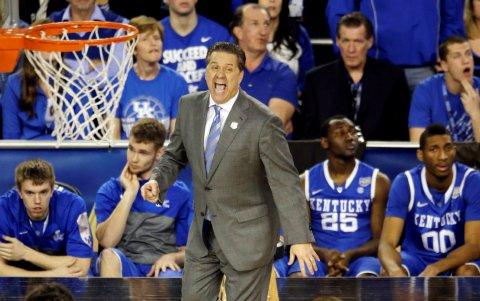
ARLINGTON, Texas — Like it or not, Kentucky coach John Calipari has become a sometimes reluctant, often defiant spokesperson on one of college basketball’s hot-button topics: “One and done.”
And because Calipari’s Wildcats, with a starting lineup full of freshmen, beat Wisconsin 74-73 in the national semifinals Saturday night at AT&T Stadium, he was able to stay at the Final Four for two more days to answer more questions.
“One and done” refers to a rule that prevents prodigious basketball players from entering the NBA until they turn 19 or are a year behind graduating their high school class. Players determined by the NBA to be “international” may be exempt from this rule.
“The connotation that has been built around ‘one and done’ is so ridiculous that it makes it a bad thing, a negative thing,” Calipari said.
In effect, the rule prevents high school graduates from immediately declaring for the NBA draft. Critics say this has led too many players to consider playing just one year of college ball.
Calipari is quick to point out that the 19-year-old age limit was set by the NBA (as part of an agreement between the league and its players’ association) and not the NCAA.
New NBA commissioner Adam Silver denounced the rule as “a disaster” and said one of his priorities was to change the minimum age to 20.
This might surprise some, but Calipari agrees with Silver.
“I said we need to move to a two-year (requirement),” Calipari said. “It would be great for the players because then they would be about a year and a half away from a college degree.”
Calipari guided Kentucky to the 2012 national championship with a lineup heavily reliant on freshmen players and will try to do that again Monday night with an all-freshman lineup against a more experienced Connecticut.
Calipari insisted he is not consciously looking for players who are focused on just one year of college play.
“(The NBA) is the elephant in the room that we don’t need to talk about,” Calipari said of the recruiting process. “I say the same thing: ‘Don’t consider coming to school for (only) one year. You would be making a huge mistake. But whether after one year you have a choice, that will be up to you and your family.’ “
Under Calipari’s watch, 17 Kentucky players have been drafted among his first four teams — and at least a half-dozen from this year’s roster are expected to follow. Most are one-time players.
“My thing is, I’m proud of what we did for these kids,” Calipari said. “Many of those (who left for the NBA) changed the entire (financial) direction of their family.
“It’s not like guys go to the NBA and never should have left because they didn’t make it. They’re all doing well in the NBA; they’re giving back to their community. To me, it’s about the players.”
No guarantees in the NBA
Not every freshman who leaves for the NBA becomes a feel-good story. Of the 46 students who declared for last year’s NBA draft, only 20 earned guaranteed contracts by being selected in the first round.
However, of the nine freshmen who declared for the 2013 draft, eight were selected in both rounds, with only one freshman left out.
Speaking to reporters Sunday during Final Four activities, NCAA President Mark Emmert reiterated that he has been “pretty vocal in his opposition” to the NBA’s 19-year-old minimum and that he would like to see the age limit raised.
Bob Bowlsby, commissioner of the Big 12 Conference, was among the NCAA executives who participated in the news conference led by Emmert. Bowlsby said his wish would be for college basketball to follow college football and baseball. A student-athlete who enters college to play football or baseball is “left alone” by professional teams until he or she completes three years of eligibility.
Bowlsby admitted that college isn’t for everyone. He criticized professional sports for depending on colleges as a farm system.
So far, the NBA’s developmental D-League has failed to attract recent high school graduates who instead see a greater benefit in playing a year at a top college program where exposure and, in some cases, competition are attractions.
“I really think the NFL and NBA have been irresponsible in not providing other legitimate opportunities to kids who really don’t want to go to college,” Bowlsby said. “This is really where the rubber meets the road. There should be another feeding system than the one that kids are forced into because of the profile of our programs.”
Working together to find a solution
Calipari, himself a former NBA head coach, would like to see the professional league and the NCAA work together and find a solution that reduces the financial risk of a top talent wanting to stay in college.
According to his proposal, a review of the “clock” and the financial structure of the NBA would be necessary. Currently, a player selected in the first round receives an initial three-year contract based on his draft position and can then negotiate a higher salary in the fourth year.
If the NBA expands its minimum age to 20 and blue-chippers stay in college for two years, “then take one of those (three blocked contract years) off so the kids still get their (big) money at the same time,” he said.
The NCAA must do its part, Calipari said, by funding “disability” insurance for players who choose to stay in school beyond a year. The purpose of this insurance policy would cover the loss of a player’s projected position in the upcoming NBA draft if they were injured while in college.
It remains to be seen whether these proposals will gain enough traction to be considered. In the meantime, Calipari and other coaches say they will continue to pursue the best recruits available.
In Kentucky’s case, success breeds success. The Blue-chippers believe that in less than 12 months under Calipari, they can compete for a national championship and likely become a first-round pick.
Calipari points out that his current team has a collective B academic average.
“Does a player have to be here to be a great ‘college player?’ “,” Calipari said. “These are students; in some cases, they simply aren’t for four years.”
To those who say Kentucky could have a huge advantage in becoming an “NBA factory,” Calipari might respond that one can only imagine if 6-foot-10 Anthony Davis, the 2012 Final Four’s standout player, had been a junior on the Wildcats team that will play Monday night for the national championship.
“We’re going to move the media away from ‘once done’ because that has a really bad connotation,” Calipari said. “What we’re talking about is ‘succeed and continue.’ Succeed (at the college level) then move on (to the pros). It’ll be on T-shirts: ‘Succeed and Proceed.'”
Kentucky players wore them Sunday on the way to a practice.
