

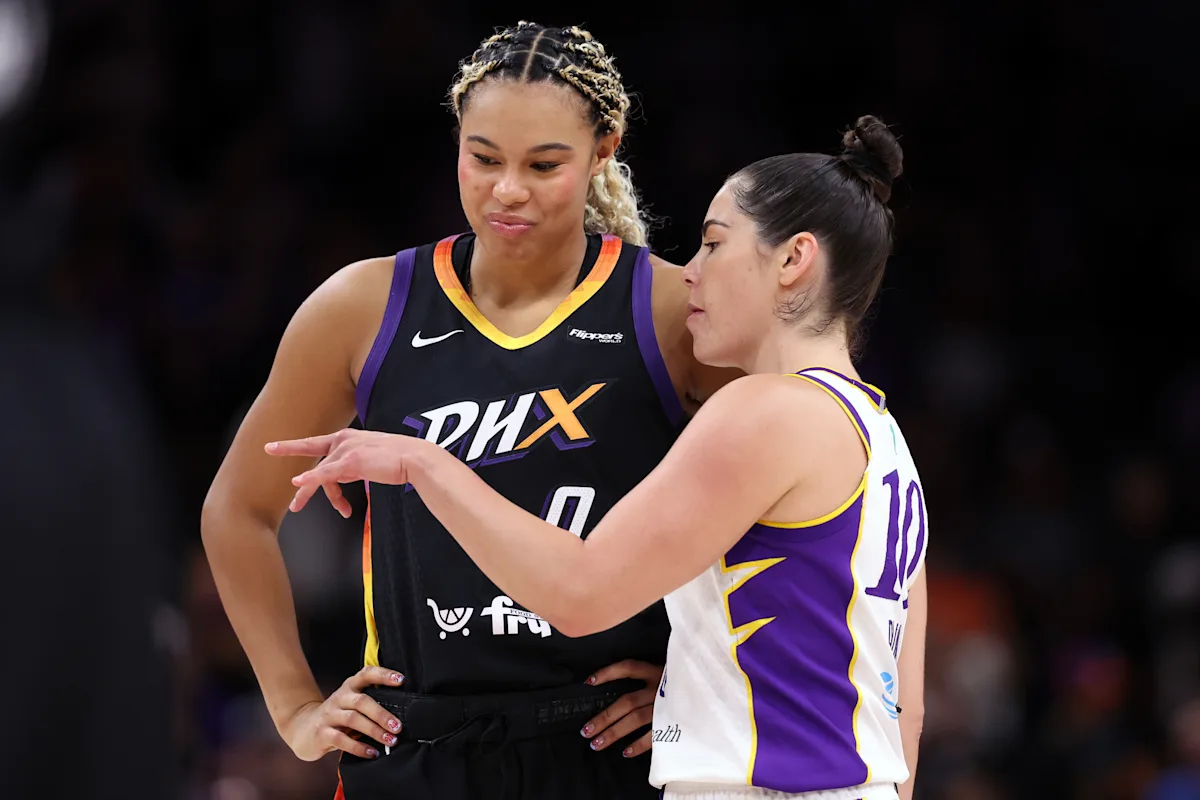
In its latest collective bargaining agreement (CBA) proposal, the WNBA reportedly relented, agreeing to a minimum of revenue sharing, which has been the WNBPA’s main priority throughout negotiations.
However, the league willingness to share remains limited, as the proposed salary structure would result in players receiving less than 15 percent of league revenue, with players’ share decreasing over time.
Advertisement
The WNBA, it appears, is trying to lure the WNBPA with a significant salary increase, promising more for max players ($1 million before incentives), veterans (on average $500,000), and minimum salary players (at least $250,000), hoping that players will choose to recoup the initial extra money, rather than fighting for a greater share of the league’s revenue in the future.
Players see this ploy clearly and remain steadfast in their position that a fair revenue sharing model is an absolute necessity. The union is not seeking a short-term salary increase. They are committed to a longer-term vision in which players will be fairly compensated for the continued growth of the WNBA.
Like WNBPA Senior Vice President Kelsey Plum, explained to Sports at reception:
We say we bet that in six years we will be much better. More money, more income, more business than today. This is why revenue sharing is so important. The mistake is trying to offer money up front, but not being judicious and betting on your long-term vision of revenue sharing as the ultimate goal.
Plum further emphasized:
We’ve been very categorical from the start, very specific about what we’re looking for, which is revenue sharing. Significant revenue from all aspects of the business. It’s not just about the league, it’s also about the team’s revenue. There’s a certain level of frustration because we started with that, and we can’t move forward until we get there and get to a level where we feel comfortable.
WNBA players’ resistance to other aspects of the league’s proposals also reflects a strong commitment to ensuring that the WNBA is a league that supports, rather than complicates or inhibits, the quality of life of players, beginning in 2026 and beyond.
Advertisement
Preserving WNBA team-provided housing is a top priority
That starts with protecting team-provided accommodations, a staple of the WNBA since 1999 when the first CBA was implemented, which the league is seeking to eliminate in the next CBA.
ESPN explained The WNBA’s long-standing player housing policy:
Under the current collective bargaining agreement, teams provide housing in the form of a one-bedroom apartment or a housing allowance to all of their players. Players with children under the age of 13 who live with them full or part time (visitors do not qualify) are eligible for a two-bedroom unit. There is no explicit limit in the CBA on what teams can spend on housing, but there is a limit on the allowances that can be made to players who opt out of team housing, which varies from market to market.
Any player wishing to upgrade their accommodation within the team accommodation may pay the team the difference in cost.
During the offseason, players who are recovering from an injury suffered during the previous season or who are paid to market the team during the offseason (called team marketing agreements) may continue to live in team-provided housing.
According to sources interviewed by ESPN, most players take advantage of team housing rather than the stipend during the season.
Regarding the league’s proposal, a player told ESPN“I think it’s just too complicated something that shouldn’t be complicated. I shouldn’t be stressed about where I’m going to live when my job is to play basketball.”
The WNBPA views housing as a “the five main priorities” particularly due to the fact that a significant number of players benefit from non-guaranteed contracts and the strong disparities in cost of living between markets.
Advertisement
Somewhat encouragingly, ESPN’s reporting suggests that both sides are offering some housing-related concessions. Players are willing to include the cost of housing in the benefits that would be deducted from their share of income. In addition, ESPN reports that“It is expected that there will always be ways for teams to help players in certain circumstances, such as if they are in training camp, on a seven-day contract or traded mid-season, to obtain accommodations.”
ESPN also notes that maintaining housing issued to teams could be beneficial for some organizations. While requiring significant logistical coordination, teams in high-cost markets, including the Bay Area and New York, could risk losing free agents discouraged by exorbitant housing costs. ESPN also foresees another potential difficulty, to propose:
Alternatively, the league could explore no to forbid accommodation provided by the team, but just not demanding he. It could also become a competitive advantage, similar to the league-wide race in recent years for franchises to build multimillion-dollar training facilities, for teams more willing and able to invest money in providing housing.
Too early a WNBA season start date – and potential “exclusivity” – would be a problem
News of the WNBA’s proposed early start date for training camp was confusing to most fans, analysts and other league observers, particularly because of how it would directly conflict with the NCAA Tournament and, presumably, complicate the draft and rookie integration processes.
Advertisement
The WNBPA, according to FOSunderstands that an increase in the number of games will likely be codified in the new CBA. But the union prefers that the matches be added at the end and not at the beginning of the schedule.
Much of the players’ opposition to this schedule adjustment comes from the fact that an earlier training camp start date could prevent them from competing in other leagues.
Like several players expressed to FOSbecause “the WNBA is not yet the premier league in terms of salaries, resources and benefits,” the players “believe that the league should not interfere with outside revenue opportunities unless it is prepared to compensate them in a manner that justifies their exclusivity within the WNBA.”
Advertisement
“Exclusivity,” meaning barring WNBA players from playing in other professional leagues, has not been a solution. “explicitly” discussed during the negotiations, according to FOS. Rather, like some sources indicated at FOS“[E]xclusivity was implied with the proposed longer season, coupled with the same prioritization rules that exist in the current ACA.” FOS further noted that “the WNBA has always encouraged players to compete in other leagues, but the CBA’s new proposal signals a shift in that mentality among league owners and executives.” »
