

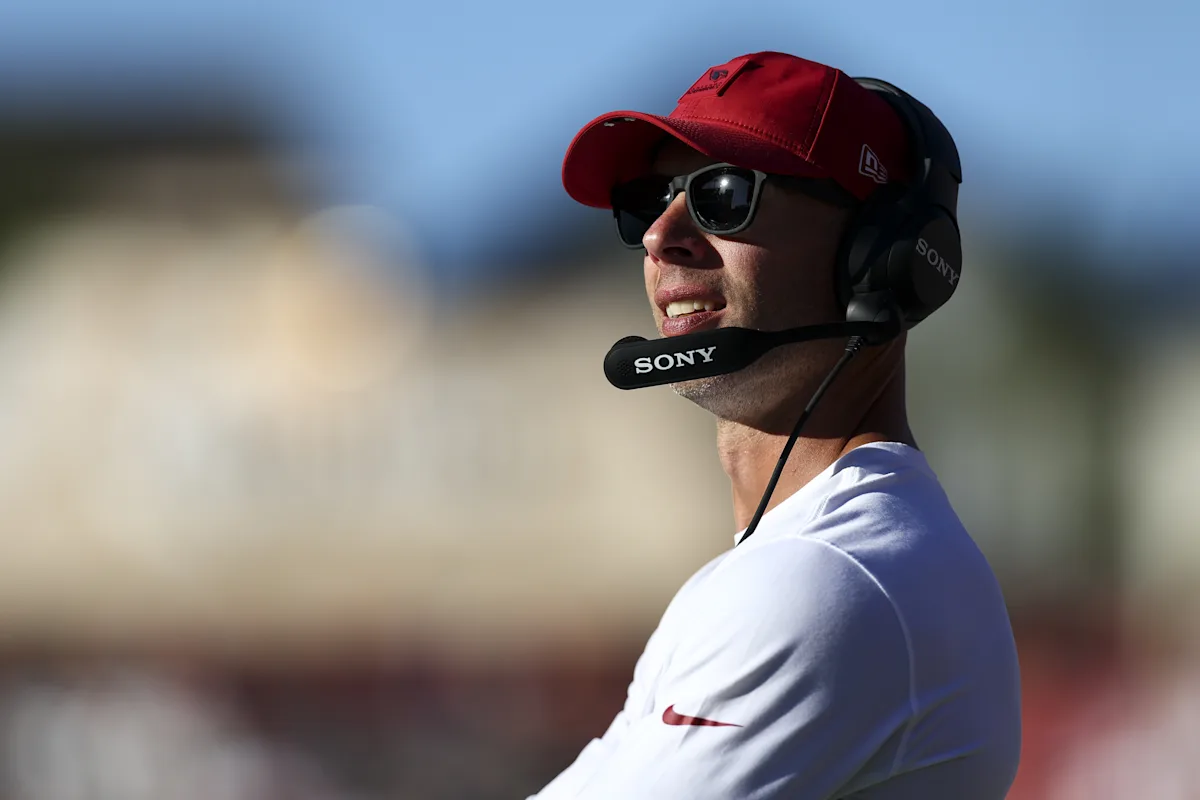
I don’t know if Jonathan Gannon will be a good, bad or average defensive coordinator for the Green Bay Packers. It is, in fact, virtually impossible to tell how good or bad a defensive coordinator is without an incredibly long track record. Jeff Hafley coordinated the NFL’s seventh-best defense (by DVOA) in 2024, then, with Micah Parsons, the Packers fell to 14th. And then once Parsons got hurt, they were down to 28.thending 19th overall, when you average everything.
So, did Jeff Hafley do a good job? I have no earthly idea. Apparently the Miami Dolphins thought so, and maybe they’re right! But I don’t like pretending I know things when I don’t, and I’m just not sure. The fundamental problem for all developing countries is that much is beyond their control.
Advertisement
The New England Patriots – who, as you may know, are going to the Super Bowl – finished the season ranked 23rd.rd in defensive DVOA. They finished 11th in EPA per game. They finished fourth in points against. The difference is that DVOA adjusts for the quality of the opponent they face, unlike the other two metrics, and while the Patriots defense got results, they got them against the Raiders, Panthers (Young was either benched or injured midway), Saints, Titans, Browns, Falcons, Jets (2x), Bengals with Jake Browning, Giants, Ravens with mostly Tyler Huntley and the Quinn Ewers-led Dolphins. This is an absolutely TERRIBLE list of offenses. Is defensive coordinator Terrell Williams a genius? Was he secretly terrible? Or can we just not say it?
And of course, the DC does not control the players he has. It’s up to the front office in terms of drafting and acquiring, and up to God in the form of injuries. It’s not Jeff Hafley’s fault that Jaire Alexander is a big weirdo, that they got Micah Parsons, that they lost Micah Parsons, that they lost Devonte Wyatt, or that Keisen Nixon turned into a trash-talking pumpkin.
That said, I believe (and I think everyone would agree) that there are good and bad defensive coordinators. Vic Fangio has a long track record of producing great results and I have no doubt he is a good defensive coordinator. In my opinion, the best current DC is Brian Flores in Minnesota, which brings me to my point. I don’t think the underlying scheme of a given DC really matters much, and that all have merit if executed correctly. Instead, I believe there are two basic philosophies among developing countries, and I have summarized them in the following mathematical equations. Both equations assume you stop running at a not-terrible pace. They are:

I think of the passive model in terms of the old Cover-2 shell, or Tampa-2, although this is not the only example, but it is easy to understand. In classic Cover-2, safeties prevent splash plays, force/attempt all passes to be on target underneath, and rely on safe tackles to prevent big YAC gains. If you have a good front four or a Brian Urlacher who eats up the middle of the pack, so much the better. This model made a lot of sense for a long time, but it made a LOT MORE sense when teams made more mistakes, and there has been a league-wide trend toward more conservative, error-free ball over the last 40 years that has really accelerated lately.
Advertisement
The last time The NFL’s league-wide completion percentage was below 60% in 2006.when it peaked at 59.8%, and in fact, 2007 was a turning point for passing as the league reached 61.2%, and hasn’t dropped below 60% to this day. In 2020, the league average reached 65.2%, and has not fallen below 64% since. The league has consistently moved toward a higher completion percentage over time, representing a general shift toward more conservative play. In 2010, the league-wide interception percentage last reached 3%, and in 2025 it reached an all-time low of 2.2%. But all this conservative play comes at a cost.
Explosive zones decreased as completion percentage increased. In 1972, the completion average was 13.2 yards, which is also the last time it exceeded 13. In 1991, the league reached 12 yards per completion for what is probably the penultimate time, as it has only topped that mark once since, during the crazy offensive season of 2011. Since then, it has been consistently above 11 yards per completion, until 2022, where it dropped to 10.9, where it has remained until today.
Picks are down, pass and completion percentages are up, and explosive plays are down, and these trends seem to be continuing, meaning the passive model is no longer as useful as it once was, and that’s why my admiration for the Flores system has grown. Flores’ defense rushes four fewer defenders than any other defense in the league, and thus it is the least predictable pass rush in the league. Doing any sort of film study against Minnesota is a nightmare because of the volume of possible combinations. It’s not just about identifying “the blitz,” but identifying whether it will be five, six, or seven (or a few times this year, eight) people coming at you, who the rushers will be, and where to shoot your route while making sure a sneaky lineman hasn’t slipped into your passing lane. And just when you think you see seven people coming, suddenly all but three fall into the blanket.
Flores’ defense is of course not perfect, as no defense is, but it is still exceptional. Vikings finished third in defensive DVOA this year despite a disastrous offense that often puts them in terrible situations. They also finished second in 2024 and first against the pass. And while this defense certainly has talent, its highest graded player by PFF was Jonathan Greenard with a very average 74.2. The exceptional (but comparable) The Houston Texans defense had six higher-rated players, including three in the 80s or 90s..
Advertisement
More than anything, I think there is good evidence, buried in the Vikings and, to a lesser extent, the Bears and blitz-happy Dennis Allen (whose Bears led the league in turnover differential), that while passive model defenses are only as good as their constituent parts, active model defenses CAN create improvement via scheme, at least a little.
And I’m not sure what Jonathan Gannon is, at least for now, but once we take a look and hear more about his philosophy, that’s the framework I’ll use. And I don’t even necessarily think it’s entirely a special situation. I think one of the reasons Jeff Hafley’s defense was better without Micah Parsons in 2024 is because he was forced to be active to create a pass, whereas with Parsons in 2025 he could stay passive and still get a pass. But it’s a lot easier to plan for Micah Parsons than it is for “a bunch of random shit I organize”, and so while Parsons is amazing, they were even worse overall.
Perhaps at some point the league will return to a more explosive and less cautious offensive norm, but until then, passive defenses will struggle as offenses are content to pick them apart with a high passing percentage. I really hope the next man is aggressive and prefers risk. Losing slowly is still losing.
