

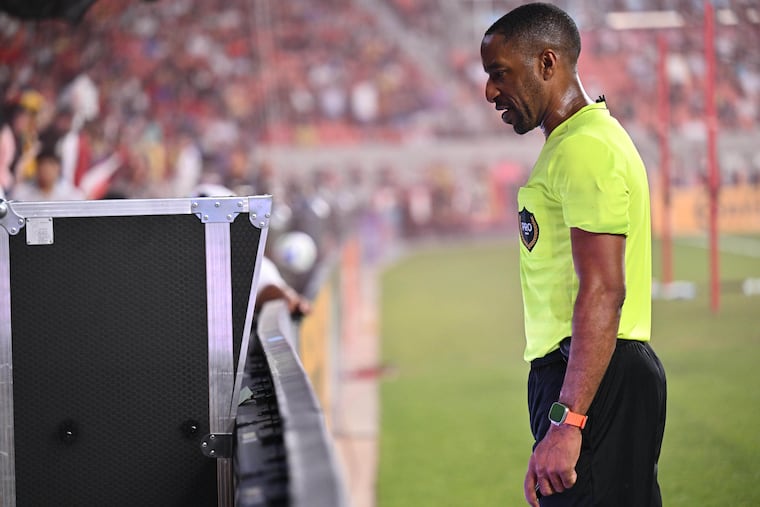
WASHINGTON — Whether fans like football video reviews or not, they tend to complain when those reviews seem to take up too much time.
It may seem natural to want to limit the length of these exams, perhaps one or two minutes. The sport’s world governing body says no, at least for now.
“Well, there may be different opinions, which I will respect,” FIFA refereeing chief Pierluigi Collina said on Thursday in a press briefing ahead of Friday’s 2026 men’s tournament. World Cup draw. “Certainly, when something takes a little longer, it’s not because the referee is, say, lazy or slow. It’s likely that the things being considered are particularly complicated.'”
» LEARN MORE: The FIFA World Cup draw takes place this week. Here’s what you need to know before, during and after Friday’s event
A match referee from 1995 to 2005, including the 2002 Men’s World Cup final, Collina took up his new role at FIFA in 2017 and has remained a public figure ever since.
“Another thing to consider is that when you’re waiting for someone, every second feels like an eternity – when you’re under pressure and you’re doing something, time flies,” he said. “So the referees, when they do that, probably don’t really realize that time is passing so quickly for them. But we all know that timing is an issue in every activity, so we’re always trying to improve.”
Collina admitted a report from the Times of London Earlier this week, the International Football Association Board – the entity that sets the rules for how football is played – is considering expanding the areas that VAR is allowed to rule on.
» LEARN MORE: The best and worst World Cup opponents for the USMNT and the teams Philadelphia should want to host
The extension would include second yellow cards, which would result in red cards and expulsion; and whether the officials were correct in calling a corner or a goal kick.
“This was already announced after a meeting of the IFAB technical and football advisory committee: the discussion took place, and the result was to propose to continue the discussion and propose” at the next IFAB business meeting on January 20, Collina said. If a proposal is adopted there, it will be submitted to the annual general meeting in March. That vote would take place on June 1, in time for the World Cup.
“Certainly, extending the possibility of VAR to intervene in certain specific circumstances is something (on) the table,” Collina said, adding: “It would be a shame if the outcome of the competition, whatever the competition, is decided not by what the players do on the pitch, but by an honest mistake made by the decision-maker.”
Specific to corner calls, he said “the main criterion is the absence of delay” in the action on the field.
» LEARN MORE: USMNT to face Cristiano Ronaldo’s Portugal, Belgium and Germany ahead of World Cup
“How long does it normally take? 10, 15 seconds for the attackers to be ready to take the corner,” Collina said. “In those 10-15 seconds, if the corner was given incorrectly, everyone has proof that the start of the game is wrong. For me, it is difficult to understand if they have the opportunity to see this, why we have to hide our heads under the sand and hope that nothing happens on the corner that is taken.”
Collina also said FIFA hopes to use referee body cameras again next summer, after debuting them at the Club World Cup.
“It was, I would say, a great success,” he said. “It has been implemented in some leagues, (which) means it has been well received by viewers – and referees have also benefited from its use. So we are quite confident that the legislator, as mentioned, the IFAB, will give us permission to implement it in the next World Cup (in) ’26.”
FIFA defends the expansion of the World Cup to 48 teams
It’s no surprise to hear FIFA officials say Thursday that it’s a good thing to expand the men’s World Cup to 48 teams, as it will for the first time next year. The women’s tournament will follow in 2031 when the United States will host a regional tournament alongside Mexico, Costa Rica and Jamaica.
But the way these officials presented it was nevertheless news, especially to the international media who visited Washington this week.
“This represents less than 25% of the 211 countries affiliated with FIFA,” said Arsène Wenger, head of global football development at FIFA and a famous former manager of English Premier League club Arsenal. “However, 75% of the teams are not there, and I count China, India, or 3 billion people.”
» LEARN MORE: International fans with World Cup tickets arriving in the United States next summer can apply for a priority visa. Here’s how.
FIFA director of soccer Jill Ellis, a former manager of the United States women’s national team, highlighted how the growth of women’s soccer around the world has made it easier to host a 48-team tournament without fear of lopsided matches.
“We see it in the college basketball landscape right here in the United States,” said the coach who led the Americans to World Cup titles in 2015 and 2019. “We’re used to these teams that are maybe lower ranked and suddenly have this phenomenal run.”
Will the weather be a problem again?
The high temperatures at this summer’s Club World Cup have understandably sparked many complaints and fears of further problems next summer. Wenger raised this question spontaneously.
FIFA has yet to say much about whether it will take weather into account for kick-off times, beyond a hint from President Gianni Infantino in July that would be a good idea.
» LEARN MORE: FIFA admits heat impacted Club World Cup
“If there’s one uncertainty we can’t control, it’s the weather,” Wenger said. “Especially in Miami, you know, places like Atlanta, where you had some problems last year. So we’ll do everything we can to protect the competition and the players.”
He also said that “we will carefully consider the best possibilities for teams to be protected from the heat” as FIFA finalizes kick-off times ahead of Saturday’s announcement. But skeptical fans everywhere won’t believe it until they see it.
