

National Collegiate Athletic Association (NCAA) basketball administrators have apologized to women’s basketball players and coaches after details about the differences between the men’s and women’s tournaments went viral on social media.
Key points:
- Several women pointed out differences between men’s and women’s facilities at the March Madness tournament
- The NCAA has since apologized for ‘dropping the ball’
- South Carolina coach Dawn Staley said the NCAA’s message about equality was nothing more than a ‘soundbite’
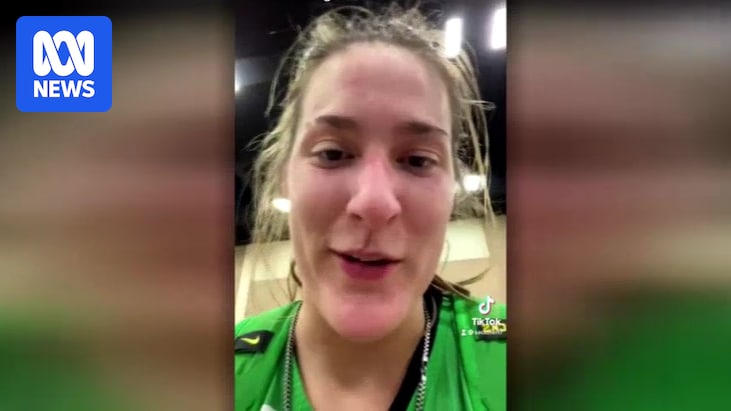
Oregon’s Sedona Prince was one of several athletes who took to social media to highlight the differences between the facilities available to male and female athletes.
She pointed to a barbell tree with 12 weights on it, saying “this is our weight room,” before turning the camera around to show a much larger facility she said was the men’s weight room.
She then refuted an earlier NCAA explanation that the differences were due to a lack of space, pointing to a large empty room next to the women’s practice field.
“If this issue doesn’t bother you, then you are,” she said.
Prince’s video has been viewed more than 16 million times and sparked a reaction from some of the biggest names in basketball.
Seven-time NBA All-Star Steph Curry was among those who commented, saying, “Wow, come on now! Y’all trippinz trippin,” in a Twitter post in which he tagged the NCAA.
NCAA senior vice president of basketball Dan Gavitt pledged to do better during a Zoom call Friday morning, a day after photos showing the difference between the weight rooms at the two tournaments were released.
“I apologize to the women’s student-athletes, coaches and committee for dropping the ball on the weight room issue in San Antonio. We will resolve it as soon as possible,” Gavitt said.
During the call, other differences were raised: there are 68 teams for the men, 64 for the women. And the NCAA pays for the men’s National Invitation Tournament (NIT), but not the women’s tournament.
“The size of the field and the NIT would be decisions made in conjunction with the membership,” Gavitt said.
“These are not decisions we could make independently. These are good questions and it is time to raise them again.”
In an effort to solve the weight room problem, the NCAA modified the convention center space to turn it into a usable training room.
“We have not been successful this year in what we have done to prepare over the last 60 days to have 64 teams in San Antonio. We recognize that,” said Lynn Holzman, senior vice president of women’s basketball at the NCAA, who is a former college basketball player.
“Last night we had a call with our coaches and team administrators to solicit their feedback and experience so far.
“Yesterday was the first day our teams had a chance to practice,” she said.
“Part of this call was to get feedback on potential solutions to address some of these concerns, including the weight room issue.”
The weight room isn’t the only problem
Female players also raised questions about the gift bags they received and how they compared to those given to men.
The NCAA said the value of the bags was fair.
A discussion began between conference commissioners and the NCAA about how to avoid further problems in the future.
“I hope this will pave the way for a broader review of how we invest, support and make decisions in the sport of basketball at all levels of our system,”
» said America East Commissioner Amy Huchthausen.
“There are of course complexities and tensions, but times like this should force us to re-examine how we got here. It’s not just about dumbbells or gift bags.
“It’s about our core expectations of justice and fairness and ensuring that the outcomes of our decisions can meet those standards in order to provide a quality experience for our student-athletes.”
South Carolina coach Dawn Staley said it was unacceptable for something to fail only in the women’s field, and she criticized NCAA President Mark Emmert in a statement posted to Twitter Friday evening.
“What we know now is that the NCAA’s season-long message about ‘unity’ and ‘equality’ was a matter of convenience and a sound bite for the moment created after the killing of George Floyd,” Staley wrote.
“We cannot, as leaders of young women, allow Mark Emmert and his team to use us and our student-athletes for their convenience.
“All the teams here are facing the same problems as the men’s teams this season, but their ‘reward’ is different.”
AP/ABC
