

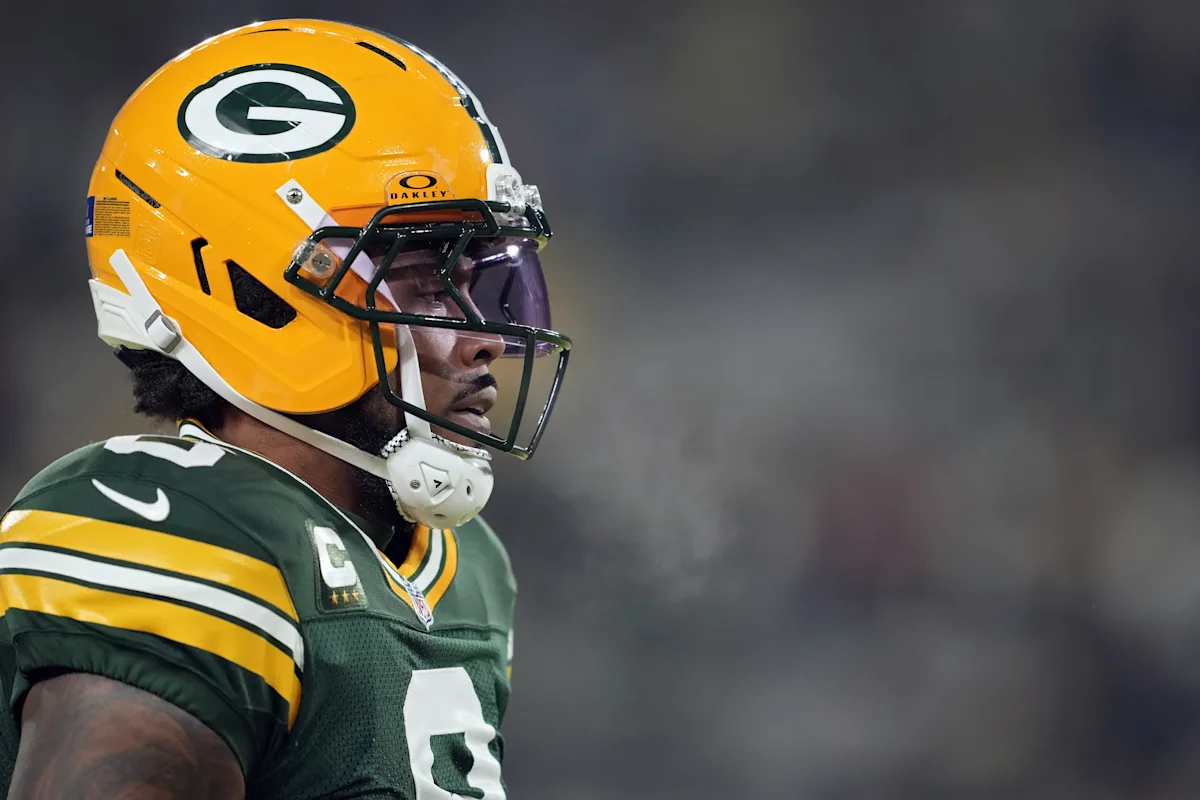
Under general manager Brian Gutekunst, the Packers have developed a pronounced running back bias. The team favors big, powerful backs, valuing their ability to gain yards over big gains. Coupled with an increased focus on gap-oriented interior runs, this has led to a Packers backfield comprised of essentially one type of runner: players in the mold of Josh Jacobs.
The Packers want Jacobs, or a Jacobs-style back, to handle the ball a lot, turning their primary running back into a workhorse who will carry the rock more than 300 times during the season. Due to injuries, Jacobs didn’t quite reach that threshold, but it’s still worth comparing him to other backs who carried the ball a lot to see what the Packers were getting for their money. I’ve already done a bit of that in my cap-related look at Jacobs’ future in Green Bay, but this will dig a little deeper into the data.
Advertisement
Here’s what we’re looking at: Jacobs carried the ball 234 times during the 2025 regular season, so I gathered information on all NFL runners who carried the ball at least 200 times. In the modern NFL, that only gets us 21 names, or about two-thirds of the league (a potential red flag for the Packers’ strategy; if it’s a good idea to have one guy carry the ball repeatedly, why aren’t more teams doing it?). For comparison, in 2000
Among those backs, Jacobs had the second-highest cap hit ($11.3 million) and was tied for fifth-oldest player. 10 of the 21 guards on the roster were 25 or younger this season.
How did Jacobs behave? Compared to other backs who carry the ball a lot, Jacobs’ 2025 hasn’t been great. Although he scored a lot of touchdowns (his 13 ranked third on the list behind Jonathan Taylor and Derrick Henry), per rush, Jacobs was pretty bad. Only three players had a worse per carry average than Jacobs’ 4.0 in 2025. For comparison, five players averaged more than 5.0 yards per carry, and 13 averaged 4.5 or better – more than half the roster was at least half a yard better per carry than Jacobs in 2025.
Situationally, Jacobs was also uninspiring. His 49.1% success rate ranks him 12th, essentially middle of the pack. This is notably a significant drop from 2024, when Jacobs had a 52.2% success rate.
Advertisement
And worst of all, Jacobs was once again merely average in the areas he typically excelled: forcing missed tackles and creating yards after contact. Jacobs is tied for 11th on the list with 47 missed tackles forced in 2025, according to Pro Football Focus. That number was probably reduced a bit by the fact that Jacobs only played in 15 games last season (every player ahead of him played in at least 16 games, and six of them appeared in all 17), but that’s not really a point in Jacobs’ favor. If your workhorse breaks down, a trip to the glue factory may not be far in the future.
When it comes to yards after contact, Jacobs averaged just 3.06 yards after contact per carry, good for 12th on our list of 21 backs. To be fair to Jacobs, most of the players ahead of him were only about half a yard better, but it’s worth noting that the leader was De’Von Achane, who averaged 4.11 yards after contact per carry despite a listed weight of 188 pounds, about 40 pounds lighter than Jacobs. Size, it seems, is not necessarily a determining factor in producing yards after contact.
In all honesty, Jacobs has faced many challenges this season. He has battled nagging injuries throughout the season, which is both a real limiting factor and a worrying development for an already quite elderly fullback. He also faced a lot of uncertainty regarding his offensive line. Aaron Banks and Zach Tom missed significant time early in the season, and Tom was ultimately lost for the final month of the season due to a different injury. Elgton Jenkins also missed much of the year with a leg injury, leaving the Packers short-handed up front. It’s difficult for a guard to succeed when his line is in shambles.
Where does this leave us with Jacobs? It’s hard to say for sure, but it seems likely that this is the beginning of the end. How confident are you that a player who was already one of the oldest players in the league handling a heavy workload will be healthier and more effective when he’s a year older? And how good do you feel about committing to an even higher ceiling for Jacobs, knowing the outcome will likely be similar, or even worse, as he gets older? This isn’t a good spot for the Packers, but they seem determined to roll with Jacobs and hope for the best.
