

After a record number of people streamed through the gates at Melbourne Park for the first day of this year’s Australian Open, Tennis Australia boss Craig Tiley said: “The cricket is going to be in December. Our goal is we want to own the month of January.”
Part of that strategy is making the tournament more than just tennis. Over the course of three weeks – including qualifying week and the main draw – the sports precinct becomes a behemoth of brand activations, activities and entertainment.
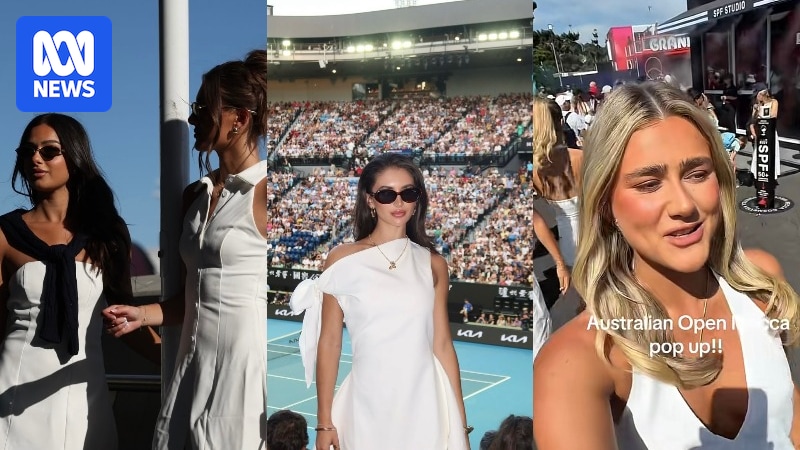
There are also many influencers who travel to the tournament and post tirelessly on social media. Many are invited to premium experiences and seats by brands in exchange for content aimed at their subscribers, which can range from a few thousand to millions.
They helped Tiley and his colleagues make the event not only the place to be in January, but the place to be seen.
The 2026 Australian Open attracted record crowds throughout the tournament. (Getty: James D. Morgan)
Many longtime tennis fans say it changes the look, feel and experience of the Australian Open, with comparisons made to the fashion-focused spring races and the changing culture of the Australian Grand Prix.
In doing so, the general public – many of whom have been attending the tournament for years – expressed some frustration with the influencers and content creators. flood coinciding with thousands forced to queue for hours for matches while benefiting from increased access.
Emily Wade, 28, says she is a true fan who personally finds it frustrating to see the influx of influencers taking their seats at big-name matches while others who would really enjoy being there for the tennis find it increasingly inaccessible due to overcrowding and higher ticket prices.
“I’ve sat behind influencers before and seen them on the phone, talking, leaving early and I personally don’t think that’s a good idea,” Wade told ABC.
“The only comparison I have is AFL/AFLW, where the presence of influencers is very minimal, so it doesn’t affect my experience as much as tennis, where the presence of influencers increases every year.
Loading Instagram content
Kirsty Stekel, 37, said she missed the days when the Australian Open was more about dressing in team colors rather than fashion.
“I love AO no matter what, but (I) definitely mourn the days when you could get cheap ground passes, jump easily between fields and matches and everyone showed up in groups dressed in country colors to support the players – without having to worry about looking fancy or fashionable,” Stekel said.
“Wearing the national colors brought so much energy to the crowd and the day and you rarely see that these days.”
The role of content creators and influencers at the AO
Most influencers are invited by certain brands or companies to events held during the tournament, while organizers have granted increased access to content creators this year.
Brie Stewart, Director of Content, Tennis Australia told Code Sports: “We understand that they are coming anyway, and we want to be part of the history that they create.”
But one popular TikTok influencer, who spoke to ABC on condition of anonymity, said he was surprised at the level of pressure put on influencers to create content by organizers.
“I think it was 20 messages (over the entire tournament) to be allowed into the AO creator lounge,” they said. The Creator Lounge is a designated section within Tennis HQ where creators can film, edit and work.
“Some people don’t think we work for our money, but 20 edited videos (is) a lot of time in our day. I did the math, that’s a minimum (equivalent) of $60,000 in TikToks,” the influencer said.
The tournament used a “tier system” in which creators were rewarded with certain perks based on the amount of content they posted and the “impressions” of their audience.
The “rewards” included, among other benefits, behind-the-scenes tours, access to AO on-field accreditations, participation in the race for AO reserve seats, AO partner events and places in the men’s and women’s quarter-finals, semi-finals and final.
The reward system was in place the week before the start of the AO.
One online fan wrote: “I think AO played the game really well. They asked all the influencers from the previous week to liven up the mood, show food and fun and tennis and it worked.”
The influencer added that he thought people would always find negative things to say about “being an influencer” because it was “a dream job.”
“We do everything and get paid a shit ton,” they said.
Although brands have their own collaboration agreements with influencers, Tennis Australia has not paid for one or covered their travel costs.
“There’s not just one way to be a fan.”
Many tennis fans have also expressed frustration with the lack of tennis etiquette from some influencers and fan groups who are more concerned with getting content than watching matches.
One fan told ABC that a group of influencers sat in front of them at a game, took a bunch of photos with a particular branded product, then left without watching the game.
Dr Kasey Symons, a communications professor specializing in sports media at Deakin University, said there would always be good and bad apples among major groups.
Loading Instagram content
As someone who has researched fan culture in sports, she said people need to move away from the idea that there is only one type of sports fan or one way to become a fan.
“We need to understand how all fans want to connect with sport, whether they are sports lovers and heavy consumers of competition and match analysis, casual fans who enjoy the atmosphere, (and) social media users who engage in an online community,” Symons told ABC.
“There will always be fans who cross the line and annoy other fans, but they don’t reflect the group as a whole.
“There are traditional fans who can disrupt other fans’ enjoyment, and influencers, new fans and social media users can also mess up.
“This needs to become a broader discussion about how to be a good fan rather than the “right” way to be a fan.“
But online creator Nicole Bridget pointed out on TikTok that those who are invited as guests to events like the Australian Open can still be quite rigid and exclusive.
She said her problem was that brands and agencies weren’t inviting diverse people and “it’s very clear that only skinny designers are invited to AO events for another year, because apparently if you’re curvy it means you don’t like sports”.
Some women’s sports designers have also been frustrated at not being championed by brands at events.
Meanwhile, others struggled to see influencers posting content flaunting and mocking their lack of tennis knowledge in a space in which they worked hard to be taken seriously.
More women are discovering sport
Atara Thenabadu, 25, said she saw similarities between changing tennis fan cultures and F1, which attracted many young female fans after the success of the Netflix documentary series, Drive to Survive.
“When it comes to whether influencers ‘deserve’ to be there, I can’t help but think that there are undertones of sexism in some quarters, whether conscious or not, that support the so-called sacred guardrails of professional sport that for years have acted as barriers against women interested in learning about the sport,” Thenabadu told the ABC.
Morgan Riddle, girlfriend of American tennis player Taylor Fritz, has been credited by many with attracting more young women to tennis. (Getty: Cameron Spencer)
The NFL’s Kansas City Chiefs saw an uptick in viewership after singer Taylor Swift began attending games with her partner, Chiefs player Travis Kelce. While it was a success for some, it converted others into NFL fans, particularly women who had long felt excluded from the sport or intimidated by its scene..
“That said, I believe, based on the online discourse, that there have been repeated instances of lack of engagement in the sport itself, such as not watching the games or speaking loudly, which I don’t think is appropriate,” Thenabadu said.
Thenabadu added that considering both perspectives – while there was no simple solution – she believed the issues of overcrowding and long queues fell at the feet of Tennis Australia, rather than the influencers invited by brands.
“From my perspective…I don’t feel jealousy or envy when I watch influencers participate; however, I would be lying if I said I haven’t been surprised by others expressing their displeasure with influencers who have shown little or no interest in inclusive sports,” she said.
