

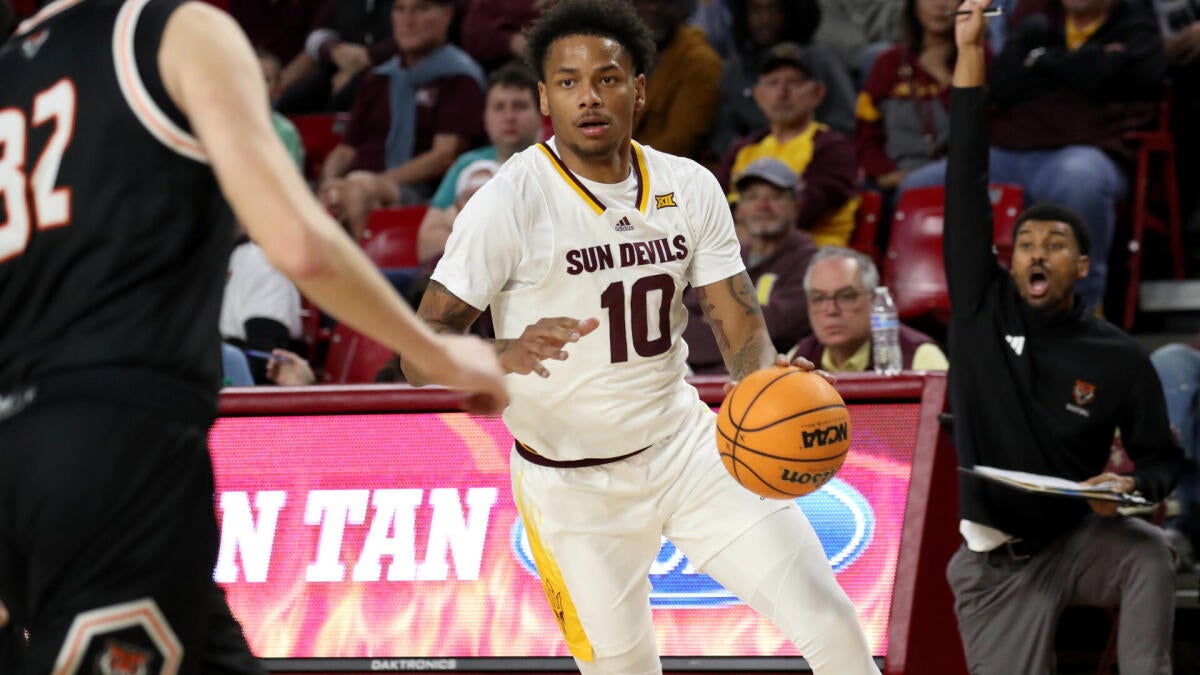
NCAA Committee on Infractions released Friday decisions involving three Division I schools and six college basketball players in unrelated cases, each involving illegal acts gambling and/or game manipulation activity.
Players used to play Arizona State, Mississippi Valley State And New Orleans. Neither school is being punished because the NCAA determined that the coaches and most other players were not involved or unaware of these unrelated schemes.
“Although the cases at each school are not directly related, the violations in each case involved gambling-related game manipulation and/or student-athletes providing information to known bettors,” according to the NCAA statement. “Additionally, all three cases involved a lack of cooperation on the part of student-athletes, who knowingly provided false or misleading information to investigators. As a result of the sports betting violations, the student-athletes all violated the rules of ethical conduct, triggering permanent ineligibility.”
College basketball rankings: Darryn Peterson faces his first tough test as Kansas meets UNC in early showdown
Gary Parrish

BJ Freeman is the biggest name of them all. The former Arizona State guard finished second on the team in scoring in 2024-25, averaging 13.7 points to go along with 3.9 rebounds and 2.6 assists. He will never play college basketball again, nor will former Mississippi Valley State and New Orleans players: Cedquavious Hunter (UNO), Dyquavian Short (UNO), Jamond Vincent (UNO), Donovan Sanders (MVSU) and Alvin Stredic (MVSU).
Freeman’s case was first reported by CBS Sports in September. The NCAA discovered his infractions while investigating another case related to the former Fresno State basketball player Mykel Robinson.
“Records on Robinson’s phone indicated that on four occasions between November and December 2024, Freeman knowingly provided information to Robinson, who was betting on Freeman through daily fantasy sports accounts,” according to the Committee on Infractions report. “Freeman also knowingly provided information on at least two occasions to his then-girlfriend, who was also betting on Freeman. When questioned by law enforcement personnel, Freeman knowingly provided false or misleading information when he denied sharing information with Robinson and his then-girlfriend. He also denied having a daily fantasy sports account – which was under his name and email address – into which he had made deposits while attending a previous school.”
Freeman attempted to reach overs on his point total, turnovers, assists and 3-point shots, according to the NCAA’s findings. He was kicked off the team last February, although a source told CBS Sports that the reason for his removal from the ASU program was not related to his playing activities. Freeman announced his commitment to UCF last spring, only to learn he would never play college basketball again.
In New Orleans, the nefarious behavior was even more egregious. According to the NCAA’s findings, “a student-athlete reported hearing Cedquavious Hunter, Dyquavian Short and Jamond Vincent discussing a third party placing a bet for them on their December 28, 2024 game. This same student-athlete reported that during a timeout near the end of the game, Short asked him not to score any more points.”
All three players were suspended at the end of January last season and never played again. Players allegedly chose to fix games seven times last season with the Southland Conference program. All attempts to manipulate the game’s results took place in December and January.
“Text messages on Vincent’s phone indicated that he sent a three-party text message with instructions to bet on this December 28 game because he and his teammates planned to ‘pitch the game,’” the NCAA statement said. “Text messages recovered from Short’s phone included an exchange between Short and Hunter, in which they discussed receiving $5,000. Short and Hunter engaged in FaceTime calls the same day with a known bettor who told them to ‘wait’ for the next game.”
At MVSU, the NCAA says it found the same thing, albeit in another project unrelated to UNO activity. The NCAA investigation began with MVSU’s 79-67 loss at Alabama A&M on Jan. 6, but as the investigation continued into 2025, they discovered match-fixing dating back to Christmas week last season.
“During an interview with law enforcement personnel, a men’s basketball student-athlete stated that prior to the team’s December 21, 2024 game, he heard Donovan Sanders on the phone with an unknown third party talking about ‘throwing the game,’” the NCAA states. “Sanders asked the student-athlete to participate in the call because the third party told Sanders that the individual intended to bet on the game and wanted to know that another teammate of Sanders would be participating in the program. The student-athlete denied altering his performance or receiving money from Sanders or anyone else. Sanders texted the same student-athlete after that game and told him to delete his messages.”
The NCAA later determined that Sanders and Stredic received money if they helped ensure MVSU lost its Jan. 6 game at Alabama A&M.
This is the second announcement of violations related to college basketball in the last two months. The NCAA continues to work on more potential cases of wrongdoing, sources said, with the possibility of another round of violations being issued before the end of the 2025-2026 season. Meanwhile, the FBI – which recently made public its investigation into NBA-affiliated gambling – continues to work on its investigations into illegal gambling, fraud and other financial conspiracies in college basketball, primarily at mid/low-tier programs, according to sources.
For its part, the NCAA and its president, Charlie Baker, have pushed to eliminate player side bets on gaming apps and in casinos. Side bets can lead to illegal activity, as in the cases described above, and can trigger frequent online harassment by gamblers toward college athletes.
