

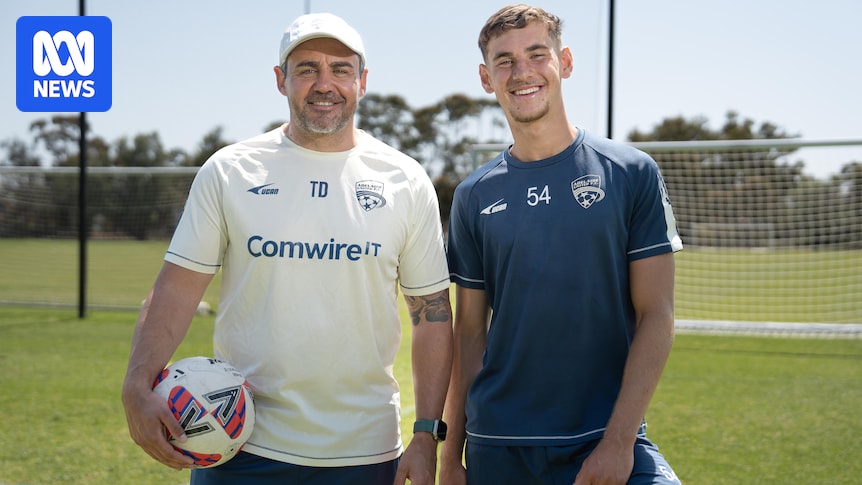
Teenager Bailey O’Neil carries a huge weight on his skinny shoulders – and he couldn’t be happier.
The left-footed defender is part of the next wave of young talent coming through the ranks of the A-League, but landing his first professional contract comes with a self-imposed responsibility.
“If I can do as well as I can and perform on the field, I can try to influence young indigenous kids to play this game.”
he said.
This is no small feat, given the overwhelming numbers at the senior levels.
The 18-year-old Adelaide United defender and Arrernte and Yankunytjatjara man is one of three Indigenous male players on the A-League team’s roster this season, alongside Perth Glory veteran David Williams and Western United’s Tate Russell.
Adelaide United’s Bailey O’Neil dribbles the ball during a training session at Hindmarsh Stadium. (Adelaide United: Courtney Pedlar)
It’s a statistic that dismays former Socceroo and now Adelaide United assistant coach Travis Dodd, who believes the comprehensive coverage of rival codes – namely the AFL and NRL – is a major reason.
“Kids can see their heroes (from these codes) on television any week and any day,” Dodd said.
“Whether they’re performing or it’s a media opportunity, they see these Indigenous stars on a regular basis.”
The young O’Neil defied this trend: as he grew up, he found himself drawn more strongly neither to Australian rules nor to rugby league, but to the global game.
The explosive and powerful Dodd was his inspiration.
“Travis was my idol growing up. I saw him play for Adelaide and the Socceroos,” O’Neil said.
“He was the first indigenous player to score for the Socceroos. It really inspired me a lot.“
O’Neil has represented Australia at junior levels. (Instagram: _baileyoneil)
Dodd does everything he can to make sure O’Neil succeeds in the tough world of professional football.
Their association began last year, when Dodd formed a team to compete in a First Nations Cup in Queensland and joined O’Neil on the field.
Dodd has since been named a member of Adelaide United’s coaching staff and will focus on the development of the club’s younger players, including O’Neil.
Dodd said that, on the field, his young protégé demonstrated obvious “street smarts.”
“He’s very aggressive,” Dodd said.
“I saw it when I was coaching against the Adelaide United NPL (National Premier Leagues) team last year.”
“I want to be a model”
The quick-thinking O’Neil values Dodd’s advice and intends to “listen to him, learn from him.”
“He had a very successful career in the A-League,” O’Neil said.
“He talks to me every practice, every day, (and I) just try to listen to him, take some of his advice and continue to improve.”
O’Neil in possession of the ball during a training exercise. (Adelaide United: Courtney Pedlar)
O’Neil has yet to make his senior debut but wants to play as many minutes as possible this season.
However, he is waiting behind captain Ryan Kitto for a starting place in defense.
His goal, like that of so many young footballers, is to one day play in Europe.
But he believes he bears a responsibility far greater than simple personal glory.
“I want to be a role model for young Indigenous children and they can look up to me.”
he said.
Football Australia looking to improve courses
Football Australia’s governing body recognizes the low number of Indigenous players at senior level as a problem and challenge.
It has already established a national Indigenous advisory group and appointed a First Nations executive director, and is currently seeking a programs and pathways manager to “design, implement and manage football programs tailored to First Nations communities”.
In the meantime, Travis Dodd not only supports O’Neil, but also his efforts to get more Native kids playing football.
“You’re trying to make progress, and I certainly feel like we’re trying. It’s just baby steps,” he said.
“We can get things done.
“(I would) like to see this snowball into an avalanche and hopefully we can see an influx of players in the years to come.”
