

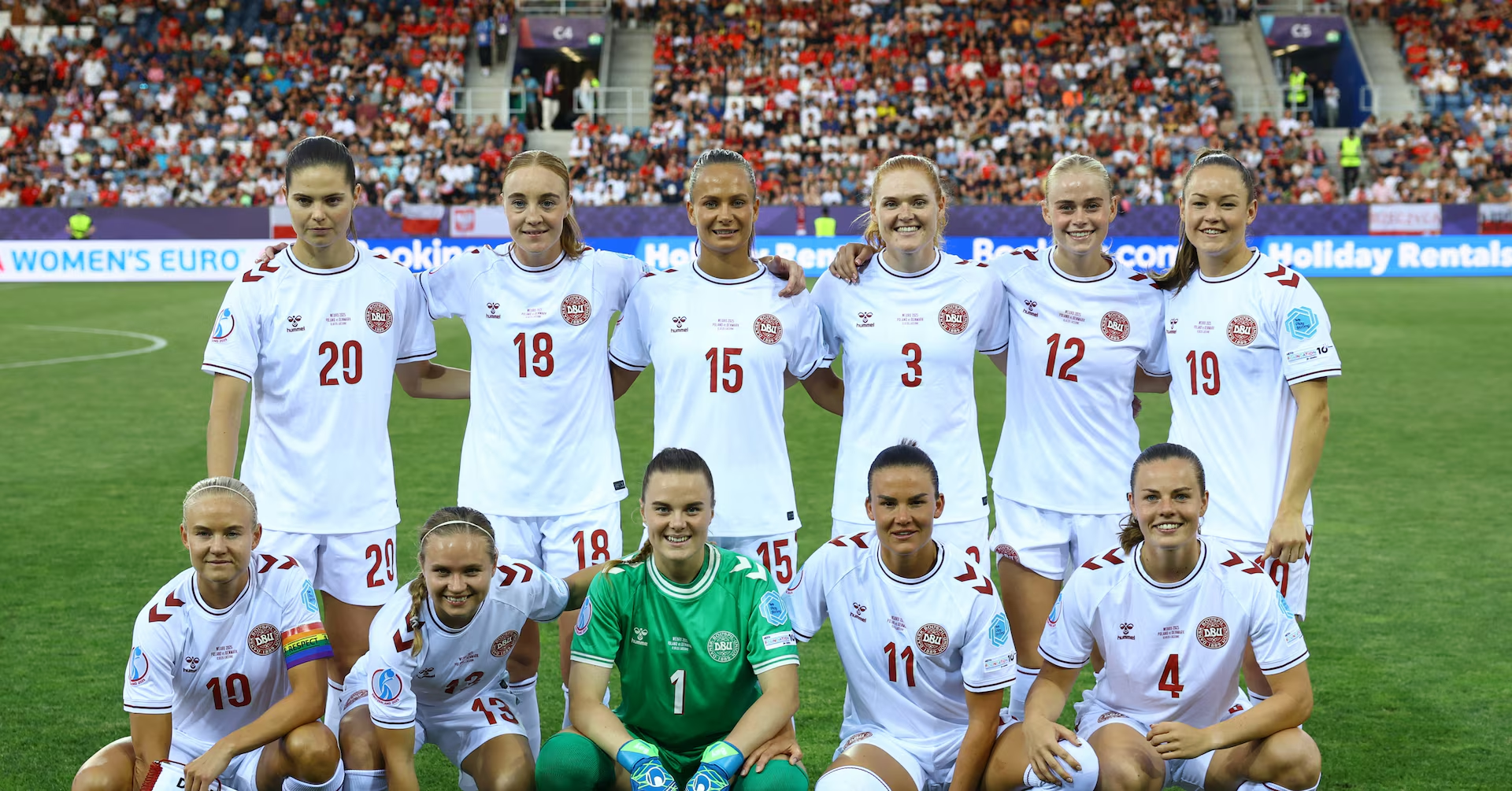
ZURICH, July 17 (Reuters) – Professional women’s soccer teams are increasingly ditching white shorts to address concerns about period anxiety, but studies have shown the problem continues to impact performance and discourage young girls from playing sports.
Alex Krumer, professor of sports economics at Molde University College in Norway, presented his peer-reviewed study on the effects of wearing white shorts on performance to an audience at the University of St. Gallen last week, coinciding with the Women’s European Championships in Switzerland.
Register here.
Krumer’s research, based on data from World Cups and European Championships between 2002 and 2023, found that women’s teams wearing white shorts averaged 1.27 points per game, compared to 1.57 points for dark-colored teams. The men’s teams showed no decline in performance when wearing white.
Krumer said there hasn’t been enough discussion on the issue.
“Sport should be a vehicle for women’s empowerment,” he told Reuters. “It’s about inclusion because it’s an exclusive part of women’s football, not necessarily for professionals but for young girls, it’s important.”
Denmark, Norway and Finland are among the teams wearing white shorts at Euro 2025.
“My co-worker messaged me: ‘Alex, they’re playing games in white shorts. It looks like they really want to piss you off,'” he said.
England’s Lionesses have swapped their white shorts for blue ahead of the 2023 World Cup after complaints from players. Captain Leah Williamson said talking about sports periods should be normalized.
“Half the population owns one, you’re not alone,” the defender said in an interview with the Football Association earlier this year.
“We empower each other in so many other ways that it’s just one small cog in the wheel of mutual reinforcement. There’s just no shame, which I think is the main thing that allows us to be free.”
Williamson and England midfielder Beth Mead took part in an Arsenal campaign in February aimed at erasing the stigma surrounding sporting spells.
“You don’t want to be embarrassed and, especially when you’re at school with boys and you’re joking around, you’re brought up to think that it’s a really shameful thing. There’s so much rubbish piled up around it,” Williamson told the FA. “I exercise to be free. I can’t be free if I care about the most natural thing in the world.”
Menstruation was a topic discussed at this year’s UEFA Medical Symposium in Lugano.
“The menstrual cycle is not only a taboo subject in sport, but also a significant barrier to participation,” European football’s governing body said.
“According to a study conducted by UEFA partner Adidas, 65% of those who menstruate say that menstrual leakage is their main concern when playing sports.”
A separate 2024 study by UK charity Youth Sport Trust found six in ten girls fear playing sport due to menstrual leakage.
“We should tell girls, ‘Look, we’re ditching the white shorts because we care, so come play soccer,'” Krumer said.
“If the uniform is a barrier to (girls’) participation, you reduce their social network, whereas boys don’t have that barrier of the uniform.”
Krumer expressed frustration with the lack of historical data on women’s soccer compared to men’s soccer.
“Even during European Championships or World Cups, since 2003, it was really difficult to find data on women’s football, like photos or videos,” he said. “For men, it’s very simple. But for women, the data is simply not available.”
Reporting by Lori Ewing Editing by Toby Davis
Our standards: The Thomson Reuters Trust Principles.
