

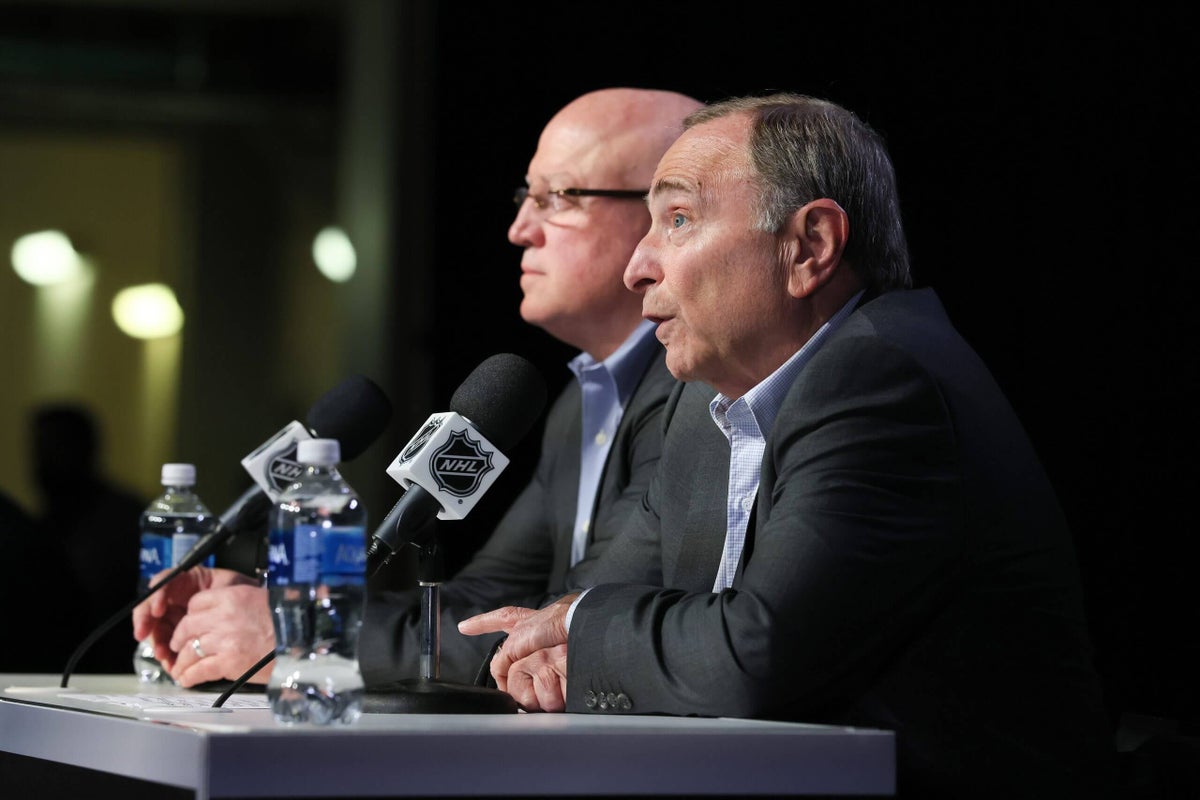
EDMONTON — At the start of a Stanley Cup Final featuring a Florida-based team for the sixth straight year, NHL Deputy Commissioner Bill Daly told reporters there would be no changes included in the next collective bargaining agreement to account for the perceived advantages enjoyed by teams based in tax-efficient jurisdictions.
While Daly acknowledged that some clubs around the league have raised the issue, he said NHL headquarters does not “share the level of concern that they have.”
“These imbalances have been there forever,” Daly said Wednesday. “There’s nothing new here. There are so many reasons why a player might choose to play in a particular place, for a particular team, for a particular coach that have nothing to do with the fiscal situation of that market.
“So I don’t think that’s something that we’re going to proactively address in this collective bargaining.”
The subject has taken on particular importance since the Florida Panthers won their third consecutive appearance in the Stanley Cup final. This followed the Tampa Bay Lightning representing the Eastern Conference in the finals for the three seasons before that.
Speaking Tuesday, Panthers general manager Bill Zito said he believes the team sees only a “marginal” benefit in attracting players in a market with no income tax, citing everything from weather to strong ownership to a successful culture as elements that have made his organization a destination.
Like the league, the NHL Players’ Association is not convinced there is a problem to be resolved when it comes to tax benefits.
“From 2008 to 2020, who ran this league? Pittsburgh, Chicago, Los Angeles, Detroit for a brief period, Boston,” said Ron Hainsey, assistant general manager of the NHLPA. “Certainly (Brad) Marchand, (Patrice) Bergeron and (Zdeno) Chara could have made more money elsewhere. They didn’t. They chose to stay. They were a good team and reached the finals several times. Pittsburgh, I’m sure Sid (Crosby) or (Evgeni Malkin) or (Kris) Letang could have made more money elsewhere. They stayed there the whole time. Why? Good team. I liked where they lived. I didn’t want to do the same thing in Los Angeles.
“What do they all have in common? They all have a different tax situation than Florida. That was 12 years. Now we’ve had six years of Tampa, Tampa, Tampa, Florida, Florida, Florida – just coming off the previous 12, I guess we have to wait another six years to see if there’s even a problem.
“Reacting that way because Florida and Tampa are having their moment here where the players, the good teams, took less time to stay. It’s the same thing that happened the previous 12 years, right, with all these other things?”
“When we talk about ‘Is this really a problem?’ » I’m not sure that’s the case. I don’t know if we can expect Florida and Tampa not to be great at some point in the cycle here. That’s really where we are right now.
Closing of the ABC
All indications are that the NHL and the NHL Players’ Association are getting closer to an agreement ABC extension, but Bettman wasn’t yet ready to say it was almost over.
Bettman last fall, at the Board of Governors meeting in New York, suggested that if all went well, he might have a new CBA to announce at this Cup final. But it’s not there yet.
“We have a very constructive, professional and cordial dialogue,” Bettman said. “We started a little later than expected for various reasons on both sides, so I don’t have any announcements to make today about reaching a deal.
“But we have over a year left (before the CBA expires in September 2026), and I think we’re in really good shape and having some really good discussions.”
The parties officially began negotiating in early April and have remained there fairly steadily. They will have more CBA sessions during the Stanley Cup Final.
“We’re having good, ongoing conversations,” NHLPA general manager Marty Walsh said after Bettman’s news conference. “This time of year is tough because we have the Stanley Cup Playoffs and the Stanley Cup, but it’s moving steadily. It’s moving forward. I feel good about where we’re at, and we’ll see what happens. It gets complicated at times, any collective bargaining agreement, but it’s not what it was in the past here, where you see national conflicts between unions and businesses.”
Will it only take a few days or weeks for the deal to be finalized?
“I can’t answer that question,” Walsh said. “We only started in April, so a slow start there, so I’m not going to give a timeline on that.”

Gary Bettman and Marty Walsh have indicated that a new ABC is about to form. (Bruce Bennett/Getty Images)
Hockey Canada Trial
Bettman reiterated that the league will have nothing to say about the five players on trial in London, Ont., until proceedings are completed. He was asked what the league would do if all five players were found not guilty.
“We have always said we would not comment on what is happening, that we would let the legal process do what it needs to do and at that point we will decide what, if anything, we need to do,” Bettman said. “We want to respect the process.”
But before moving on, Bettman added: “But we will make one thing clear at all times whenever I am asked about this: What has been alleged is abhorrent, disgusting and should not be tolerated. »
Succession plan
Bettman likely knew the question was coming, but he once again downplayed any notion that he would soon be stepping down as NHL commissioner or that he had a succession plan in place.
“The rumblings all seem to be coming from you,” Bettman said in a playful jab at me (LeBrun), which also comes back to asking him about it after the general managers’ meetings in March. “There’s nothing new to report. I continue to love what I do. I continue to be energetic and I recognize that age at some point, I suppose, can become a factor. But as I sit here today with you, that’s not the case. Sorry to disappoint you.”
Well, to be honest, we weren’t the ones who started the rumors about his future. One of its owners, Craig Leipold, did: back in January.
Expansion process
As Daly noted in a Questions and answers with Athletics Two weeks ago, the league was not planning to open a traditional expansion process, but rather to continue to listen to interested parties and perhaps act accordingly at some point.
“We’ve had a lot of interest from people and markets wanting to host NHL cities, and we’re having a lot of meetings about them,” Daly reiterated Wednesday. “We decided that we were not going to engage in a formal expansion process, but if someone wants to basically apply for an expansion franchise and has all of the required elements that we would look for in an expansion franchise, we will talk to the Board of Governors and see if they are interested.”
It certainly seems like it’s only a matter of time before Houston and Atlanta take a look.
“There are some people we’ve talked to more than others, but there’s a lot of interest, and I think we’re happy with that,” Daly said.
Movement on the LTIR fault
Daly also revealed during the Questions and answers with Athletics Two weeks ago, the league and NHLPA agreed to amend the long-term injured reserve loophole regarding the lack of a salary cap in the playoffs and how some teams took advantage of it.
Hainsey confirmed that this is also an issue of great importance to the league and will be addressed in the upcoming CBA.
“I don’t want to get too much into one topic or another, but it’s obviously an issue that the league has made a priority, right?” » said Hainsey. “And we’re continuing to discuss a mechanic to deal with that, right? And I think there’s evidence that that mechanic is being used more and more, right? When it was an every-two-year mechanic, that was a thing. So players have been thinking about that, certainly at different times, whether publicly or privately.”
Russia and the Olympic Games
When asked about Russia and the Olympics, Daly provided a pertinent update.
“At the moment, and I don’t expect this to change, the IOC and the IIHF have announced that there will be no participation of the Russian team in the Olympics. At the moment, we do not expect Russian participation.”
(Top photo by Gary Bettman and Bill Daly: Bruce Bennett/Getty Images)
