

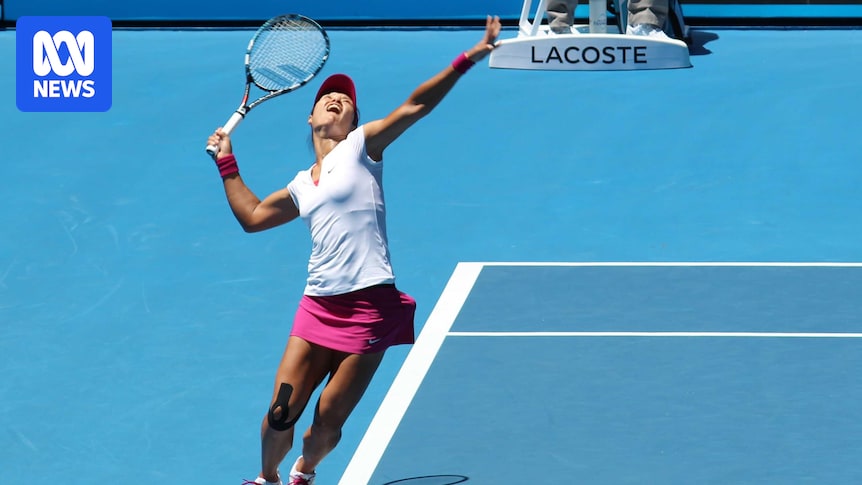
China’s thriving tennis scene has been a major boon to the country’s sense of national pride.
Around 20 million people play the sport, placing China second in the world in terms of tennis participation, behind the United States.
An Olympic gold medal for one of the sport’s rising stars, Zheng Qinwen – nicknamed “Queen Wen” – has seen a surge of patriotism.
But the sport has faced some turbulence.
Women’s tournaments only returned to China last year following a four-year boycott due to security concerns for former player Peng Shuai.
Peng temporarily disappeared from public view after posting on social media about his relationship with a senior government official then denied claims she had been sexually assaulted.
The hashtag #WhereIsPengShuai made global headlines and prompted the Women’s Tennis Association to boycott China. (Twitter)
And in recent weeks, some players have apologized for racist comments or gestures that offended Chinese fans.
In a country that traditionally favors the variety of this table sport, tennis generates hundreds of millions of dollars and becomes a source of soft diplomacy.
My apologies for the racist gestures
In the whirlwind of Asian competitions in recent weeks, some players have made headlines for the wrong reasons.
Former world number two Paula Badosa has been heavily criticized after posing for a photo with chopsticks in the corners of her eyes.
She denied that the gesture was imitating Asians, saying: “I was playing with my face and my wrinkles.”
“I love Asia…and I have a lot of Asian friends. They are the nicest.”
She later apologized: “Really sorry, I didn’t know it was offensive (or) racist. It’s my mistake. I take full responsibility.”
The Wuhan Open, which returns this year for the first time since 2019 due to the COVID-19 pandemic, has been the scene of another controversy.
Polish player Magda Linette also apologized after posting a photo of her train to Wuhan with a caption in Polish: “Viral database has been updated.”
Global tensions
Hunter Fujak, a senior lecturer in sports management at Deakin University, said although he did not know the details of these cases, the public was often quick to crucify athletes for their mistakes, which were often due to naivety rather than bad intentions.
He added that athletes are often expected to be role models, but many of them are young and have given up their education to pursue sports.
“Athletes are humans, and humans make mistakes. It turns out the magnifying glass tends to be on them,” he said.
“In a time where we are experiencing heightened geopolitical sensitivity, these hot spots can flare up and become bigger issues.“
Haozhou Pu, an associate professor of sports management at the University of Dayton, agrees that China’s recent sports pitfalls could be linked to increasingly complex geopolitics, especially when tennis is “closely tied to sports nationalism.”
“I think players need to be more aware of political risks and administrators of international competitions need to adopt more proactive strategies in response,” he said.
China’s Golden “Queen Wen”
The recent incidents spoil what would have otherwise been an exceptional year for Chinese tennis.
Much of the hype is about the charismatic Zheng Qinwen, who won the gold medal for China at the recent Olympics.
The gold medal won by Qinwen Zheng in Paris was widely celebrated in China. (Reuters: Pilar Olivares)
It was a victory she described as more meaningful than winning a Grand Slam, even though those tournaments often carry greater prestige and multimillion-dollar paychecks.
When she broke into the top 10 and became runner-up at the Australian Open earlier this year, many drew parallels between her and two-time Grand Slam winner Li Na.
“Li Na and Zheng Qinwen played a vital role in reshaping the image of female athletes in China,” said Jingying Cai, a doctoral researcher at Western Sydney University who specializes in Chinese and Australian women’s tennis players.
“They have improved China’s international image through their victories, highlighted the development of global sports and strengthened its soft power.“
Zheng Qinwen was ranked 15th on the Forbes 2023 list of highest-paid female athletes, with around $8.3 million in backing from companies including Nike, Rolex, Alipay, McDonald’s, Yili, and Gatorade, among others.
Dr Pu, of the University of Dayton, said Zheng and Li were very marketable and shared a “fierce but friendly” demeanor.
Rebels and the tennis revolution
Dr Pu pointed out that Li Na was seen as a sort of rebel who was “flying solo”, breaking away from a state sponsorship model that requires players to hand over the majority of their winnings.
Chinese player Li Na won the Australian Open in 2014. (ABC: Ning Pan)
“The ‘solo flight’ model, largely inspired by ‘free market’ ideas, has transformed the tennis development system in China and given players more autonomy in their own careers,” he said.
“Zheng took a very different path to success than Li Na. She was not part of the state system and she never tried to challenge or break away from the system like Li Na did.”
He said that for many years, Zheng’s family had been the main support of his tennis career.
In an interview with The New York Times last year, Zheng revealed the impact of being a sporting prodigy in China: At just eight years old, she lived in a different city from her parents so she could train.
She said she cried a lot and begged her parents not to leave during their fortnightly visits.
Ms Cai said Zheng represented a new generation of Chinese athletes, adding that she inspired young players and was affectionately called “the new national icon” on social media.
Chinese tennis tournaments attract global stars such as Naomi Osaka. (Reuters: Tingshu Wang)
China’s growing tennis ambitions
The rise of Chinese tennis has largely focused on the women’s game thanks to Li and Zheng, but the men’s game is also going from strength to strength.
In 2022, Chinese journalist Zhang Bendou expressed his disappointment:
“Men’s tennis in China has been a myth for many years. China can send rockets into space, among other great things, but we simply haven’t produced a single ATP top 100 player,” he said, referring to the men’s tour.
China’s Zhang Zhizhen is currently ranked in the top 50. (Reuters: Tingshu Wang)
Zhang Zhizhen was the first to reach this milestone, in October 2022, and is now one of three Chinese men in the top 100. He also won an Olympic silver medal in mixed doubles with compatriot Wang Xinyu.
In an interview with state media Xinhua this week, the director of the Chinese Tennis Administrative Center, Bai Xilin, launched a “Double 10, Double 100” strategy that aims to have 10 players of each gender in the top 100.
Bai told Xinhua: “Since reform and opening up, as people’s conditions improve, their horizons have broadened.”
Ms Cai highlighted that China is investing in tennis infrastructure and that the Chinese tennis market has seen significant growth in recent years, from $950 million in 2019 to $1.2 billion in 2023 – a figure that is expected to increase further this year.
“This growth can be largely attributed to ongoing economic development, accelerated urbanization and the rise of the middle class, which provide a solid foundation for the expansion of the tennis market,” she said.
Belarusian Aryna Sabalenka beat China’s Qinwen Zheng to win the Wuhan Open. ( Reuters: Florence Lo)
She added that Zheng’s success not only attracted younger fans and made the sport more “popular and fashionable”, but also played a role in sports diplomacy, projecting China’s confidence and competitiveness onto the world stage in areas where the country had not historically dominated.
Ms Cai said the “love of tennis” could help unite people, despite “cultural misunderstandings”.
“In my research, I have found that sports diplomacy increases cultural understanding, thereby reducing racism and fostering a positive sports environment,” she said.
Dr Pu said the “frenzy” surrounding Zheng Qinwen today reminded him of the enthusiasm surrounding Li Na many years ago.
“But it took China almost a decade to produce the next Li Na,”
he said.
“It would be interesting to see if this windfall can be reflected in the lasting success of elite Chinese tennis players on the court.”
