

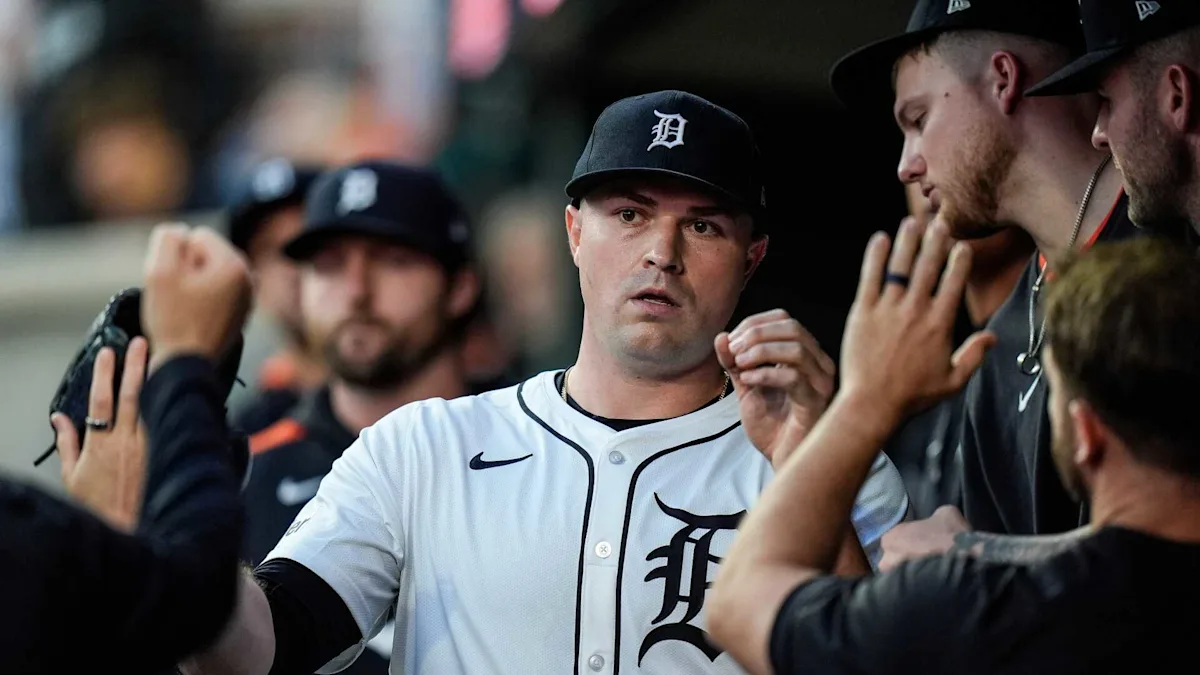
NEW YORK — Two-time AL Cy Young Award winner Tarik Skubal requested a record $32 million in salary arbitration, while the Detroit Tigers offered the left-hander $19 million.
Skubal was the highest-profile of 166 players eligible for arbitration at the start of the day and was among 18 who exchanged numbers with their teams. Those who disagree will be heard before three-person panels from January 26 to February 13 in Scottsdale, Arizona.
Advertisement
Toronto first baseman Vladimir Guerrero Jr. has the highest salary in an arbitration case decided by a panel, earning $19.9 million in 2024. Colorado third baseman Nolan Arenado submitted a record $30 million ask in 2019, then agreed to an eight-year, $260 million contract.
Juan Soto’s $31 million contract with the New York Yankees in 2024 is the largest one-year deal for an arbitration-eligible player. David Price has the highest negotiated salary in a one-year contract for an arbitration-eligible pitcher, a $19.75 million deal with Detroit in 2015.
A two-time All-Star, Skubal, 29, will be eligible for free agency after the World Series. He is 54-37 with a 3.08 ERA in six major league seasons.
Skubal was 13-6 with an AL-best 2.21 ERA in 31 starts last year, striking out 241 and walking 33 in 195 1/3 innings while earning $10.5 million. His 0.891 WHIP led qualified pitchers.
Advertisement
Catcher William Contreras traded with Milwaukee, asking $9.9 million while the Brewers offered $8.55 million.
Washington right-hander Cade Cavalli has the smallest gap: $900,000 versus $825,000.
Among the 148 completed deals were Seattle outfielder Randy Arozarena ($15.65 million), Cincinnati right-hander Brady Singer ($12.75 million), Baltimore outfielder Taylor Ward ($12,175,000), Philadelphia left-hander Jesús Luzardo ($11 million), Seattle right-hander Logan Gilbert ($10,927,000) and outfielder Toronto Daulton Varsho. ($10.75 million) and New York Yankees infielder Jazz Chisholm Jr. and Philadelphia third baseman Alec Bohm (both $10.2 million).
The teams went 5-4 in hearings last winter, leaving the clubs with a 358-270 advantage since arbitration began in 1974.
All deals for players eligible for arbitration are guaranteed, but deals subject to panel decisions are not.
