

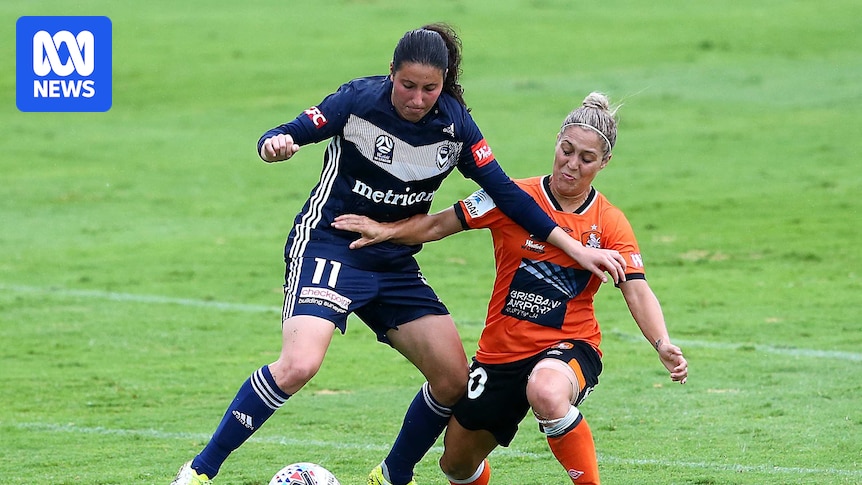
With an average W-League salary of just over $16,000 per season, it’s understandable why Mindy Barbieri didn’t have the necessary insurance to cover her at a Young Matildas camp last month.
Key points:
- Soccer player Mindy Barbieri couldn’t afford private health insurance before elite training camp
- A subsequent knee injury is expected to cost him thousands of dollars in medical bills.
- A public fundraising campaign was launched before the FFA stepped in to cover its bills.
The 19-year-old, who just won last season’s Premiers’ Plate with Melbourne Victory, has moved to Sydney and made many sacrifices in a bid to make her case for Australia’s national program.
But things didn’t go as planned. Barbieri ruptured his ACL during camp and required $10,000 surgery.
Barbieri was only partially covered by the Football Federation Australia’s (FFA) insurance policy, as she had missed a payout from her own private insurance fund.
“I was unable to continue paying my health insurance for financial reasons,” Barbieri said in a statement.
Mindy Barbieri (left) has long been touted as a rising star in Australian women’s football. (Provided)
Professional Football Association (PFA) CEO John Didulica says this is an unfortunate situation, particularly for a player injured while on duty with the Australian national team.
“It reinforces how perfectly balanced the lives of female footballers pursuing an elite career are and the support they need to stay in the sport,” Mr Didulica said.
The FFA has since intervened and announced that it will cover Barbieri’s medical costs.
However, it wasn’t until a GoFundMe page began circulating on social media, supported by top coaches and players.
Barbieri said she would fully refund everyone who promised to donate.
“I want to thank everyone for the donations and in supporting this, I truly appreciate from the bottom of my heart the support from each and every one of you,” she said.
How can this happen?
Former Matildas goalkeeper Melissa Barbieri (who is not related to Mindy) said every player should make sure they are fully insured.
“It’s in everyone’s best interest,” she said.
“I think under the requirements as an elite athlete you have to have private health insurance.”
Mindy Barbieri (left) and Melissa Barbieri played alongside each other at Melbourne Victory. (Provided)
Melissa Barbieri said Mindy wasn’t the first professional woman she’d met who was forced to go into the field without being fully insured.
“I remember a teammate did her collarbone and the same thing happened, she didn’t have insurance and she couldn’t get the surgery,” the veteran Australian goalkeeper said.
“She just ended up trying to come back without it and now she has a giant bulge in her collarbone, but she managed to keep going.“
Young Mathilde poorly covered
Sportscover Australia CEO Simon Allatson said it was no surprise that one of Australia’s fast-rising women’s footballers had chosen not to take out private health insurance because she couldn’t afford it.
“The cost of private health cover would be a legitimate consideration for them,” Mr Allatson said.
“If you’re a professional footballer playing in the European leagues, private health cover probably won’t be a big problem financially.
“It is difficult to know how many professional athletes in different sports would benefit from private health insurance.”
Simon Allatson said the gender pay gap could be a reason why female athletes do not take out private insurance. (Provided)
Allatson, who has worked in the insurance industry throughout his career, said Australia’s major sporting leagues often take private insurance cover into the playing contract rather than leaving it up to the player to decide.
“Sports like the AFL and NRL have ensured their players have private health insurance coverage,” he said.
It is also a common practice in other professional leagues in the United States and Europe.
“When you consider the value of athletes running on the basketball court or in the NFL, franchises make sure they have adequate health coverage for their athletes,” Mr. Allatson said.
“We’re talking about billion-dollar companies. Private health coverage would be mandatory.”
