

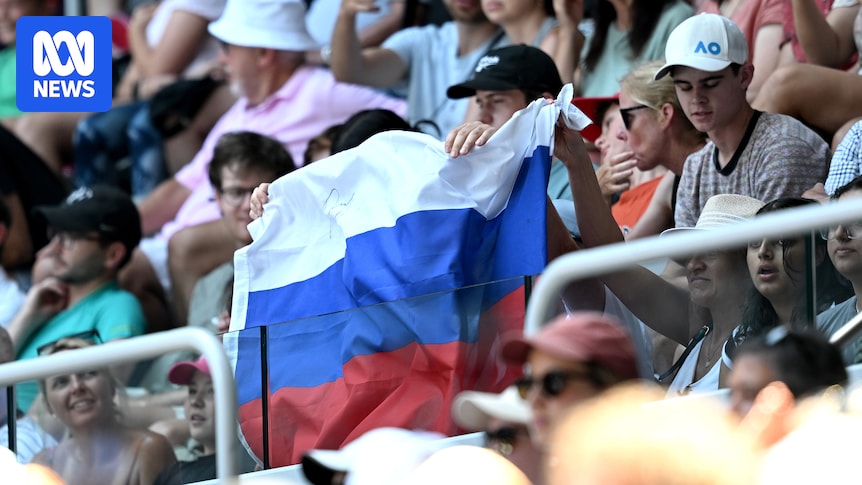
The presence of a Russian flag in the stands of the Australian Open prompted organizers to ban them from Melbourne Park.
Key points:
- The flag was visible behind fans on court 14 during a match between Ukrainian Kateryna Baindl and Russian Kamilla Rakhimova.
- Tennis Australia said fans were initially allowed to bring the flags if they did not cause disruption.
- Russian and Belarusian players have been playing under no flag in many sports since the invasion of Ukraine last February.
The red, white and blue stripes of the Russian flag were visible in the crowd during the first round match between Kateryna Baindl and Kamilla Rakhimova on the first day of the major tennis tournament.
Tennis Australia (TA) said the display during the Baindl-Rakhimova match prompted a change in its policy at the tournament.
“The flags of Russia and Belarus are prohibited on site at the Australian Open,” TA said in a statement.
“Our initial policy was that supporters could bring them but could not use them to cause disruption. Yesterday we had an incident where a flag was placed on the pitch.
“The ban takes effect immediately.
“We will continue to work with players and our fans to ensure the best possible environment to enjoy tennis.”
Ukraine’s Baindl beat Russia’s Rakhimova 7-5, 6-7 (8/10), 6-1 on court 14, where spectators saw a Russian flag hanging from a fence during the match.
The same day the ban was announced, a Russian flag was waved by supporters in the stands of the John Cain Arena during the match between Russian Andrey Rublev and Austrian Dominic Thiem.
This match started before the ban and ended after it was announced.
Belarusian fifth seed Aryna Sabalenka said she respected TA’s decision.
“If everyone feels better that way, then it’s no big deal,” she said.
“I have no control over that. What can I say? They did it, okay? No flags, no flags.”
Opponents Russia and Belarus have been unable to play under their countries’ flags in a number of sports, including tennis, since the invasion of Ukraine began in February last year.
Russian Andrey Rublev’s match against Dominic Thiem took place for the first time at the John Cain Arena on the second day. (PAA: Lukas Coch)
Ukrainian Ambassador Vasyl Myroshnychenko said the Russian flag is a symbol of “all the atrocities that Ukrainians have to endure.”
“It was a very emotional moment for the tennis player, but for everyone who saw it, we learned that these Russians were not only displaying the flag, but they were also making fun of the Ukrainian player,” he said.
Myroshnychenko said he welcomed the decision to ban the Russian and Belarusian flags from Melbourne Park.
“It’s always good to learn from your mistakes and try to fix them…I think it’s important that they enforce it because it’s a big distraction as well as a traumatic experience,” he said.
“They could have avoided this from the start if they had banned Russian participation from the start, but they didn’t. We’re unfortunately going to see more of this throughout the competition.”
He said he would like to see the ban extended to Russian symbols in any form.
“To say that sport is beyond politics is simply not true, and everyone knows that,” Mr. Myroshnychenko said.
One of the supporters who carried the flag, a Russian-Australian named Eugene, defended his right to support the country of his birth.
“We always go to the Australian Open to support the Russian players. There was absolutely no intention to provoke anyone,” Eugene told ABC Radio Melbourne.
“We certainly didn’t heckle the Ukrainian player, not even once, we applauded him and were loud every time Kamilla won a point, but there was no provocation or incident.
“There were no heated exchanges of words at any time yesterday.”
Eugene, who emigrated to Australia aged five, called the flag ban discriminatory against Russian fans.
Russian-Australian Eugene carried the Russian flag in the first round match. (ABC News: Simon Tucci)
“We are not supporters of the war, we are not really supporters of Putin, we are supporters of the Russian players. We certainly didn’t have any political messages either,” Eugene said.
“It’s very anti-Australian, it screams intolerance, discrimination, racism. How can we ban the flag of a country?
“It’s not Australian because we don’t practice racism, we’re not a racist country, we believe in giving people a fair chance and what Tennis Australia is doing at the moment is basically discriminating against Russian and Belarusian players.”
Players from Russia and Belarus have been banned from playing at Wimbledon in 2022, leading to that tournament being stripped of its ranking points by tennis governing bodies.
Former Australian Ambassador to Ukraine Doug Trappett – who held the role from 2015 to 2016 – said the Australian Open and Tennis Australia should have done the same, drawing attention to a missile attack on the Ukrainian city of Dnipro which left dozens dead.
Meanwhile, Ukraine’s second-ranked tennis player, Marta Kostyuk, said she would not shake hands with her Russian and Belarusian rivals who she said had not done enough to speak out against the invasion.
The 20-year-old Kyiv native made headlines last year when she refused the customary handshake at the net with former world number one Victoria Azarenka after the Belarusian beat her at the US Open.
Belarus has been used as a key staging ground for Russia’s war in Ukraine and the two countries are set to engage in a joint military exercise.
Marta Kostyuk (right) refused to shake hands with Belarusian Victoria Azarenka at last year’s US Open. (Getty: Sarah Stier)
After winning her first match at the Australian Open on Monday – upsetting 28th-seeded American Amanda Anisimova – Kostyuk said she would snub handshakes with any Russian or Belarusian opponent who did not openly condemn the invasion.
“I haven’t changed from the war and everything that happens on tour,” she said.
“Because people who just say they don’t want war, it gives the impression that we (Ukraine) want war.
“Obviously, we don’t want war either.”
Kostyuk – whose family is still in the Ukrainian capital kyiv – said it was not “humane” to remain silent on the issue.
“I don’t really talk to anyone,” she said of the Russian and Belarusian players.
“I barely say ‘hi’ to them.”
ABC/Reuters
