

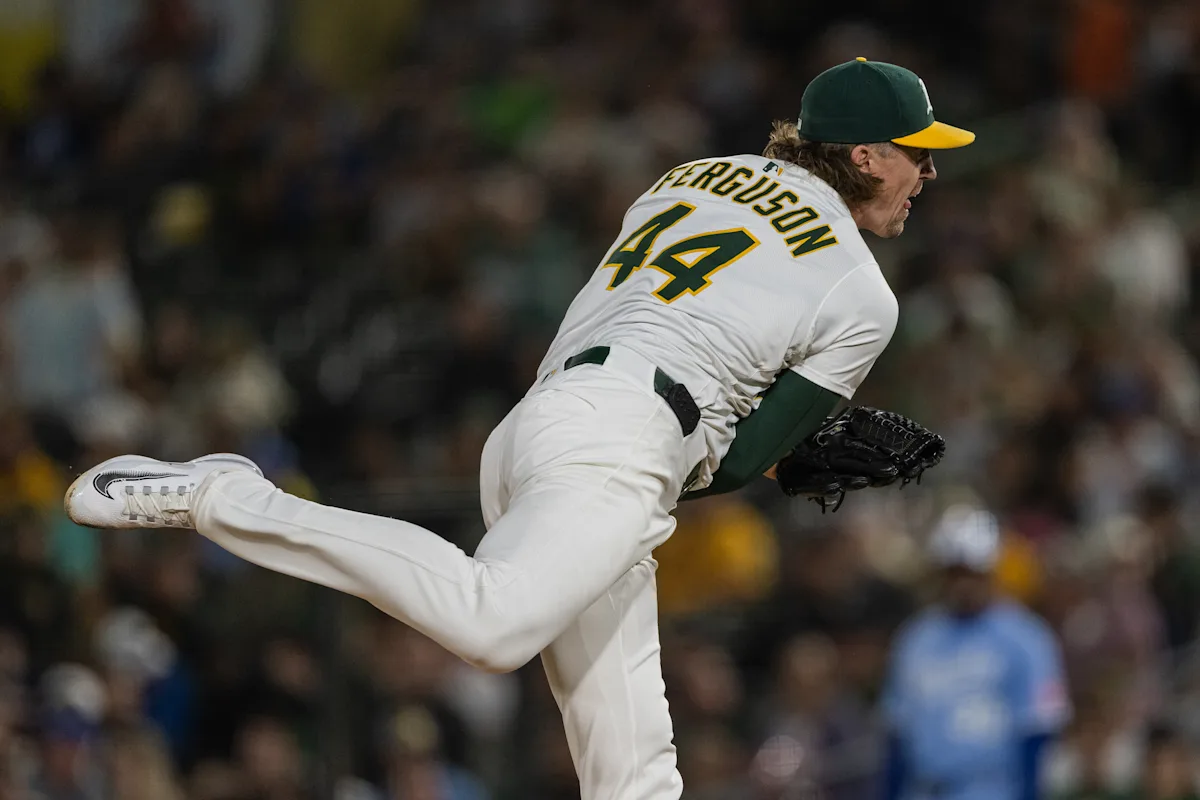

SACRAMENTO, CALIFORNIA – SEPTEMBER 27: Tyler Ferguson #44 of the Athletics fields in the top of the eighth inning against the Kansas City Royals at Sutter Health Park on September 27, 2025 in Sacramento, California. (Photo by Justine Willard/Athletics/Getty Images) | Getty Images
It’s well known that relievers are a fickle group. From year to year, you usually don’t really know what to expect, as mediocre relievers suddenly blossom and have career years and the guys you thought you could count on inexplicably struggle.
Sometimes this volatility doesn’t just appear from one season to the next. Relievers often have great months followed by terrible months, even if their speed and arsenal remain unchanged. Case in point, Justin Sterner, April 2025: 14.2 IP, 0 ER. May 2025: 11.2 IP, 9 ER. September 2025: 12 IP, 1 ER.
This makes it especially difficult to build a bullpen for an upcoming season, not knowing who will regress or flourish for no apparent reason, and who will pitch with at least some consistency from month to month versus who will ride the proverbial roller coaster.
Why are relievers so prone to this extreme variance? Some possible answers:
They are not
Maybe relievers aren’t much more volatile from season to season and month to month than other players. Cody Bellinger is a good example of a position player who went from spectacular to spectacularly awful without warning. In 2025, Cam Smith went from a 116 wRC+ in the first half to a 41 wRC+ in the 2nd half. Is the story that relief is unstable a matter of “perception” rather than reality?
Small samples produce large variance
Relievers don’t end up racking up big inning totals and any time you look at samples of 50 innings instead of 150 innings or 500 plate appearances, you’ll see more variance. This is especially true as you zoom in: the samples cited above for Sterner all last between 11.2 and 14.2 innings each.
Perhaps the difference between a good season and an average season, at least statistically, comes down to 2-3 Gascan appearances totaling 3 IP and 8 ER, which inflates the numbers over a 50 inning sample. A starting pitcher with a 1 in 30 start in which he only lasts 3 innings and serves 8 ER still has a chance to post excellent overall numbers.
It’s a demographic question, stupid
Hey, no insults on AN please. OK, I guess it’s okay to insult yourself. Don’t do it again, asshole$$. Regardless, another theory is that whoever becomes a reliever isn’t a random group of pitchers. These are pitchers who have failed to become a starting pitcher and lack the necessary pieces to thrive multiple times through a batting order.
This might mean relying on 2 throws, in which case, every time a throw doesn’t work, you have a “one throw thrower” on your hands. Or it could mean not being good enough to make the “best 5” – including the failing of not being consistent enough from one outing to the next, or from one round to the next.
Perhaps what landed a reliever in the bullpen is precisely what makes him more prone to volatility: He has the strengths to pitch in the big leagues, but just enough flaws to require a spot in the bullpen rather than the rotation.
There are 3 possibilities, some or all of which may be right or wrong. This is where you come in (to type a minimum of 3 words, new rules) and determine if any of them are correct or what other factors might be at play. And if you’ve really figured it out, share it with the A’s, because I can assure you that no one in MLB has all the answers – otherwise relievers would be a lot more consistent and bullpens would be a lot easier to put together.
