

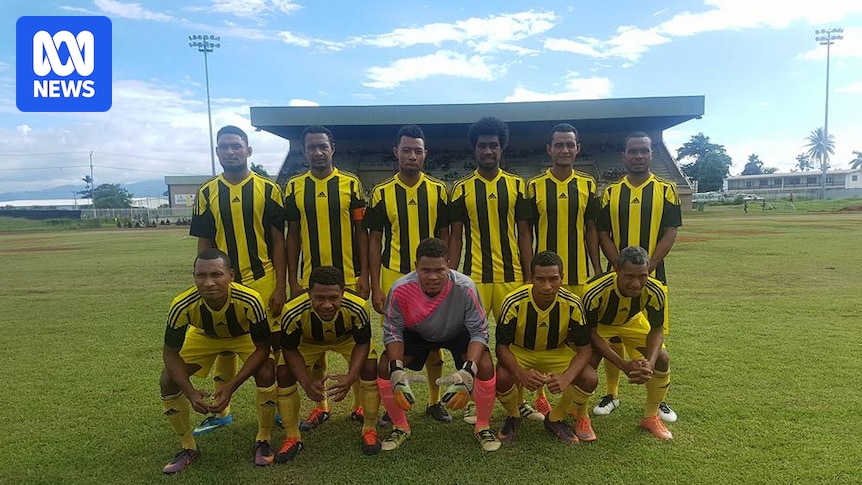
Sports fans in Papua New Guinea are used to political battles: the national rugby league has been riddled with conflict over the years, the fight for control of the PNG Rugby Union is unresolved, as is the battle over who will run the national football competition.
This year again there will be two national football leagues in PNG, but again this will be the one with the fewest teams with official FIFA support.
Key points:
- PNG Football Association blames rugby league’s dominance for its woes
- Former PNG goalkeeper backs National Premier League model
- NSL says there is no real pathway for NPL players
Rival factions in PNG football have been at war for more than 18 months, but while the officially sanctioned National Soccer League (NSL) kicked off the 2018 season with just seven clubs, the National Premier League (NPL), which started with 12 clubs, plans to add even more when its new season begins later this year.
Although the NPL appears to have stolen the limelight, PNG Football Federation (PNG FA) chief executive Dimirit Mileng blames the NSL’s struggles on rugby league’s dominance.
“The breakaway is not a problem for us, I can assure you,” Mileng said.
“We have our football running and we are doing everything that guides us in the statutes of the football association. The breakaway league is just a social activity.”
But such comments only provoke laughter from NPL founder John Kapi Natto, who says the PNG FA needs to get its own house in order.
“It makes me happy when I hear people say that the National Premier League doesn’t have quality, it’s just media propaganda,”
» said Kapi Natto.
“We talk about the other league as the National Football League, and yet they did not conclude their finals and they violated the statutes by sending teams to the Oceania Champions League.”
While it is no surprise that Kapi Natto is defending his own competition, he has support from others involved, such as former PNG goalkeeper David Aua.
NPL is the right model: former PNG goalkeeper
As coach, Aua took the Papaka village team in the Central Province to the inaugural NPL grand final, before falling to PNG’s most successful club, Hekari United.
“It’s a testament to the tournament,” Aua said.
“Building a team of village boys, training them and getting them to a level where they faced Hekari, and after almost beating them home and away, that’s a testimony in itself, the standard was very high.”
Officials including John Kapi Natto (far right) launched the Papua New Guinea National Premier League last year. (Provided: EMTV)
According to Aua, the NPL model is the one to follow as it expands across the country, with plans for two new conferences in the Highlands and the Niugini Islands.
It was a plan Natto presented to Deputy Sports Minister Wesley Raminai and he said the minister was ready to follow it as he sought to bring together rival factions.
Nowhere to go on the NPL path, says NSL
Against this backdrop, Aua believes it is time for players and officials involved in the separatist competition to stand up in the interest of restoring harmony, and even though he is in the rival camp, Mileng said he can see some merit in what the NPL is doing.
“We have no problem with what they are doing,” Mileng said.
“Going out and getting people to play football is good.
“But their players will eventually realize that they can’t go anywhere on this path, and they will then have to come back and join our national association.“
And therein lies the impasse: how to get Natto and his rival within the PNG FA, President David Chung, on the same page.
Kapi Natto hopes Mr Raminai can play a mediating role, but this tactic is fraught with danger because FIFA, the world governing body, does not tolerate any suggestion of political interference in national associations.
Many people also question the fact that Chung is playing the role of judge and jury on who should run football in PNG, an issue that CEO Chung clearly does not want to address, at least in public.
As president of the PNG FA and regional confederation, OFC, and a senior FIFA official, many observers say there is a clear conflict of interest.
But Mileng would not comment on the suggestion, saying only that his job was to ensure that the football association operates year after year in accordance with the constitution which is in place for the benefit of all football players.
“And if anyone feels dissatisfied with what’s happening, they need to get involved to change things,” Mileng said.
But that’s exactly where the dispute began when Kapi Natto attempted to take on Chung as FA president in 2016, only to be controversially excluded from the election.
The founder of the NPL claimed then that he had the support of the majority, and he believes that this is still the case today.
“Ninety percent of the country follows me, the government follows me, the provincial governments follow me,” Kapi Natto said.
“They see that my program extends into rural areas, so they support me in what I do.
“So I’m going to continue with that vision.”
