

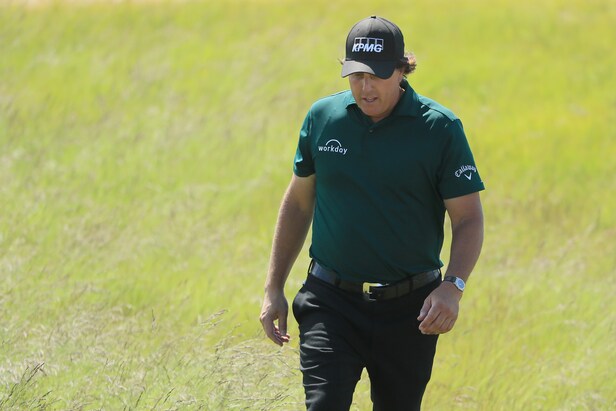
CROMWELL, Conn. – Another week, another tournament, even if golf isn’t quite ready to move forward.
Three days after Phil Mickelson chased a missed putt and returned the ball to the hole to keep it from rolling off the 13th green at Shinnecock Hills in the third round of the U.S. Open — a moment he would eventually admit to a few in the media as not his best — his actions and words remain a hot topic. This was included in this week’s Travelers Championship lineup.
“He should have been disqualified,” insisted a former major champion. “Why don’t these governing bodies just enforce the damn rules? It was like Tiger (at the Masters) in 2013. It was tough, but this one, Phil knew what he was doing and was telling everyone what he was doing, which was worse. It’s like robbing a place, coming out and telling the cops ‘I did it,’ and the cops are like, ‘It’s okay, it’s just you.'”
While the dozen players informally surveyed by Golf Digest all agreed that another lesser player would have been disqualified for committing the same infraction, the vote was much more split on whether Mickelson should have been.
Under the letter of the law, his two-stroke penalty was appropriate, according to the USGA. Rule 14-5, which says a player must not make a stroke while a ball is in motion, was applied because that is what happened. But other rules raise other questions. The intention and spirit of the game were also discussed.
Rule 14-5 does not expressly authorize what Mickelson did nor expressly prohibit what he did. Then there is Rule 33-7, which allows the committee to disqualify a player if it believes a serious infraction has been committed, but also not to do so in extenuating circumstances.
“He hit a moving ball and tried to use the rules to his advantage,” said Brandt Snedeker, who was among those who thought Mickelson should not have been disqualified. “The USGA had an opportunity to disqualify him for being egregious, but they didn’t, so no. The rules screw us up so many times, so it gives him more power to use them.”
Bryson DeChambeau took a similar stance, even though he could see the gray in the situation.
“Personally, I think he followed the rules,” he said. “Now his intentions are absolutely (he should have been disqualified) but he was playing within the rules.
“That’s where in times like this, the USGA sees a flaw and makes a correction. I don’t think it’s a bad thing. I think it’s a great learning experience for everyone and will benefit the game in the end.”
It’s also a conversation that doesn’t seem to end, at least for now.
In the eyes of some, it was as much about Mickelson as it was about the USGA and another dubious championship.
“It speaks to the frustration of guys who find themselves playing in setups like that,” said another former major winner. “Driving a guy like Phil, who is incapable of getting angry, that was the first sign that something was wrong on the course. We all go crazy and have our breaking points. The USGA found Phil’s breaking point. What he did was stupid but understandable. I’m not justifying it but it’s understandable.
“The mistake was his response. It was ridiculous. But I don’t think you can get a disqualification for that. He didn’t get an advantage. He was a kid throwing the toys out of the cart and saying it was over.”
Although the tournament is over, the conversation about what happened, both with Mickelson and at Shinnecock Hills, doesn’t appear to be going away anytime soon.
“Instead of talking about Brooks Koepka winning the US Open, we’re still talking about this,” one player said. “And it’s a shame.”
