

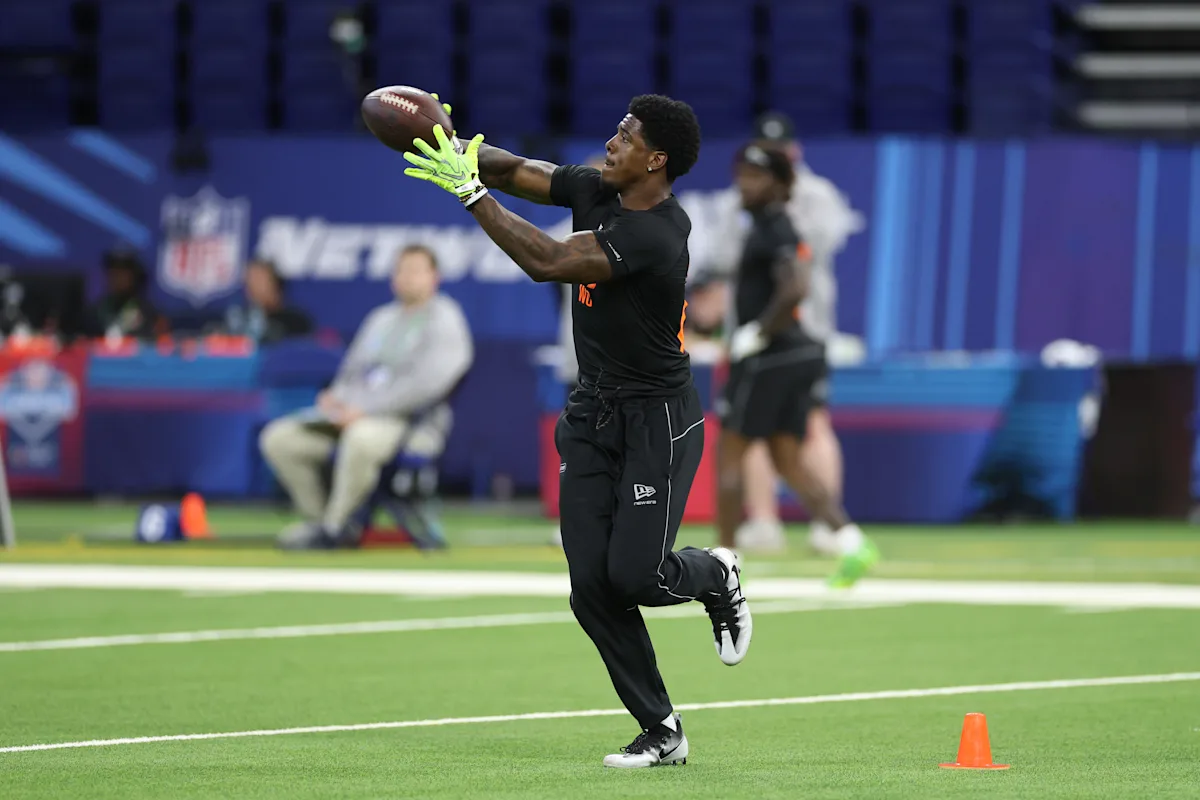
The NFL Scouting Combine is officially in the books.
Yes, Pro Days are always early. Yes, private training and medical checks will be important. But let’s not kid ourselves: Indianapolis is where narratives are created, confirmed or broken. This is where Day 3 players suddenly enter Day 2 conversations. This is where fringe first-round prospects solidify their top-20 status. And this is where some highly regarded names are quietly losing momentum.
Advertisement
From the Seattle Seahawks’ perspective, it was also interesting to note that formal meetings involving Seattle were fewer than usual and that John Schneider was back in Seattle before on-field drills even began – something we don’t remember happening recently. No criticism. Just the context.
Now let’s move on to the names that helped – and hurt – each other the most.
NFL Combine Winners
Brenen Thompson – WR, Mississippi State
Thompson arrived in Indianapolis viewed primarily as a situational vertical threat. He walked away as one of the biggest financial winners of the week.
At 5’9″, 164 pounds, he ran a 4.26 in the 40-yard dash, with a 1.54 10-yard dash. That’s elite acceleration and long speed – not just fast, but fast.
Advertisement
In 2025, he started 11 games, had around 900 receiving yards and 7 touchdowns, averaging over 16 yards per catch. At Mississippi State, he lined up primarily as a Z receiver and vertical slot weapon, running go routes, posts and deep overs. NOW? He’s firmly in the conversation as a legitimate Day 2 vertical specialist.
Germie Bernard – WR, Alabama
Bernard entered the week as a solid receiver prospect. It left him consolidated as one of the best players in this position.
At 6’1″, 206 pounds, he ran 4.48 – more than adequate for his size – and posted elite agility numbers, including a 4.31 shuttle and a 6.71 three-cone. Add in a 32.5″ vertical jump and a 10’5″ broad jump, and you have a well-rounded athletic profile.
Advertisement
He cleared 1,000 receiving yards in 2025 with 8 touchdowns at Alabama, functioning as a true star target capable of winning after the catch and in contested situations. The Combine didn’t create its stock, it solidified it.
Jeff Caldwell – WR, Cincinnati
Caldwell could have made millions.
At 6’5″, 216 pounds, he ran 4.31 with a 1.48 split. Then he exploded for a 42″ vertical jump and an 11’2″ broad jump. This size-speed-explosion combination is rare – period.
He passed for around 1,100 yards and 9 touchdowns in 2025 as a full-time X receiver in Cincinnati, thriving despite press coverage and in contested catching situations. Before Indy, he was under the radar nationally. After Indy? He’s on boards everywhere.
Dillon Thieneman – South, Oregon
There was a time when some Seahawks fans dreamed of landing Thieneman via trade at pick No. 32. That dream may be over.
Advertisement
At 6’0″, 201 pounds, he ran 4.35, jumped 41″ vertical and 10’5″ broad. His positioning drills were fluid, controlled and explosive.
He has likely established himself as the Safety 2 in the class and a legitimate first-round candidate.
Tacario Davis – CB, Washington
At approximately 6’4″, 194 pounds, Davis has rare length for the position. He ran in the 4.41 range and posted a 37″ vertical with a 10’3″ width.
Previously projected as a potential first-rounder earlier in his career, his stock cooled during the season. But the Combine reminded teams why these features are worth betting on. His coverage drills showed better fluidity than expected for a high corner.
Advertisement
Day two seems a lot safer now.
Defensive Line Risers
Gracen Halton from Oklahoma measured at 6’3″, 293 pounds and erased “undersized” concerns. He ran 4.82, jumped 36.5″ (third best by a defensive tackle in the last 20 years) and displayed elite agility for the position. Its testing could push it into a similar zone once occupied by interior explosive disruptors.
Clemson’s DeMonte Capehart (6’5″, 313, almost 34″ arm), he is an NFL-ready run-rusher and has shown potential to develop as a passer with a 4.85 40 and solid splits. His projection as a high-ceiling defensive tackle is on the rise.
Advertisement
Dani Dennis Sutton from Penn State At nearly 6’6″, 265 pounds, he ran 4.63 with explosive jump shots. Already productive with around 10 sacks in 2025, he has confirmed elite NFL traits but needs refinement.
NFL Combine Losers
Cashius Howell – EDGE – Texas A&M
Howell’s arm length was historically short at 30 1/4″. Although he had speed, the measurement significantly hurt his projection, especially when compared to other undersized edges that offer compensatory characteristics.
Malachi Fields – WR, Notre Dame
After a strong Senior Bowl, Fields needed a strong athletic performance. Instead, he ran a disappointing 40 and struggled with falls in the gauntlet drill. For a receiver who wins with physicality and timing, concerns about stiffness and separation have resurfaced.
Emmett Johnson – running back, Nebraska
His 4.56 40 was the slowest among running backs in the event. While his tape doesn’t scream “slow,” the lack of elite explosion numbers has raised questions about his ceiling.
LT Overton – EDGE, Alabama
A 4.87 40 score and average split were tough blows for a player who needed to prove his explosiveness from the first step. Its positional identity: Edge? Interior? Hybrid? – now becomes even more critical.
Lee Hunter – DT, Texas Tech
Hunter posted one of the lowest explosion profiles among defensive tackles, including a 21.5-inch vertical and an 8’4-inch wide. Strong against the stripe run, but the lack of bursting out of the backfield limits his disruptive projection.
Final Thoughts
The mix does not finalize the draft boards, but it completely reshapes the levels.
Advertisement
Some prospects confirmed what the tape already suggested. Others have forced teams to reevaluate caps and roles. For teams like the Seattle Seahawks, who historically value athletic thresholds and explosive traits, Indianapolis matters.
Now we wait for Pro Days, medical clarity and – eventually – draft night.
But make no mistake: many careers have changed in Indianapolis.
