

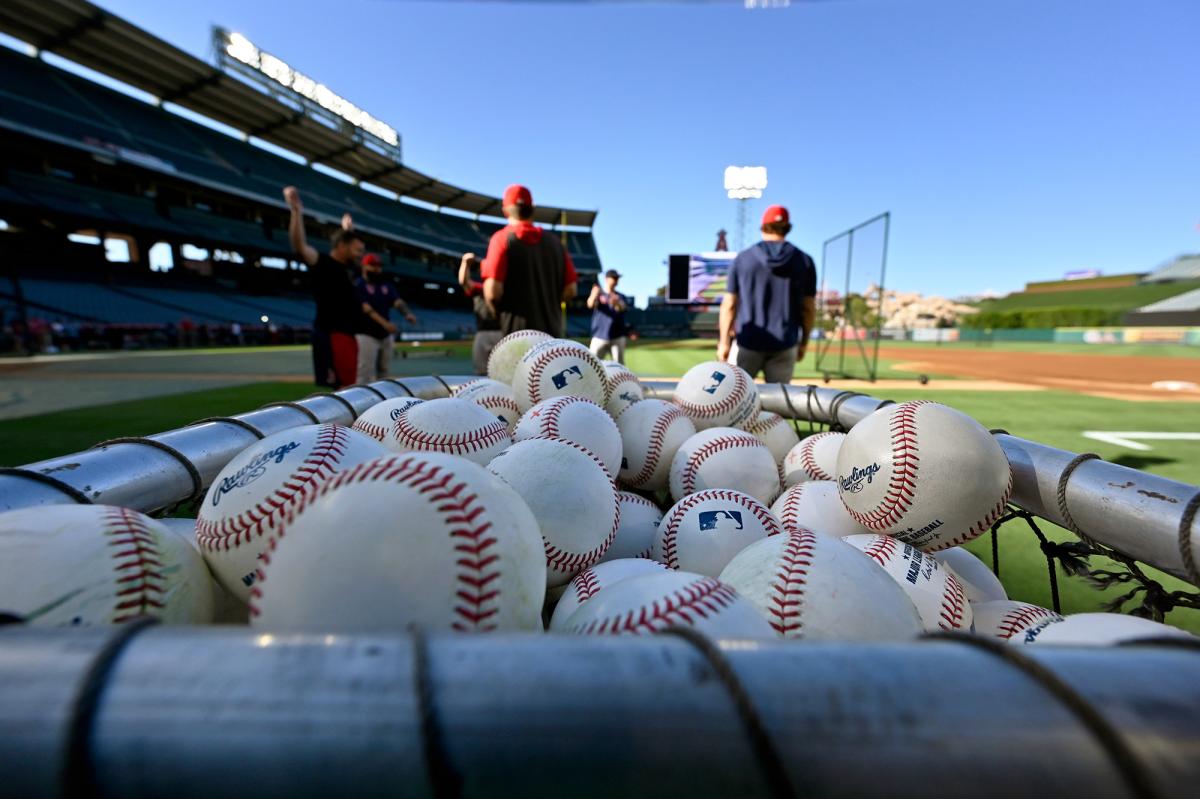
“I’d like to think I speak for 99 percent of us…If I have to continue to invoke terminologies like ‘drag,’ ‘pill,’ and ‘tacky’ when covering baseball, I might turn to a more compelling topic like stick figure art.”
— Ken Davidoff, New York Post, July 9, 2019
SAN DIEGO — Ladies and gentlemen, Major League Baseball has taken over. Should we plan a trip to the nearest stick figure art exhibit?
The talk of baseballs – whether they are squeezed, dejuiced or manipulated in any way – is here to stay. Major League Baseball held a news conference Wednesday, here at the Winter Meetings, to discuss the findings of the independent study it commissioned to understand why balls left the field at a record rate in 2019. The findings, recommendations and resolutions depressed those of us who enjoy this subject as much as we enjoy a long conversation about the history of orthodontics.
Last season’s 6,776 homers, which shattered the previous mark of 6,105 set in 2017 and sparked a flurry of complaints from players, team employees and fans, resulted from less drag on baseballs and increased player focus on launch angles, according to the report from four professors with doctorates ranging from mathematics to physics to engineering.
“Approximately 60% of the increase in home run is due to an increase in carry and 40% is due to a change in pitching conditions,” the authors wrote, citing laboratory work and a study of Statcast data. According to studies, approximately 35% of this increase in carry is the result of raised seams on balls.
While agreeing with the assertion that playoff balls carried more drag, resulting in fewer home runs, the authors provided no explanation behind this and concluded: “No evidence was found that the changes in baseball performance were due to anything intentional on the part of Rawlings or MLB and were likely due to manufacturing variability.” »
In that case (and at this point I don’t even care if MLB pressed the balls or not), let’s fix that manufacturing variability, shall we? Kill that headache where it hurts, in that 60 percent. Even if it means giving up the romantic notion of hand-sewn baseballs, each as unique as a snowflake, and manufacturing the balls synthetically for more consistency and less noise.
Alas, that won’t happen any time soon.
“I think one of the things we’re going to have to do as we continue this journey of discovery is accept the fact that baseball is going to vary and baseball performance is going to vary, and we’re going to do everything we can to control that, but it’s kind of fundamental to the equipment choice that we made,” said Morgan Sword, MLB’s senior vice president of league economics and operations.
“Journey of Discovery” proved an apt description of how MLB views this baseball problem. The authors offered four suggestions: 1) Better tracking of bullet manufacturing and shipping dates; 2) The installation of atmospheric monitoring systems at field level for the 30 stadiums; 3) A codification of current procedures used to monitor bullet drag; 4) An expansion of the monitoring of other properties of baseballs, in particular their coefficient of restitution, or even their rebound. However, they all fall into the category of “more research” rather than concrete changes.
“I think baseball’s variability is a product of it being a man-made product with natural materials,” MLB Commissioner Rob Manfred said. “I think that’s part of the charm of the game, and the reason I’m willing to live with that variability is that both teams are playing the same baseball.”
This just means that both teams can complain, wasting time and energy on more important and interesting matters.
The authors, who came from all over the country on MLB’s expense, seemed absolutely thrilled to participate in this study and discussion. More than happy to continue my studies.
Yet no fun comes from a serious quality control problem. The charm of a man-made product with natural materials is diminished by the scrutiny carried out by Statcast and scrutinized by social media.
So get ready for more science talk and conspiracy theories as well as your home run studies in 2020, baseball fans. It is, to use the language of the moment, a real obstacle.
