

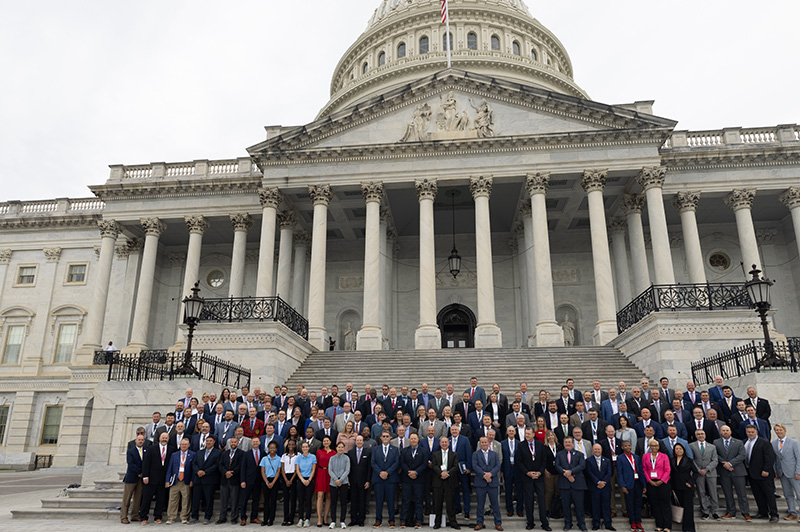
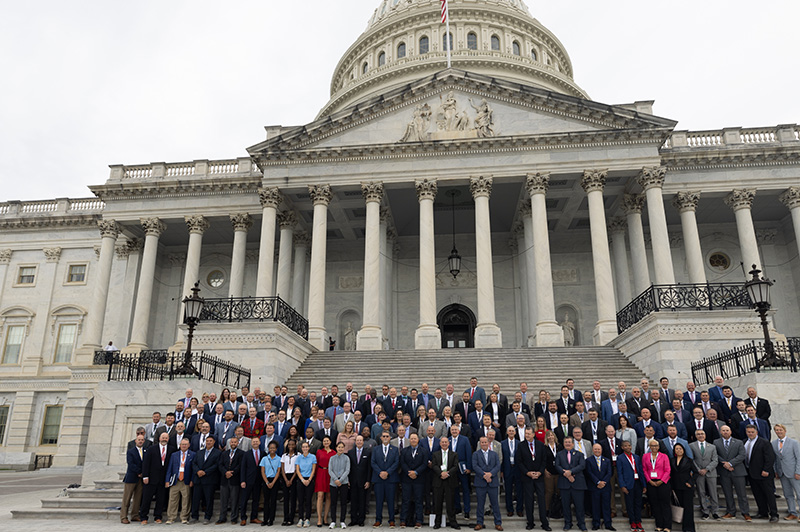
Participants in National Golf Day 2024 gathered on the steps of the U.S. Capitol ahead of legislative visits. Photo by Scott Ramsay
Editor’s Note: National Golf Day will take place April 30 – May 2, 2025. GCM is covering the GCSAA’s involvement in the event with stories throughout the week. To follow our complete coverage, Click here.
As the golf industry heads to Washington, D.C., for National Golf Day, it’s important to remember that not all laws take place in the nation’s capital. Spring is also a busy time for state legislatures across the country, which year after year consider bills that could impact how golf courses are managed.
According to the National Conference of State Legislatures, there are a total of 7,575 elected officials serving as members of the State House of Representatives and Senate, each of whom has the ability to introduce, advance and influence measures affecting land management, plant health, outdoor electrical equipment and a host of other issues impacting superintendents. Compare that to just 535 members serving in a paralyzed U.S. Congress and it quickly becomes clear how important advocacy is at the state level.
So far in 2025, more than 30 bills have been introduced in state capitols across the country that could impact golf course management. Not all of these proposals have a chance of passing, but many of them will at least be heard in committee, and some of them could even pass through one or both chambers and become law. Below is a look at some of the most concerning pieces of legislation we are currently tracking, listed alphabetically by state.
By California standards, there are few bills of concern, but certainly one that the golf industry enthusiastically supports, namely SB 72, the California Water Plan, which generally seeks to increase the water supply to meet current and future needs by addressing issues related to the development of new water storage facilities, groundwater recharge, water recycling, desalination, conservation measures, and more. On the other hand, California’s golf industry opposes SB 51 which would move the state to permanent standard time. Not only does the bill go against the wishes of a large majority of Californians – as a 2018 ballot measure demonstrated – but it would also mean fewer opportunities for evening rounds and harm middle and high school golf programs.
from Connecticut The legislative session is shaping up to be similar to previous years with numerous bills introduced that would restrict or prohibit the use of insecticide and rodenticide products, even for certified applicators. Superintendents are aware of these bills and provide testimony as needed.
In Massachusetts, H 950 would restrict the use of glyphosate products, while S 587 would ban the use of neonicotinoid insecticides. Meanwhile, H 954, among other things, would create a patchwork of different local ordinances by allowing municipal governments to regulate pesticide use.
For years, problems linked to pesticides New Jersey has created great challenges, but it seems that the problem du jour now turns to the use of outdoor electrical equipment. Although apparently blocked due to opposition, S 217 would ban the sale and use of gas-powered leaf blowers statewide. Meanwhile, at the local level in West Orange, New Jersey, the mayor’s veto of an ordinance banning the use of gas-powered leaf blowers was upheld by the council on cost grounds.
that of New York Bethpage State Park will host golf’s most exciting international tournament, the Ryder Cup, this fall. However, that hasn’t stopped lawmakers in Albany from introducing numerous proposals making golf course management more difficult, including banning the use of turf health products on national park lands, bills banning the use of leaf blowers and mowers, and S 5983 that undermines regulation of pesticide applications at the state level.
Rebate programs on landscaping equipment have become fashionable in recent years as lawmakers try to encourage the conversion to battery-powered equipment. GCSAA generally supports such programs, given that they do not require conversion and include golf courses as eligible businesses for the rebate. However, S 1574 in New York and HB 3016 in Oregon, as introduced, unfortunately appear to only include landscape contractors and not golf course superintendents.
Whatever the issue, at the intersection of public policy and golf course management, the GCSAA will continue to fight for the best interests of its members while advancing their profession.
Michael Lee is GCSAA’s Senior Director of Government Affairs.
