

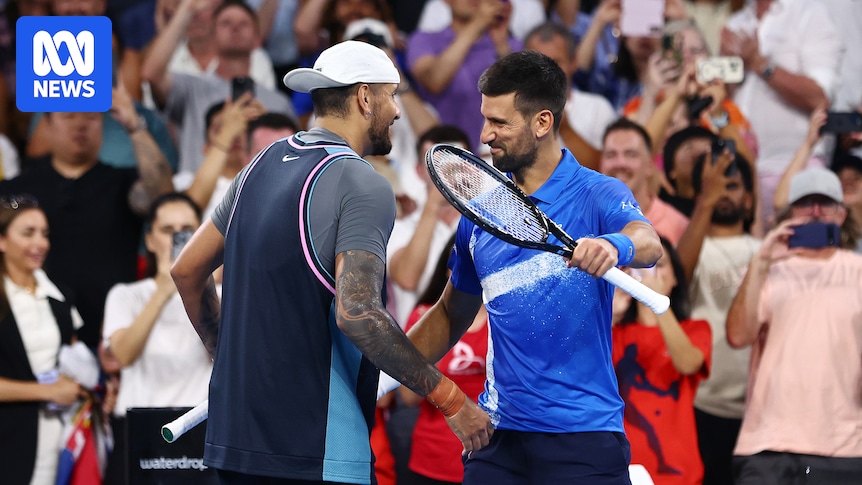
As Nick Kyrgios hit the winning point, Novak Djokovic ran after him, pointing and cheering as 5,500 people roared in Pat Rafter Arena.
The party was in full swing.
Hosted by two of tennis’ most recognizable characters, the double was the center of attention, the main exhibit, the main event.
Needless to say, it’s not always like that.
On New Year’s Day, on court 10, Jamie Murray and his doubles partner John Peers faced Nicolas Jarry and Giovanni Mpetshi Perricard, the latter having, the day before, made an impression on the public by eliminating Kyrgios from the singles tournament.
A good crowd had gathered around Court 10, the furthest court from the imposing Pat Rafter Arena.
The roars of the Pat Rafter Arena crowd echoed across the floodlit courts.
It seemed very far from this orbit. Far away from bright lights and big crowds.
This is where doubles is often relegated.
Jamie Murray (left) and his doubles partner John Peers are often relegated to the outside courts. (Getty Images: Zhe Ji)
It is this fact that makes Murray believe that the very future of doubles is in danger.
“I would never say it’s a bad thing for the best singles players to get together and play,” Murray told ABC Sport at the Queensland Tennis Centre.
“Ultimately, I think the more top singles players play and engage in the tournament, the better.
“But the problem they have on the tour is that, well, there are a few things, but that schedule is not set up for these guys to play the full length of the doubles tournament.”
A quick glance at the program for the penultimate day of the Brisbane International revealed this problem.
On Saturday afternoon Jiří Lehečka faced Grigor Dimitrov at 3:00 p.m., the match ended prematurely around 4:30 p.m. when Dimitrov retired in the second set.
Jiří Lehečka managed to reach the men’s singles final by reaching the doubles final later in the evening. (AP Photo: Pat Hoelscher)
Lehečka was due to play the doubles semi-final later in the evening with Jakub Menšík, arriving on court around 11 p.m.
Opposite them were Nicolas Jarry and Giovanni Mpetshi Perricard.
Mpetshi Perricard, incidentally, played for a place in that same singles final around 8:30 p.m. that evening against Reilly Opelka.
The semi-final of the doubles match was to take place on Court 1 after a “suitable rest”.
Why Court 1?
Because Mirra Andreeva, who was in action in the WTA semi-final against world number one Aryna Sabalenka from 6:30 p.m., was due to play her WTA doubles final at the Pat Rafter Arena alongside Diana Shnaider against Priscilla Hon and Amma Kalinskaya after the Mpetshi Perricard/Opelka clash.
Mirra Andreeva played two matches on the same evening on the penultimate day of the Brisbane International. (AP Photo: Pat Hoelscher)
Andreeva lost the singles semi-final but won the doubles final.
“The schedule is never easy,” Lehečka said after her singles semi-final.
“Of course, if you try to plan the whole day and you have a lot of matches going on, sometimes it’s a mess. It’s not easy to get everything in order.”
It would perhaps be understandable for Lehečka and Mpetshi Perricard to consider their place in the doubles competition, given their progress in singles.
Murray said that was understandable, given both the level of fatigue and the disparity between the sums on offer for each competition.
“I think they (singles players) play until it becomes a disadvantage, basically,” said Murray, who specializes in doubles on tour.
“The gap in terms of prize money is so big now, how do you motivate these guys to play a match for $10,000, $20,000 when the next day they’re playing singles for $200,000?
“It’s understandable that they don’t always do their best, let’s say, or that they step aside when the schedule gets too busy or whatever. I totally understand that.”
The trophies are comparable, but the financial rewards are not. (Getty Images: Bradley Kanaris)
This difference in price might surprise people.
Likewise, this may not be the case.
At the WTA Brisbane International event, the prize money for advancing to the final of the singles competition is $120,735.
The doubles final? $48,590.
The ATP tournament is a similar step up, with singles finalists earning $56,580, doubles finalists $18,510.
Lehečka admitted that one of the main reasons he played doubles was to get used to the court – which Murray said happened often.
But doubles has its own unique skill set that some players struggle to adapt to.
“It’s a different skill set and it takes, for guys who don’t play a lot, some time to get used to it, the speed of the game and the different shots you have to play,” Murray said.
Novak Djokovic has found doubles frustrating at times. (Getty Images: Chris Hyde)
“Novak is one of the best, probably the best returner of all time, in tennis.
“But in doubles it doesn’t always pay off because, while he’s used to making returns to the middle of the court, in doubles it happens a lot because the guys are crowded in the middle and your margin for error is much less. You’re aiming for much smaller targets than in singles.”
That said, playing doubles remains popular among players, with Davis Cup matches still sometimes coming down to doubles, even in its current diluted form.
Pulling out of the doubles once he had achieved his goal was not an option for Lehečka, however.
Jiří Lehečka said he would stick with the tournament, even though he reached both finals. (Getty Images: Chris Hyde)
“I’m the type of guy who, when I sign for the doubles, I want to play until the end,” Lehečka said.
“That’s why I don’t play doubles often, because when I’m not sure or convinced that I can finish the match, I prefer not to play rather than retire (at the) end of the second round.
“That’s why I think I decided to play doubles in this tournament here in Brisbane, because it’s the start of the year.
“Doubles is fun to play. Of course, I focus on singles.
“With the calendar, it’s like that.”
That’s how it is, but it’s something that Murray says can change.
Murray said he would start doubles tournaments on a Sunday and finish everything by Friday.
“I think the tour can do a better job of making it easier for them to commit to the full length of the doubles tournament,” Murray said.
“It’s a can of worms, but what’s the point? If you think growing doubles play is about getting the best singles players out as often as possible, then I think you need to start doubles early in the week because you won’t get their commitment if you do it late in the week.
Doubles matches don’t always attract large crowds. (Getty Images: Paul Kane)
“Start (a doubles tournament) on Sunday, have a final on Friday. That would be my thing, if it was like, ‘Let’s encourage the singles guys to play as much as possible.’
“But I also understand that the schedule now is a fucking disaster for everyone, really, with all these extended events, so many extra days on the road.”
As tournament director of Queens, the pre-Wimbledon grass-court tournament, Murray can have some discretion to organize tournaments as he sees fit, although he needs the full buy-in of the ATP and WTA to implement changes.
“I just feel like there’s a lot of little kinks and other things that could be fixed that wouldn’t necessarily cost money and would just make it a better product to bring to market,” he said.
“If this is your business, you’re not going to try to sell this business if it’s half-baked. You want to know it’s the best product possible.
“And OK, if people don’t consume it, then, OK, that’s fine.
“But at the moment, I have the impression that it’s not in the best conditions. That’s what annoys me the most.
“I’m not saying it’s the most amazing sport in the world or anything like that, but it’s fun.
“It’s fun and a lot of people throughout the year tell me how much they enjoy it, or they enjoy it more than the singles because it’s faster and we love all the reactions and it’s what we play at our club with our friends.
“There are a lot of fans, which I think the Tour probably underestimates.”
