

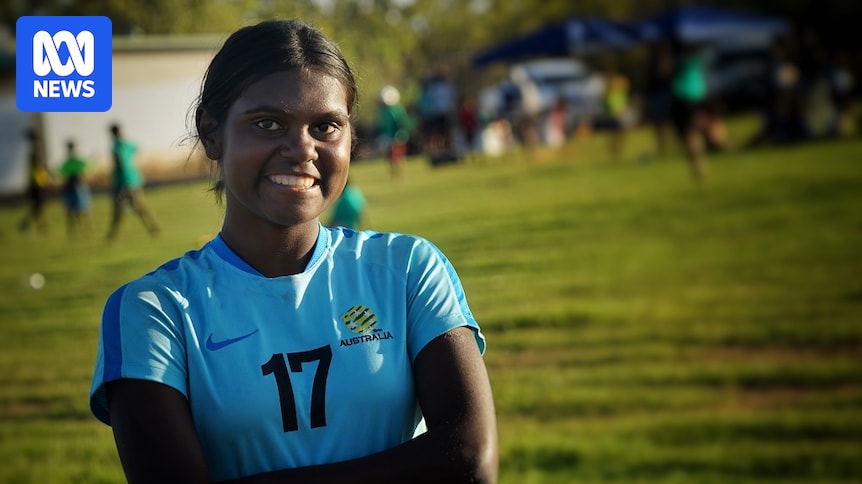
From a young age, Shadeene “Shay” Evans always had a soccer ball at her feet and the talent on the field to match it.
As a child growing up in the isolated Northern Territory community of Borroloola, every evening the Central Coast Mariners forward would join her friends for a kick-off.
“I remember all of us kids running like crazy, barefoot in the tall grass in the hot sun,” Evans said.
“I loved scoring goals, it made me really happy and I just wanted to score more.”
Shadeene Evans has represented three A-League clubs. (ABC News: Provided)
A proud Marra woman, Ms Evans was born and raised in Borroloola, about 970 kilometers southeast of Darwin.
Now 23, she has since played in the A-League for Central Coast Mariners, Adelaide United and Sydney FC.
She also represented the Australian under-20 team, the Young Matildas, as the team’s vice-captain.
“I’m very culturally connected to my community, to the land and to my family,” she said.
“I love being spiritually connected to my country, (and) it has definitely shaped my opinions, my outlook on life and who I am today.”
The isolated community of Borroloola is home to around 870 residents. (ABC News: Michael Franchi)
“That’s what it’s all about.”
This week marks Indigenous Football Week, an initiative launched by the John Moriarty Foundation (JMF) to recognize how football can create positive change for some of Australia’s most vulnerable children.
JMF has a presence in several Indigenous communities across the Northwest Territories, New South Wales and Queensland, including Borroloola, where it runs after-school activities for children to exercise and receive nutritious meals.
Through football and teamwork, it also encourages regular school attendance, healthier lifestyles, self-respect and community involvement.
The John Moriarty football program has been running at Borroloola since 2012. (Provided: John Moriarty Foundation)
Evans grew up training with JMF in Borroloola, before being spotted by former Matildas coach Alen Stajcic and winning a scholarship to a famous Sydney sports school in 2012.
This made her the first recipient of a JMF scholarship.
During the low season, she often returns to Borroloola, where she helps the JMF program organize training with local youth.
Evans said she felt extremely proud of what Indigenous Football Week represented, but also what it meant to other Indigenous children in remote communities.
“It really means a lot as a player and as a Marra woman,” she said.
“This year another group of Borroloola children will have the opportunity to play their first match away from home and travel to Tennant Creek for a gala day with the JMF players.
“For me, that’s what it’s about: giving opportunities to the kids who are coming up.”
Shay Evans is helping to inspire the next generation of Indigenous footballers. (Provided: John Moriarty Foundation)
Football brings people together
JMF program director Jamie Morriss said the initiative had helped improve school attendance, but more importantly, health and wellbeing.
“Football is the main driver that brings children to our sessions, but (they) also include hot meals and fresh fruit and vegetables,” he said.
“We find that soccer helps them stay physically active, and (the) healthy meals and rules that we provide are really important to support them.”
Jamie Morriss says JMF has helped improve the lives of children in Borroloola. (ABC News: )
Samuel Evans, an elder of the Yanyuwa Marra community and uncle of Ms Evans, also said the football program had had a positive influence on the community.
“When the kids play football here they all come together, they enjoy it because we have the same problems as any other community in the Northern Territory,” Samuel said.
“We have burglaries, kids lighting fires, breaking into shops, walking the streets all night and drinking.
“Football is a good thing that bringss together in the afternoon, and they feel happy because they have something to do.
Samuel Evans (middle), pictured here with John and Ros Moriarty, says the JMF has had a positive influence in Borroloola. (ABC News: Provided)
Indigenous voices are key to closing the gap in football
Craig Foster, former Socceroos captain, sports broadcaster and patron of Indigenous national football teams said Indigenous Football Week was an opportunity to highlight the issues indigenous people face in football.
“The spotlight, for just one week, demonstrates the huge gaps and lack of commitment over the decades to Indigenous football, and (that) it has gotten bigger and bigger and the problems have not been resolved, like in every other area of life,” he said.
He said the “voices” of indigenous people must be included and listened to, and that football administrators should allow indigenous communities to run their own programs that honor their culture and traditions.
Craig Foster says Indigenous voices must be listened to. (ABC Sport: Damien Peck)
“They want to be heard, (and) they want to be actively involved in decision-making… which means… not being patronized, belittled or dictated to.”
he said.
“Sport can lead in this and Australian rules football should be the first sport to say ‘we hear you, we want you to be in charge of your own destiny, we want you to play your way’.”
