

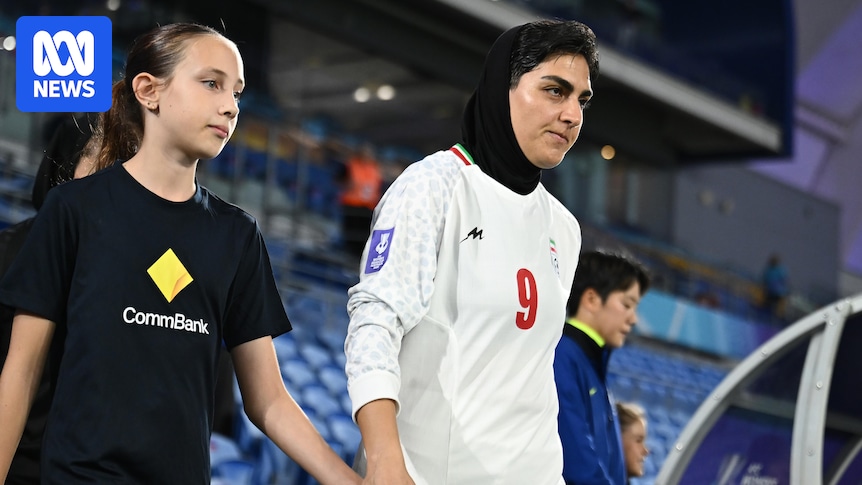
After the growing urgency Regarding the fate of the Iranian women’s football team in recent days, the breakthrough took place last night.
At the team hotel in Gold Coast, the five players, since then obtained humanitarian visasmanaged to return to their room alone, away from the constant security presence of the team.
And that’s when they were taken to a private room so they could speak to immigration officer Naghmeh Danai, who informed them of their asylum options.
She says they were afraid of being persecuted after Iranian state television condemned them for not singing the national anthem before their first Women’s Asian Cup match.
“They were very stressed. They didn’t know what to do, they were worried about their family, their assets in Iran, what’s the best decision to make now: ‘What if we stay here and we lose all our assets in Iran?'” Ms. Danai told ABC News.
Naghmeh Danai claims the Iranian regime tried to “brainwash” the players into returning home. (Provided)
“They wanted to stay, but they were worried about the consequences because, you know, how the Iranian government… can confiscate everything.
“They (the athletes) were asking questions like: “Are we allowed to work? How can we survive here? We don’t know English. The main thing they worried about was their families in Iran.“
The players’ families were reportedly threatened with sanctions if they did not return.
“From my observations, they are young and innocent. They could not even imagine the magnitude of what could happen to them if they returned,” she said.
Danai says the regime also tried to “brainwash” them into coming back, “so we tried to remove all the false information that was given to them by these (Iranian) government officials.”
Atefeh Ramezanizadeh once captained the team and is another who chose to stay in Australia. (Getty Images: Albert Pérez)
“They were even afraid of the (Australian) police here, because of the way (the police) are like Iran. We (Iranians) don’t feel safe with the police,” she said.
“And we were telling them, look, it’s the opposite here. In Australia, the police are there for your safety and security. It’s not like in Iran where the police are there to take you away.”
“Powerful and humanitarian” act for the Iranians
Ms Danai has worked as a migration agent in Australia since 2008.
“I have never experienced something so powerful, something so humanitarian for the Iranians from the Department of Home Affairs in Australia,” she said.
Asylum seekers Fatemeh Pasandideh, Zahra Ghanbari, Zahra Sarbali, Atefeh Ramazanzadeh and Mona Hamoudi, with Tony Burke. (Supplied: Tony Burke/X)
“I have seen what they have done for the Ukrainians, for the Afghans, for Hong Kong and other countries, but I have never seen anything so powerful for the Iranians.
“And I am so happy. It gives me so much hope that the Iranian people, with their unity, have accomplished so much.
“I was so proud of our girls and I was so proud of my community. I was proud of Australia, my second home, for being so welcoming to these girls.“
Ms Danai says once the women said they wanted to stay, Home Affairs staff quickly moved to begin their visa applications.
“They (the athletes) said: ‘We have tried all our lives and we have no respect or hope in Iran. Of course we would like to stay here.’
“They couldn’t believe that the Australian government would support them at that level. They were delighted to hear that the government was going to support them for the visa, for the settlement, for everything.”
Campaign launched before the Asian Cup
The Iranian-Australian community worked to raise awareness of the situation of the players, even before their first match, when they did not sing the national anthem.
“To be honest, before the first game, when we noticed the team was coming, there were a few people who had connections to Home Affairs and to Tony Burke’s office,” Iranian-Australian Farhad Soheil told ABC News.
The Iranian-Australians were very present during the matches and around the team hotel. (Getty Images: Albert Pérez)
“We were concerned that an individual associated with the IRGC (Islamic Revolutionary Guard Corps)… would come with the team.
“That was the first communication we had… and then things escalated after the first match when the players refused to sing the regime’s national anthem and we saw the video from Iranian state television.”
Mr Soheil says the Australian government and federal authorities have been “very responsive and supportive from the start”.
He says not only did they act quickly to ensure the athletes’ safety, but they quickly responded to concerns from the Iranian diaspora that members of the IRGC may have obtained visas – despite the IRGC being listed as a terrorist organization – and that they were monitoring the players while they were in Australia.
Players sang and saluted during the anthem in their last two Asian Cup matches. (Getty Images: Albert Pérez)
He said he spoke to a relative of one of the players, who is overseas, to ensure “they are aware of the process and are giving them correct information.”
“We know that they (the athletes’ families) have received many threatening phone calls from the regime,” he said.
Mr Soheil also feared that the families of athletes in Iran would be targeted.
“It could be anything, to be honest, from taking their stuff to going to jail,” he said.
“They are literally hostages. The Iranian regime is trying to push them to convince the players to come back.”
Celebrations tempered by worry
While many in the Iranian-Australian community are celebrating the five players being granted asylum, they are still trying to reach out to others.
Some have been camped outside the team hotel on the Gold Coast since their last match on Sunday night.
They are concerned that other team members do not understand their rights to seek asylum and want to get the message across to them before leaving Australia.
“We hope we can save the others,” one of the demonstrators, Hadi Karimi, told ABC.
“What you see on the news, outside the hotel, they don’t see.
“We haven’t slept in three days. When you see someone silenced, you should do something.”
Assal Alamdari said she had been in close contact with the family of one of the women granted a humanitarian visa.
“It was probably the hardest decision they all had to make… all I want is for the rest of the girls to have the opportunity to make that decision,” she said.
This afternoon the remaining players left the Gold Coast.
Ms Danai says she has spoken to the Australian Federal Police about their plight and hopes players can still approach them before they leave the country.
“I expressed my concern about the rest of the girls and the fact that they are more isolated from us and we can’t talk to them,” she said.
“They benefited from great security (from the alleged representatives of the Iranian regime traveling with them).”
“We hope more athletes will seek asylum and stay in Australia. I hope more will have the courage to do so.”
