

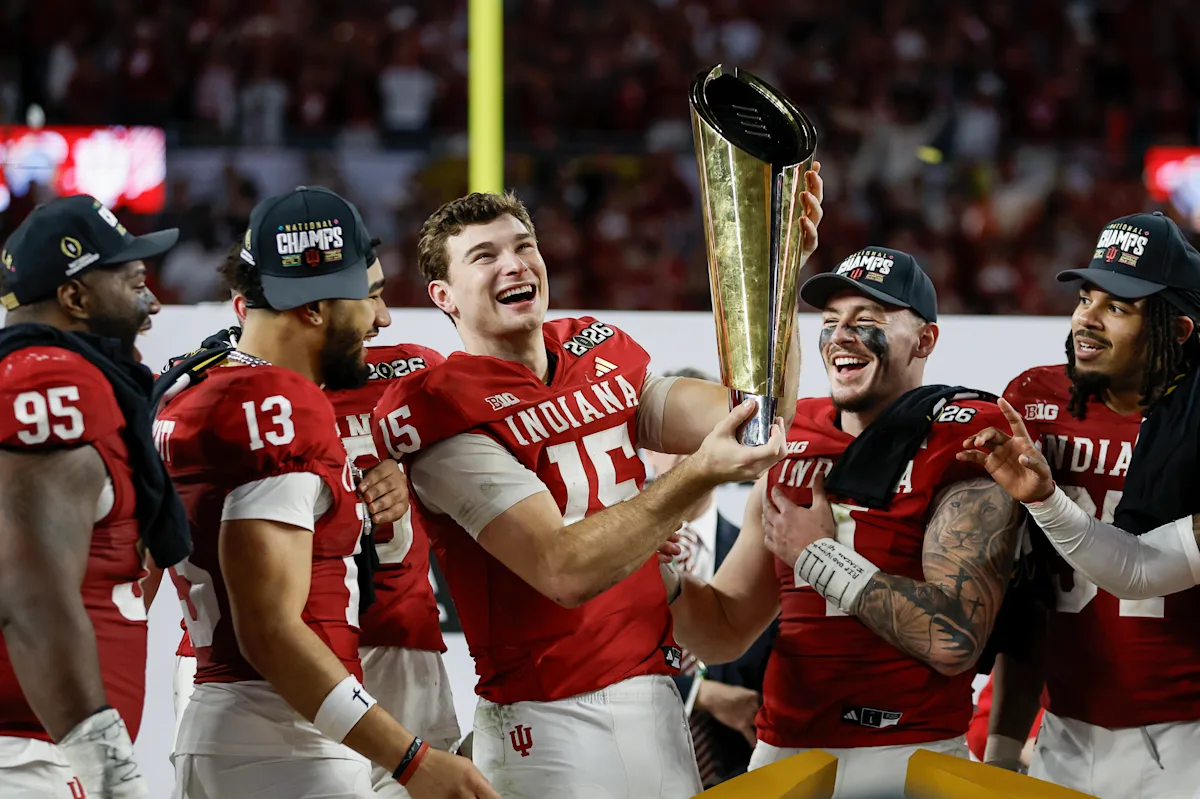
MIAMI GARDENS, Fla. — About a half hour before Curt Cignetti took the stage and lifted a trophy, before Mark Cuban donned the T-shirt they presented to the national champions, before tens of thousands of fans sang ABBA’s “Fernando” in unison as red and white confetti fell onto the Hard Rock Stadium field, there was a moment that defined it all.
With 9 minutes and 27 seconds left on the clock, the greatest turnaround in American sports history was heading toward the finish line. Indiana hadn’t put Miami away and the Hurricanes were starting to regain momentum.
Advertisement
At that moment, it really felt like four yards could be the difference between a championship that will be remembered forever and a lifetime of doubt.
Initially, Cignetti sent his placement unit into the field. Taking a six-point lead would have been a safe and within-the-rules play. But it wouldn’t have been good. Carter Smith, Indiana’s left tackle, watched as Cignetti told his kicking team he had changed his mind.
“Get off the field! Let’s go!”
It took Indiana football 139 years to get to this point, and if there was any gravity to the biggest coaching decision of Cignetti and the the greatest play of quarterback Fernando Mendoza’s lifehe had already been challenged by the time they left their timeout group with 9 minutes, 27 seconds remaining. College Football Playoff Championship Game.
Advertisement
It was only a quarter up in a game with a lot of big plays to play. But if you try to describe how the most losing program in college football history ended up two years later as the first 16-0 national champion in the sport’s modern erait fell somewhere between Cignetti’s decision to take his field goal team off the field and Mendoza intimidating across the line of scrimmage, cutting to his right when he saw a defender closing in and stretching to the end zone for the touchdown and a 10-point lead.
“A big constant we’ve had is betting on ourselves,” Mendoza said. “Every time they called this game, we knew we were going to bet on ourselves once again in the biggest stage of the game. It wasn’t the perfect cover for it, but I trusted my linemen and everyone had a solid performance today. It was the least I could do for my brothers.”

MIAMI GARDENS, FL – JANUARY 19: Head coach Curt Cignetti of the Indiana Hoosiers raises the National Championship trophy after the Indiana Hoosiers vs. Miami Hurricanes College football Playoff National Championship Game presented by AT&T on January 19, 2026, at Hard Rock Stadium in Miami Gardens, FL. (Photo by Peter Joneleit/Icon Sportswire via Getty Images)
(Sportswire Icon via Getty Images)
As Indiana went about it, from the upset win at Oregon in October, to the last-second escape at Penn State in November, to the victory over Ohio State for the Big Ten title, to the playoffs with victories over programs that made sports history, everyone wanted to figure out how.
Advertisement
Sometimes the only explanation is seeing things happen.
All the things that weren’t supposed to happen in college football? Indiana made them. The Hoosiers made the playoffs. They turned blue bloods blue. They won the national championship.
And in the end, like Jamari Sharpe threw the interception that secured Indiana’s 27-21 victorythere was no doubt what it meant: In a sport where upward mobility has always been slow and grueling, often leading to a dead end, what Indiana pulled off in two years is the most improbable run in the history of American sports.
“Never. Never” said Cuban, who won an NBA title as owner of the Dallas Mavericks and now helps finance his alma mater’s roster. “I mean, the Miracle on Ice, I don’t think there’s anything like that. Going from the latrine to the penthouse, winning 16 games in a row, I mean, who would have thought it? I don’t think anyone could ever imagine their wildest dreams.
Advertisement
Cignetti had this dream very early in his life. The son of College Football Hall of Fame coach Frank Cignetti, who was fired after four years at West Virginia but became a legend in D-II, spent his childhood imagining himself as “a Bear Bryant-type coach.” But the company never gave him those playing cards.
As he rose through the ranks, he too often landed on losing coaching staffs — Rice, Temple, Pittsburgh — until Nick Saban hired him as recruiting coordinator and wide receivers coach early in his dynasty at Alabama.
“That tied things up for me,” Cignetti said. “I was hitting the big 5-0 and I wasn’t a coordinator, I wasn’t on track to get a head coaching job and I didn’t want to be a 60-year-old assistant. I saw what those lives were like when I was a kid. I took an unprecedented chance at this business.”
He became the head coach at Indiana University of Pennsylvania, the same place where his father coached. For him, Bear Bryant’s dream was long gone. It turned out that the journey was just beginning.
Advertisement
From IUP to Elon to James Madison to Indiana – the worst of the worst. Nobody won there, and even those who had some success ended up being fired too because nothing there was built to last. It was a cemetery. At least maybe Cignetti could make some money.
A photograph of Indiana’s nearly empty Memorial Stadium, taken during the first game of the Cignetti era in August 2024, began going viral Monday on social media. It was a snapshot of what Hoosier football was: a program dead for decades, a lost cause, a waste of time.
You couldn’t even really call Indiana fans long-suffering. In basketball, the sport Indiana fans cared about most of all, they suffered. But is there really suffering if there is no hope to begin with?
“The focus wasn’t on football, pure and simple,” Cignetti said. “Basketball school.”
Advertisement
And then he just… changed it. Some of the best elements of his James Madison teams accompanied him. It required investment and attitude. He overvalued everyone in the transfer portal, and as Indiana’s 2024 season unfolded, leading to a first-round playoff loss at Notre Dame, it was clear he was dragging down many of the game’s mainstays as well.

MIAMI GARDENS, FL – JANUARY 19: QB Fernando Mendoza #15 of the Indiana Hoosiers runs for a touchdown in the fourth quarter during the Indiana Hoosiers vs. Miami Hurricanes College football Playoff National Championship Game presented by AT&T on January 19, 2026, at Hard Rock Stadium in Miami Gardens, FL. (Photo by Peter Joneleit/Icon Sportswire via Getty Images)
(Sportswire Icon via Getty Images)
Which brings us back to the fourth quarter and Cignetti wondering if he should kick that field goal. They had drawn a draw for Mendoza this week – not exactly the most graceful runner – because they thought they might have the right look to call it against Miami.
In that moment, the grit, drive and tenacity that had brought Indiana to the brink of the title was worth betting on once again.
Advertisement
“We had to block a little differently than we usually do,” Cignetti said. “It was a 45-minute discussion in the faculty lounge, what we were going to call him and how we were going to do it. Fernando, I know he presents himself as the All-American guy, but he has the heart of a lion.”
This is what the world never saw about Indiana, until they knocked off Alabama in the quarterfinals and beat Oregon in the semifinals. After that, everyone knew it was real.
But the beauty of college football is that you’re not supposed to solve it. You are meant to strive and struggle, to be heartbroken, to come back for more. At the end of the day, the blue bloods take home the trophy.
This is how it’s supposed to be. That’s how it’s always been.
Advertisement
And in Indiana’s last game to make history, it was against Miami — five-time national champions — playing in its home stadium. It was the ultimate test. And in the end, when Indiana committed an unusual false start penalty that prevented the Hoosiers from finishing the game in first, it gave Miami a chance to rewrite history.
Instead, it was Miami native and son of a former Hurricane, Jamari Sharpe, who snagged the championship-clinching interception. Just one more layer to a story that you couldn’t make up if you tried.
“It’s an amazing feeling, man, coming from where I come from, I always wanted to win the national title, I always wanted to play in the Dolphins’ stadium,” Sharpe said. “Tonight was the first time I was able to do that, and then to make the winning play like that, I still can’t believe it. It might hit me in the morning.”
Advertisement
All of this will hit us when we wake up to a reality in which Indiana – yes, Indiana – is the national champion. These days, the world of college football often seems chaotic, sometimes even dark. But it felt pure — not because it was Indiana, but because of the way it happened.
The fundamentals. Self-confidence. The three-star recruits who played like superstars, upending everything we knew about college football.
“I know a lot of people thought this was never possible,” Cignett said. “It’s probably one of the greatest sports stories of all time. But it’s because of these guys.”
