

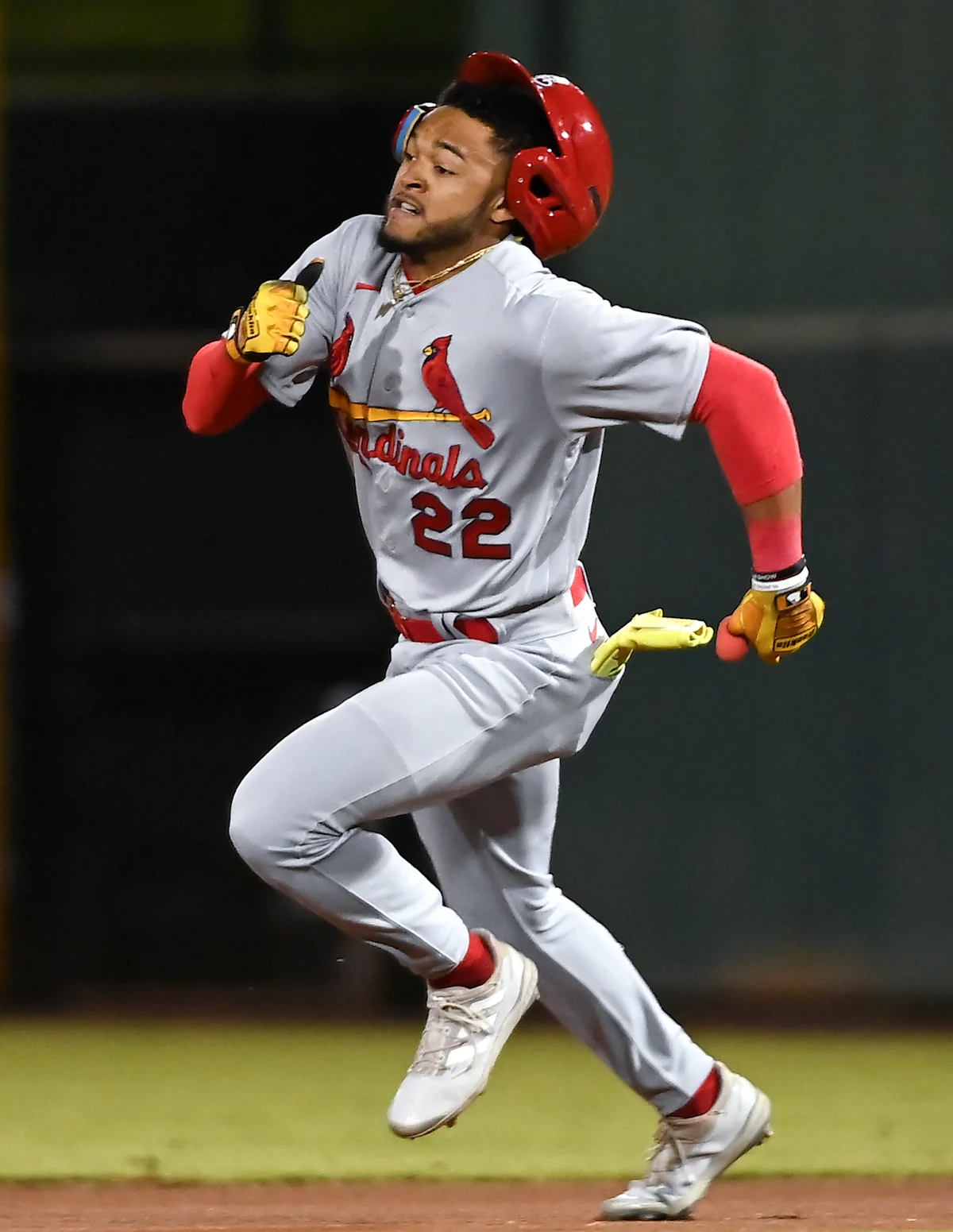
Victor Scott II is one of the most interesting players the Cardinals have drafted in quite some time. He has growing speed, elite defense and swings the bat with the ferocity of a house cat playing with a ball of yarn. While the Redbird infield has players in place you could imagine playing for the next team in contention for the World Series, the outfield is a series of question marks. Lars Nootbaar never got the breakout many hoped for and is now two years away from free agency, and could be moved by the trade deadline. Jordan Walker continues his quest to recapture the lost luster of his prospect pedigree. Scott had an up-and-down 2025 season, but showed big improvements on both sides of the ball, making him a potential 2026 candidate.
Summary 2025
Scott carried a 94 wRC+ through June and had posted 1.7 fWAR in just 283 plate appearances. The WAR was, of course, buoyed by great defense and base running, but he played at a borderline All-Star pace for most of the first half. There were signs that this would be difficult to maintain as he had a 27.2% strikeout rate and a high BABIP of .337. The rest of the season didn’t go as well. Over his last 59 games, Scott was exactly at replacement level and saw his batting average fall below Mendoza’s line as he scraped by with a 46 wRC+. Despite the poor offensive results, there were positives. Its xwOBA, which measures its expected results, remained almost unchanged in the second half. More importantly, he reduced his strikeout rate to 18.9%. His overall batting line was torpedoed by a .210 BABIP. During the season, he ranked fifth among all outfielders in FanGraphs’ defensive value metric. His value on the basepaths was 13th in all of baseball, sandwiched between Chandler Simpson and Fernando Tatis II. Scott was behind Trea Turner in sprint speed at 30.2 feet per second.
Advertisement
Not to belabor the point, Scott is great at baseball except when he’s standing in the batter’s box. If he can find a way to put together a league-average batting line, he will be a certifiable weapon and establish himself as one of the most valuable center fielders in baseball. To be fair, this same thing applies to many types of defensive specialists. We saw the version of this work with Tommy Edman putting up 15 WAR thanks to his speed and defense. Harrison Bader would also fit into that bucket of recent Cardinals. Without some offensive production, you end up with Peter Bourjos or Michael Siani, players who can be on a roster, but who can’t hold down a starting job long term.
You can count Oli Marmol among Scott’s believers. When interviewed at Winter Warmup, he brought up Scott twice, unprompted, as a player he was excited about entering the season. He spoke glowingly of Scott’s work ethic and maturity, giving him a real chance to make the necessary adjustments offensively. Scott himself spoke openly during the Winter Warmup, saying, “I told them I wanted to come back with a totally different player.” Scott then explained how he returned to West Virginia in the offseason for a panel of motion capture and force plate tests to try to diagnose his offensive woes. Tests showed that his movements were ineffective and hindered his ability to be “adaptable.” He went on to say that his mechanics caused him to spin the ball and sweep too many grounders toward second base. He didn’t delve into specific changes to his mechanics, although he did mention better shin angles and more efficient rotation by getting into his front end better. I’ll leave the mechanical analysis to people with a better sense of direction, but Scott was explicit about what he wanted the outcome of the adjustments to be. Looking ahead to 2026, his stated goal will be to be shorter with the ball, be more adjustable (especially breaking balls), take the ball the other way, and try to drive the ball into spaces rather than over the fence.
Key elements that define Scott as a hitter
To evaluate the adjustments Scott is trying to make, we need a clear understanding of who he is as a hitter today. There are three specific elements to Scott’s profile that, when combined, make him an incredibly unique hitter.
Advertisement
Output speed – His average exit velocity ranks 167th out of 177 players with at least 450 plate appearances. That in itself isn’t a problem, as the bottom of the order is populated with plenty of productive hitters like Jacob Wilson, Luis Arraez, and Steven Kwan. With Scott specifically saying he’s going to focus more on driving gap-to-gap line and covering the opposite field, he’s prioritizing improving his hit tool over maximizing his power. With Scott’s long experience with limited power, this approach is more feasible than trying to be a poor Cody Bellinger or Cedric Mullins, left-handed swingers who maximize the limited bat speed by hitting at higher launch angles.
Contact outside area – Scott’s overall contact rate is 75.6%, which is about league average. However, his contact rate on pitches outside the zone is an abysmal 46.6%, about 9% lower than the league average. Similar to being ranked low in the power department, it doesn’t stop hitters from being successful. In fact, Aaron Judge ranked last in baseball in this metric. Right behind Scott in the rankings are Jeremy Pena, Michael Busch and Mike Trout. Right in front of him are Fernando Tatis II, Jo Adell and Elly De La Cruz. You don’t have to be a genius analyst to spot the outlier here. It’s okay to swing and miss the ball, but only if you burn the ball when you connect.
Swing Decisions – To complete Scott’s unusual profile, he makes some fantastic decisions. He’s great at fending off balls, which helps alleviate his contact issues, and he swings aggressively on throws in the zone. His zone swing % minus his out-of-zone swing % is 13th in all of baseball.
The combination of poor contact and excellent swing decisions gives Scott the profile and approach of a slugger who tries to punish pitches in the zone, even at the expense of some strikeouts. The icing on the cake is that Scott also has a launch angle several points higher than league average. Scott is essentially Shohei Ohtani trapped in Victor Scott’s body… Since writing an article titled “Victor Scott is the next Shohei Ohtani” would get me banned from the internet and polite society, I will focus on the more realistic route.
Advertisement
The eight smoothest left-handed players (in terms of exit velocity) in baseball last year were: Adam Frazier, Sal Frelick, Zach McKinstry, Luis Arraez, Victor Scott II, Steven Kwan, Jung Hoo Lee and TJ Friedl. The average wRC+ for the group of left-handed slappers is 105 with a fairly narrow range of 89 to 114 (excluding Scott). For Scott, anything in that range would be a huge success. Looking at this group of players, the underlying metrics are remarkably similar. You have a few outliers, like Arraez’s ultra-high contact or McKinstry hitting slightly higher max exit velocities and producing a decent hitting percentage, but overall these players achieve their production similarly. Scott’s contact rate kept him from matching that group’s production as he was ten points below the next man on the list, TJ Friedl. Digging a little deeper into the data, his abysmal contact rate on balls outside the zone is due to a 24% contact rate on breaking balls. To give an idea of how horrible this situation was, the rest of the group had a 62% contact rate on breaking balls outside the zone. Scott’s struggles against breaking balls help explain how he achieved such a high strikeout rate despite good swing decisions and an average amount of contact overall.
Reasons to be optimistic
Contact rate can be improved
For players who received at least 450 plate appearances in MLB in 2024 and 2025, the biggest improvement in contact rate was 7% from our old friend Paul Goldschmidt. Seven players out of the sample of 115 players saw an increase of 5% or more. Scott needs to see this level of improvement, at a minimum. That’s a lot to ask, but he has a plan in place specifically to address his struggles with low-velocity pitches and breaking balls, so it will be a move worth tracking early on.
Advertisement
The Bunting can’t be worse
At the Winter Warmup, Scott said he played like crazy during the offseason. I know bunting can be a point of contention, so I’ll just share some numbers and not plant a flag. Scott was 7 for 26 in bunt attempts for a .269 average. Beyond the bruings for hits results, Scott also laid down 10 sac bunts and fouled or missed an additional 32 bunts. In our competitive group, Friedl hit 11 of his 18 bunt attempts for a batting average of .611. Kwan was the second most prolific scorer, safely hitting on six of 13 attempts. Overall, Scott was by far the worst bunter despite his much more frequent bunt attempts than his peers, so there’s a lot of upside here in simply improving on a poor baseline. If he wants to continue playing in 2026, I’m glad he worked for it.
Some skills are already in place
While Scott’s contact issues, especially when breaking balls, are his biggest obstacle, there are some things that work in his favor as well. He’s great at making throws outside the zone, which helps alleviate his swing and miss issues. He maintains this discipline not by being passive, as he is extremely aggressive in his throws in the zone. This is a great starting point and could make him a real pest to deal with if he can make more contact. He also posted solid contact rates in the minor leagues, around 80%, so there is precedent for better performances.
Advertisement
Looking to the future
I’m just as skeptical as anyone when it comes to the offseason hype surrounding player adjustments, trips to Driveline and new conditioning regimes. I give real weight to Marmol’s trust in Scott. I also think Scott’s stated goals for improving his offensive production line up perfectly with what the data shows. Diving into the underlying metrics with players often leads to the conclusion, whether true or not, that they are actually better than their surface stats or that they are a small adjustment away from taking a leap forward. With Scott, I had the opposite reaction; he needed a massive overhaul of his approach and improvements to key elements of his game, otherwise he would be relegated to a fourth or fifth outfielder. Luckily, we’re only a few weeks away from getting our first look at the new Victor Scott II in-game.
