

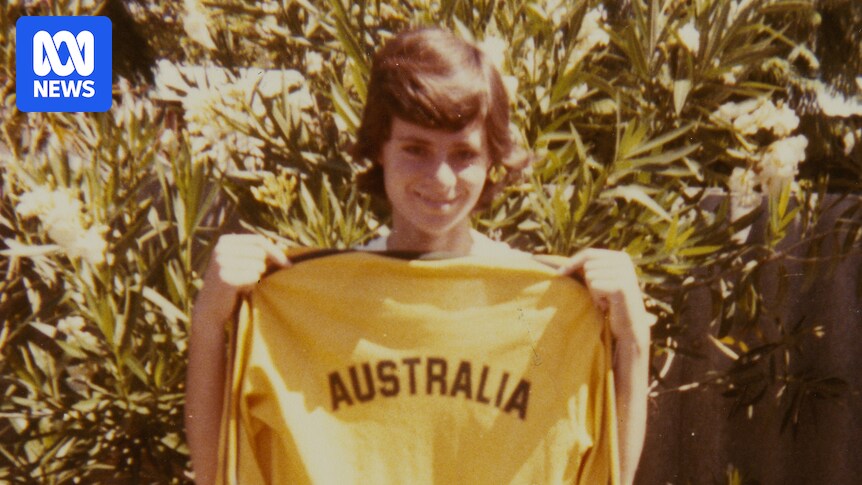
In 1979, at Seymour Shaw Park in Sydney, 17-year-old Sandra Brentnall scored Australia’s first international goal in women’s football.
It was the first Test match against New Zealand, with thousands watching, and Brentnall was wearing boots two sizes too big, stuffed with newspaper.
“They were cheap plastic boots from Target,” Brentnall said.
“We didn’t have much money; we were just grateful to have boots.“
Brentnall in 1978, four years after his family emigrated from the United Kingdom. (Provided: Sandra Brentnall )
Brentnall doesn’t remember the exact details of that historic goal, but she remembers her team’s enthusiasm.
“I fell to the ground because they were all hugging me. I was only little,” Brentnall said.
“Our big defender just grabbed me by the back of my jersey and pulled me back to my feet.”
Brentnall played for the team that would become Australia’s beloved Matildas – known at the time simply as ‘the Australian team’.
Kicked out for “being a girl”
Born in the United Kingdom, Brentnall was captain of her childhood Nottingham football team, until, aged eight, she was expelled for “being a girl”.
“In England there was no women’s football at all, so I played with the boys on a Saturday,” she said.
Brentnall said she was devastated to be left out of the team.
“You play the game you love, live and breathe, and the next week you have nothing.“
Brentnall’s father, once a semi-professional player, was determined that his daughter’s talent would be recognized and moved the family to Australia in 1974.
“It must have been huge for mom and dad to do that, to uproot and take three kids halfway around the world,” Brentnall said.
“And in a way it was heartbreaking, because my dad would go to a lot of clubs and when they saw me, they would always say, ‘No, you’re too short’.”
It took until Brentnall was 14 and grew a few inches, but she was eventually picked up by the Inglewood United Soccer Club women’s team.
Brentnall visits the exhibition at the WA State Library. (Provided )
From street games to international football
From there, Brentnall said “everything opened up.”
“There were no rankings, no juniors, just one level – ladies – and I never looked back,” she said.
“I had confidence in myself, I believed in the team, and before you know it I was playing at a higher level, and then the ultimate level, which was the Australian team.“
Brentnall had been selected and coached by Peter Dimopoulos, who is remembered as one of the driving forces behind the Women’s Soccer Association of Western Australia.
Female footballers in the spotlight
With the Women’s World Cup kicking off next week on home soil, Brentnall’s story is one of many featured in a new oral history collection at the State Library of Western Australia.
David Craddock, heritage and engagement manager at the State Library, said the collection celebrated the pioneers of women’s football.
“For whatever cultural reason, this story hasn’t been collected or told,” Mr. Craddock said.
“Over the past few months, we have digested and studied eight women and their stories of resilience.”
Another such woman is Marilyn Learmont, who was WA’s first female referee to lead the line in the Men’s National Football League.
Marilyn Learmont was finally recognized for her talent as a referee. (Provided )
Learmont, who had not played soccer herself, was motivated to learn to referee when her husband was studying to become one.
“I was helping him study and I told him it was easy, so he said, ‘If it’s easy, go ahead and do it,'” Learmont said.
“I took out the book and went for it the next time the exams came around, and I passed the first time.”
Learmont said she thought additional knowledge about the game “would be nice” because her boys played, but she didn’t think she would actually referee.
“I did it as a joke, actually, but it became a 20-year career.“
Learmont became the first woman in the world to referee an international Class B match.
“It was Australia versus Brazil, in the under-19s. No other woman had done that at that stage,” she said.
From abuse on the sidelines to demands from “the lady referee”
Learmont avoided her because she was a woman.
“I was told to go home, do my dishes, go knitting. That my place was behind the sink,” she said.
Learmont said things got better once people realized she was good at her job.
“And then I was asked to do the matches and when I was doing Country Week, they were all coming out of Kalgoorlie and Albany (and saying) ‘Oh, can we get the referee?’”
Learmont used to bring her boys to the games she officiated.
“I put a blanket up by the fence where I officiate with a little suitcase full of food and they were just sitting there like gold,” Learmont said.
“A woman has to prove she can do it.
Learmont says she suffered a lot of abuse on the sidelines during her 20-year career. (Provided)
“And once you came out with that whistle, you knew you had to control 22 men, so you did it.“
Changes in the game: Pioneering stories of WA women in football is on display at the State Library of WA from July 14 to August 28.
