

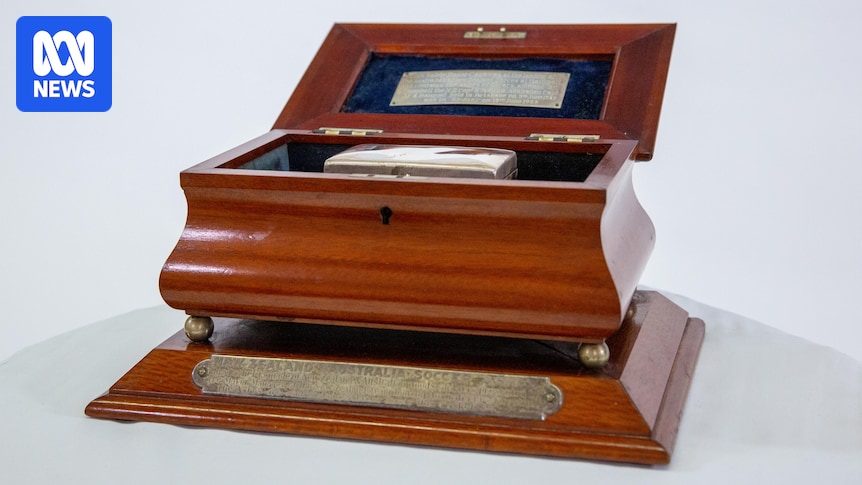
For decades, Australian football has been tracking down an object described as “the greatest domestic treasure there is”: a small hand-carved wooden box containing the ashes of two cigars smoked by the captains of Australia and New Zealand after their first international ‘A’ match on Australian soil in June 1923.
Known as the Soccer Ashes, this treasured relic was the first trophy ever contested between the two trans-Tasman rivals and is a key chapter in the Socceroos’ greatest history.
The trophy was the brainchild of New Zealand team manager and trophy creator Harry Mayer, who believed both nations needed to play for something physical, real, like what they had in cricket.
Mayer designed the coffin with a combination of woods – New Zealand honeysuckle and Australian maple, to be precise – and adorned its lid with iconic national images, a kangaroo and two silver ferns, symbolizing the relationship between the two nations.
The Soccer Ashes lid contains symbols of Australia and New Zealand. (Football Australia)
Inside the box, nestled in a deep blue velvet lining, was a small silver-plated razor case that belonged to Private William Fisher, then secretary of the Queensland Football Association, who had taken it with him to the landing at Gallipoli in 1915 – the event that sparked the ANZAC legend.
For 30 years, Australia and New Zealand have competed in the Soccer Ashes, with the trophy traveling back and forth across Tasmania, paying homage to their wartime origin story.
But in 1954, the trophy disappeared completely.
Rumors swirled as to the trophy’s whereabouts, with some fearing it had been thrown away or completely destroyed by someone who did not appreciate its significance.
And without the continued efforts of historians Trevor Thompson and Ian Syson – who, with support from Football Australia and some government funding, led a project to regain the trophy in 2019 – he may also have disappeared from the collective memory of Australian football.
Until now.
69 years after its last known sighting, the Soccer Ashes have finally been found.
The Soccer Ashes were found in the garage of Sydney Storey, former president of the Australian Soccer Football Association (ASFA) in the mid-20th century. (Football Australia)
Discovered by the family of former Australian Football Association (ASFA) president Sydney Storey, who helped organize the match between 1922 and 1966, the trophy was identified among a trove of football memorabilia, documents, photos and other items while they were sorting through old boxes in his garage after his death.
The large volume of items meant it took the family over a year to examine each box and verify their contents, but once they realized what they had on their hands, they immediately got in touch with FA.
“The big shed was literally full of relics from days gone by and it wasn’t easy to get around,” Storey’s son Peter said.
“Most of these boxes sat untouched, decade after decade, until we started going through them.
“There were so many historic and classic items from the last century in the garage – even in the house – and the items we discovered were of great interest. These included team photos, ASFA annual reports, an official ASFA badge, newspaper clippings, souvenir leaflets from football matches.
“And, most importantly, inside a well-sealed box I found a wooden souvenir from a soccer match, which we identified as the Australia-New Zealand Soccer Ashes trophy.
“At that time we didn’t know that people were looking for it or that it was of any interest, rather than something that was 100 years old.”
Why Storey kept the trophy and all the other memorabilia hidden remains a mystery.
Thompson, the author of the book Burning ambition: the centenary of the Ashes of Australia-New Zealand footballthought Storey may have wanted to keep it safe while a political tug-of-war was occurring between the old administration and the newly arrived clubs and federations which were being established following post-war migration in the 1950s.
Thompson reportedly tried to contact Storey about the matter 20 years ago, after identifying the suspects given their role in Australian rules football at the time, but was rebuffed by the family.
For Syson, who first heard about the Soccer Ashes in 2009, its disappearance was more than just an oversight; it was a symptom of a broader cultural transition that football underwent in the mid-20th century.
“It’s an interesting phase in Australian football history, where 1954 is really the beginning of the end,” he said.
“Concerns about representative football are starting to wane as club football becomes much more important. Continental Europeans come to Australia and they bring professionalism, they bring quality, they bring the pitches together. But they also bring club attention, to the detriment of other considerations such as international football.
“At this point the idea that Australia and New Zealand are an important competition is starting to wane. I think we are losing track of the Soccer Ashes because we are losing the focus of our game on this international competition.”
However, the FA is determined to fill the gaps in Australian football history.
They hope to rediscover many other objects loaded with cultural memory, lost in the dusty boxes of football over the last century, and install them in the new National Football House, which is planned to be built in the coming years.
The recognition of one’s own past has already begun. Last year, the FA celebrated the centenary of the Socceroos, hosting two friendlies against New Zealand to mark 100 years since their first ‘A’ international match, which took place in Dunedin in 1922.
The Socceroos played their first international ‘A’ match against New Zealand in Dunedin on June 17, 1922. (provided: NSWSFA)
And there are already calls for the Soccer Ashes – or a replica of it – to be used as a trophy again, and for the trans-Tasman clash to happen every year to not only mark the occasion, but also to recognize the game’s rich and storied past and ensure it does not slide into insignificance, as it has so often threatened to do over the last century.
“This trophy symbolizes something really important, and its discovery is also very important,” Syson said.
“His absence was a symptom of Australian football’s tendency to forget itself and the surrounding culture not caring at all.
“This trophy holds sacred significance for a country so obsessed with its ANZAC mythology. For that to disappear, it says a lot about how this game manages to shoot itself in the foot at every turn.
“And so maybe that’s a sign that the game can correct itself, repair itself, remember itself – if there are enough people who care about it, if there are enough people who care about the story.
“It means so much to the game.”
