

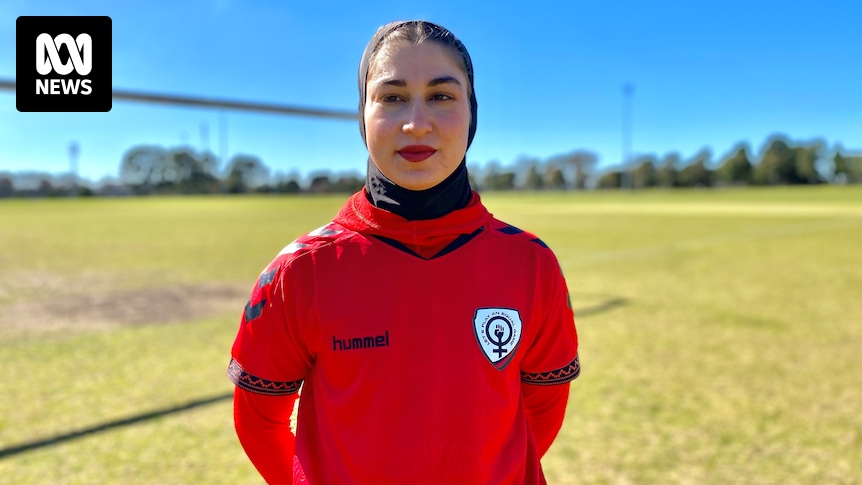
As World Cup fever grips Australia, a women’s national team can only stand on the sidelines in Melbourne and watch.
Mursal Sadat, a member of the Afghanistan women’s national football team, can only dream of one day returning to the international stage.
“It’s really hard to believe that we (the team) are no longer allowed to play and represent our country,” she said.
“Every time we played for Afghanistan, we felt brave, strong and proud.
“It didn’t matter if we lost or won, all that mattered was that we held our flag high…and that we could be the voice for all the other women in our community.”
The Australian government granted emergency visas to evacuate the team to Australia after the Taliban took control of Afghanistan two years ago, following an international campaign by activists, lawyers and the team’s former captain.
With the support of A-League club Melbourne Victory, they began playing in Division 4 of the State League of Victoria last year.
But the team was banned from international competitions for two years because they are not officially recognized by the sport’s world governing body, FIFA.
FIFA says this matter is considered an internal affair of Afghanistan. (ABC News: Tara Whitechurch)
With all eyes on the Women’s World Cup, a petition asking FIFA to grant official recognition to the team has garnered nearly 160,000 signatures in just a few weeks.
He also won the support of human rights activist and Nobel Peace Prize winner Malala Yousafzai, who urged sports authorities to “do better for gender equality”.
Ms Yousafzai is due to meet the Afghanistan women’s team in Melbourne tomorrow.
Loading Instagram content
She joined a chorus of voices demanding their recognition.
They include Foreign Minister Penny Wong as well as a group of bipartisan US politicians, who last week wrote a letter to FIFA President Gianni Infantino calling on him to “develop a process” to allow the team to play.
The Afghanistan men’s national football team continues to receive recognition.
The program director of the Afghan women’s football team, Khalida Popal, is leading the campaign for recognition. (ABC News: Fletecher Yeung)
Women’s national team program director and former captain Khalida Popal said FIFA must act.
“FIFA ignored us for two years,” she said.
“FIFA has the power and the platform and can help the Afghanistan women’s national team if they want.“
FIFA said the matter was considered an “internal matter of the member association”, namely the Afghan Football Federation.
“FIFA does not have the right to officially recognize a team unless it is first recognized by the relevant member association,” a spokesperson said.
“However, ensuring access to football for female and male players, without discrimination and in complete safety, is a key priority.”
The Taliban banned women and girls from playing sports
FIFA said it continued to monitor the situation very closely.
Since taking control of Afghanistan in August 2021, Taliban authorities have banned women and girls from playing sports.
Sodaba Azizi says that when Kabul fell, she knew her life was in danger. (ABC News: Tara Whitechurch)
Amid the fall of Kabul, players were advised to delete their social media posts and burn their jerseys to avoid reprisals.
“We knew our lives were in danger because we were playing for the national team,” said Sodaba Azizi.
“We thought they were definitely going to kill us.”
Ms Popal said members of the Afghan Football Federation could be punished by the Taliban if they allowed the team to play.
“FIFA is trying to shift the blame to the Afghan Football Federation,” she said.
“It is very dangerous for the Federation to go against the decisions of the Taliban.
“They can be killed if they support us and stand by us.”
The Afghanistan women’s national team began its season alongside Melbourne Victory, nine months after fleeing Kabul. (ABC Sport: Damien Peck)
“Gender apartheid”
Former Socceroo human rights campaigner Craig Foster said FIFA’s statutes include “gender equality provisions” that member associations must adhere to.
“FIFA should have said to Afghanistan a long time ago: ‘if you don’t allow women and girls to play football, then your FIFA membership will cease immediately,'” he said.
“How can we have a law on gender equality and then allow this gender apartheid to happen?“
“The onus is not on the Afghan Football Federation, which is going to have its own political problems internally, it’s actually on FIFA to stand up here and say: ‘This is how much we believe in women’s rights’.”
Although there is uncertainty over whether the team will ever be able to play internationally again, Sadat remains optimistic for the future.
“I hope that for the next World Cup we can at least represent Afghanistan for the qualifying matches,” she said.
“We are excited to pave the way for the next generation.”
