

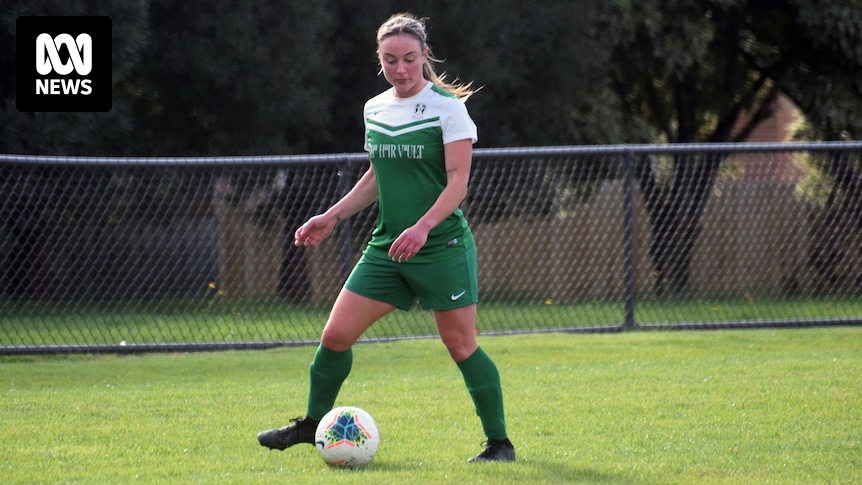
An eastern Victoria journalist has been suspended from her local football league and fined $600 for reporting on poor behavior by a referee she says she observed during a match.
Key points:
- Zoe Askew suspended from Latrobe Valley Soccer League following report questioning official’s behavior
- The league also fined Ms Askew $600, saying she had violated its media policy and code of conduct.
- Media, Entertainment and Arts Alliance says journalists should not be punished for doing their job
Journalist Zoe Askew reports on the Latrobe Valley Soccer League for the Latrobe Valley Express and Gippsland Times newspapers.
She also captains Sale United in the women’s division of the competition.
In her report on a match hosted by Moe United against Sale United in the senior men’s competition, Ms Askew alleged “malfeasance by a linesman”, who she said was “slandering” the traveling team players while also coaching Moe’s team.
Following publication of the article, a complaint was made regarding Ms Askew’s reporting.
The complaint was then referred to an independent tribunal by the Latrobe Valley Soccer League for her conduct to be adjudicated as a registered player.
The court found Ms Askew had breached the league’s code of conduct and imposed a sanction including a five-match suspension, a $600 personal fine and a three-point deduction for Sale United’s women’s team.
Following an appeal from Sale United and Ms Askew, the three-point penalty awarded to the club was removed from the final charge.
The club rooms of Sale United Football Club, a team in the Latrobe Valley Soccer League. (ABC Gippsland: Oliver Lees)
“The journalist in question is still a registered player”
The tribunal’s final report stated that although Ms Askew was working in a professional capacity at the match, she was still subject to a player sanction.
“The player must be aware of the perceived conflict relating to their affiliation with an LVSL club and, as such, must adhere at all times to the LVSL competition rules, including the media policy and code of conduct.”
Sale United Football Club filed a referee’s comments form after the match based on allegations of misconduct seen by Ms Askew, as well as another player on the pitch.
Latrobe Valley Soccer League president Allan Roberts said Ms Askew’s allegations of misconduct were deemed “factually incorrect”.
“This is not about press freedom or trying to silence the press,”
he said.
“Ultimately, match officials are an integral part of any community…and we will do whatever they need to do to ensure their safety and protection on and off the field.”
He said he was disappointed that Gippsland Times editor Liam Durkin had not sought comment from the league before publication.
“One side of journalism is not providing the whole story; it’s exacerbating the problems (and) exacerbating the rumors around what happened,” he said.
“Look, we all wear different hats, I totally understand that.
“But what we say can sometimes impact people and there are consequences.”
Sale United Football Club were also charged in court with failing to control a club player and were asked to issue a public apology.
Ms Askew declined to comment on the court’s outcome.
“What precedent does this set?
Adam Portelli, deputy chief executive of the Media, Entertainment and Arts Alliance, said the situation was indicative of the complex context journalists in regional areas often face.
“Journalists fulfill a central social function… they should not be punished simply for doing their job,”
he said.
“Often the only sports club or business in town is the organization they have to report to.
“There are obviously going to be increased dangers for journalists reporting to communities when you’re under that kind of pressure.”
Mr. Durkin also publicly supported Ms. Askew throughout the legal process.
Mr Durkin, who attended the match in question, insisted Ms Askew’s report was balanced and fair.
“It’s an important sanction, very important; much too drastic in my opinion,” he said.
In a subsequent editorial in the Latrobe Valley Express, of which Mr. Durkin is also editor, he wrote that Ms. Askew’s treatment had led a local football coach to compare the situation to “life in the Soviet Union.”
“The decision…(has) made a dangerous intersection between work and play,” he wrote.
“What precedent does this set?
