

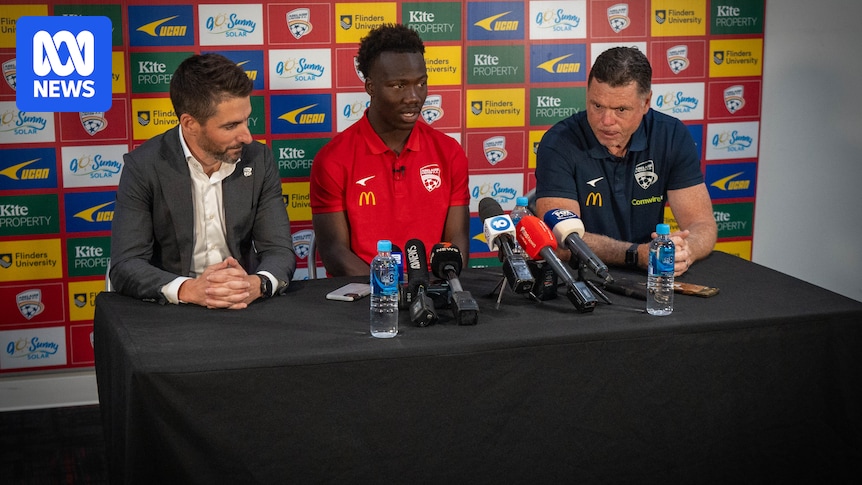
When Adelaide striker Archie Goodwin signed for American Major League Soccer club Charlotte FC in August, it was the final straw for many Reds fans.
“The last person out, please turn off the lights and lock the door. All this club wants to do is sell their players,” read one of the many negative comments on social media.
Goodwin’s sale came at a frustrating time for fans, with other key players Stefan Mauk and Zach Clough also signing overseas deals.
Other transfers in recent years have seen Reds goalkeepers Joe Gauci and Steven Hall leave for English Premier League clubs, while young star Nestory Irankunda signed a huge contract with German giants Bayern Munich, before moving to English Championship side Watford this year.
Adelaide fans were frustrated that millions of dollars in transfer fees had been generated, but not enough of that money was being used to sign quality players to strengthen the Reds squad.
But is this the reality of the A-League, which, like so many other competitions around the world, must be a “sales” league – developing and selling players – to stay afloat?
Adelaide United chief executive Nathan Kosmina said the sale of players was critical to the club’s finances. (ABC News: Marco Catalano)
“The business of football is built around the transfer market. There is no doubt that the commercial revenues, crowds and distribution revenues that come from it are fundamental,” Adelaide United chief executive Nathan Kosmina said.
“Leagues all over the world, outside of the top five leagues, in fact, every other league in the world is a selling league,” he said.
The high point for the Reds came when they sold 17-year-old Nestory Irankunda. in a multi-million dollar deal with Bayern in 2023.
“The reality is at the highest level now it’s an athletes’ game and he’s a super athlete, obviously his technical ability and finishing is very good as well,” Irankunda’s agent Adrian Griffin said.
Football agent Adrian Griffin orchestrated the deal to send Adelaide Socceroos Nestory Irankunda to German giants Bayern Munich. (ABC News: Marco Catalano)
Kosmina said the club had “interest from all over the world” in Irankunda.
“He was too good for the A-League even at a very young age in terms of talent and potential and it’s good to see he’s starting to realize it,” he said.
Sydney are one of the biggest clubs in the A-League and proudly boast on their website that they have “generated over $5 million from the transfers of four players in just two years”, including Hayden Matthews and Adrian Segecic.
Former player and now head of player management Alex Baumjohann says spending more time at his academy has paid off.
“In the last two years we have generated more transfer revenue than the club had generated in the previous 18 years,” he said.
Sydney FC head of player management Alex Baumjohann said the Sky Blues were trying to balance winning trophies with selling players to overseas clubs. (Provided)
Money paid to clubs is more crucial than ever, with annual payments from the sport’s governing body slashed as the code falls on hard times.
“The reality is that distributions are so low at the moment that I think clubs have to sell to pay the bills,” Adrian Griffin said.
The players’ union, the Professional Footballers Association (PFA), said FIFA data showed more than $11 million was made in Australia over this year’s two main transfer windows.
Although the union was happy that the league was beginning to seriously exploit the global transfer system, it nonetheless had concerns.
“The league risks committing a strategic overcorrection by now focusing solely on player sales and all but abandoning fan-based revenue streams,” said Beau Busch, chief executive of the PFA.
Professional Footballers Australia chief executive Beau Busch said transfer revenue could be shared. (Provided)
He warned it was dangerous to plan around volatile transfer revenues replacing central distributions, ticket sales and other key areas.
And the PFA has launched a bold initiative which it believes could make a big difference to all clubs.
“The PFA proposes a policy of partial sharing of incoming transfer revenues,” Busch said.
“If, say, 25 percent of each player sale was split between all clubs, central distributions would receive perhaps a $500,000 boost, while individual clubs would also keep the lion’s share of their windfall earnings.
“Financial ups and downs would be smoothed out, allowing for more stable operations over time.”
As an agent, Adrian Griffin has seen the good times and the bad of the A-League and recognized that an over-reliance on money from player transfers was dangerous.
“I think A-League clubs need to find a way to survive without selling players,” he said.
“Once they have this good business model, I think they will be able to reap the rewards and obviously create a profitable club.”
Adelaide affirms its commitment to creating sustainable business models. (ABC News: James Coventry)
Sydney and Adelaide say they are committed to creating sustainable business models, winning the A-League and helping players realize their dreams.
“We always want to win trophies and be successful, but at the same time we want to provide these avenues for young players,” Baumjohann said.
Kosmina said the club would “help players realize their dreams of going abroad”.
“And when they leave, there will almost certainly be one or two more,” he said.
So be patient, A-League fans, there is a method to your club’s madness.
