

New PGA Tour CEO Brian Rolapp was interviewed just before Thanksgiving by CNBC, which shared the video with the world via its YouTube channel, letting us know exactly what he meant by parity on the PGA Tour and whether he really wants golf to start after the Super Bowl.
“Golf is not football” Rolapp said.who has worked with the NFL for more than two decades. “So I still have a lot to learn.”
Between the end-of-season RSM Classic and now, Rolapp hasn’t bothered to deny this Harris English said to the RSM Classic, according to which the PGA Tour could start the season after the Super Bowl, not play in the fall, have only 20 events, and so on. But none of these facts are set in stone.
Apparently, these are concepts, among many others, brought up in competition committee meetings and in discussions with everyone from players and sponsors to fans and television networks, including those who don’t even have a contract with the PGA Tour at present.
Ideas are the result of what most people call brainstorming sessions.
Here’s how it works. You all want to create something, solve a problem, or change the way something is done, and the rule is that you get into a room with other people and bravely present your ideas on the subject, no matter how crazy they may be. Some people call this throwing things at a wall to see what sticks.
They were trying to think outside the box. Golf, as many know, is entirely rooted in tradition, the past and what has always been done. This is its charm and its current dilemma.
“Part of the problem with professional golf is that it has developed as a series of events that play out on television, as opposed to the way those events are actually perceived, which gives them meaning in their own right,” Rolapp said.
Professional golf happened this way because that’s how professional golf developed.
And that wasn’t the only sacred cow Rolapp was addressing. He seized the third rail of the “stars” of the Tour against those who are not on the Wheaties box. His example was a surprise.
“Everyone assumes that a tournament only matters if one or two players participate. There is no data that supports that,” he said.
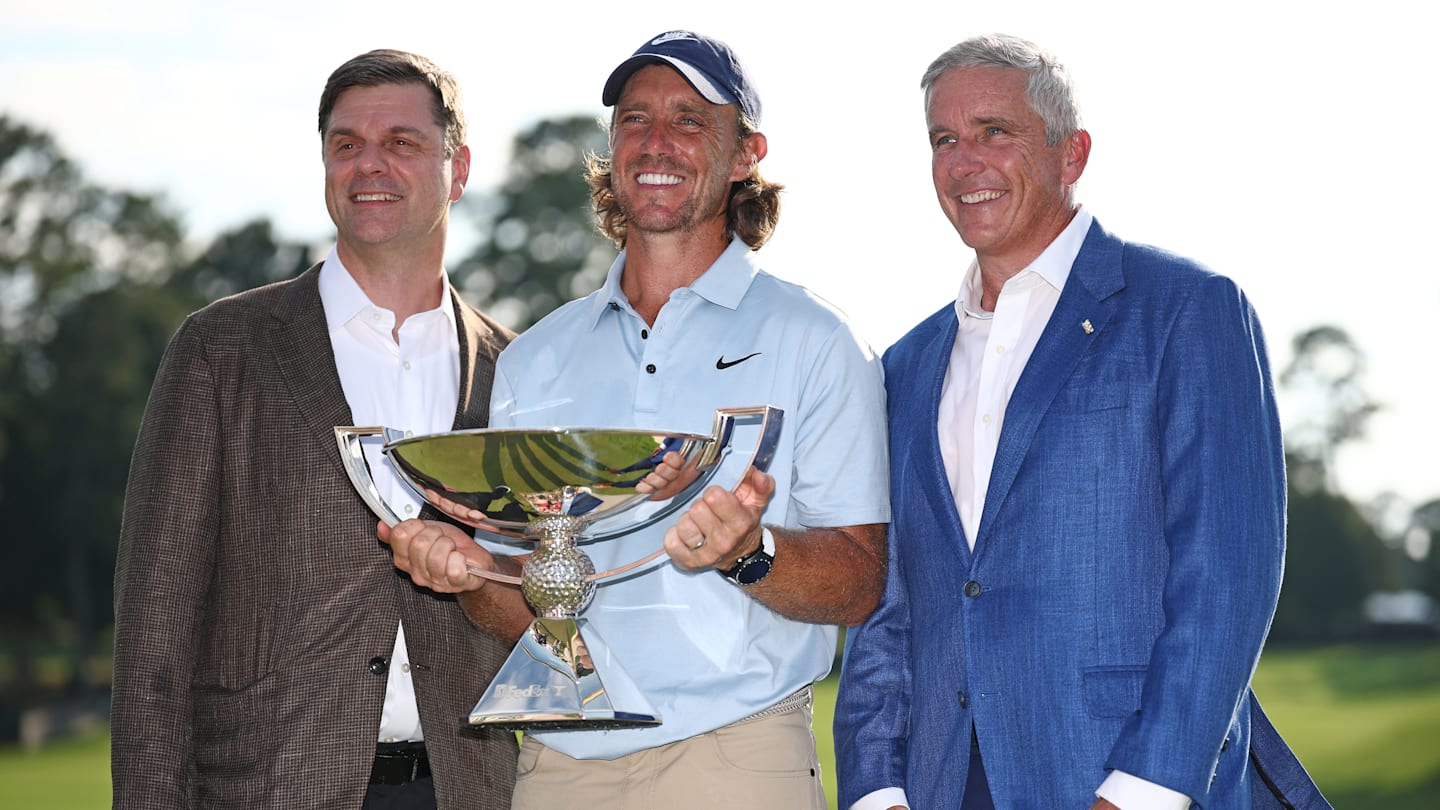
He used the recent FedEx St. Jude event as an example. Rory McIlroy, he noted, skipped the tournament to rest for the final two events of the season. There have been a lot of problems with McIlroy out.
However, Rolapp noted that what happened on Sunday was that Justin Rose and JJ Spaun were in the playoffs. You can’t get more competitive than that.
“Justin ended up winning, and I think we did, towards the end of that TV show, to almost five or six million viewers,” he said. “The six million people watching that playoff hole weren’t saying, ‘My God, this sporting event stinks because one player isn’t in it.'”
Rolapp said it could have been a better event with McIlroy, but the way it went, it was a success.
“Any sport worth its salt (that) says, ‘This competition only works if there are a few people participating in it’ is not a sport. It’s a circus,” he said.
(I don’t know about you, but I’m warming up to Rolapp.)
Golf, he believes, is doing better than people think, in terms of viewership and popularity. He came up with some facts to prove it.
According to Rolapp, golf participation has increased by 40 percent since COVID. On television, the Sunday audience is on average three to five million viewers.
“To put that in perspective, that was higher than a first-round NBA game. That was four times the viewership of Sunday Night Baseball“, he added.
Simply put, PGA Tour golf has a strong base of dedicated fans and followers.
However, he said it will be the competition committee’s job to figure out how to create bigger and better events, how to fit them into the calendar where fans will watch more golf more often, and how to fit them into a competitive model that golf and sports fans will want to watch. And nothing has been decided yet.
The fortunate thing for golf, according to Rolapp, is that golf has already conquered the difficult part of any sport, what he calls parity, which is slightly different than what most golf fans might consider parity. Most golf fans think of parity as two guys they’ve never heard of playing for a title. His idea of parity is different from that.
“On any given Sunday, you don’t know who’s going to win. Golf has that,” he said. “The difference between the 10th best golfer in the world and the 50th is tiny. That’s incredible strength. Golf already has the hardest part.”
(I don’t know about you, but I’m thinking of putting it on the Christmas card list now that I’ve heard what he means by parity.)
Best of all, Rolapp looks ahead, far into the future, with the best quote from the interview: “You can’t build a permanent sport that outlives your stars if you don’t build a system that works beyond your stars.” »
Wow. The next few seasons are going to be interesting on a whole new level.
