

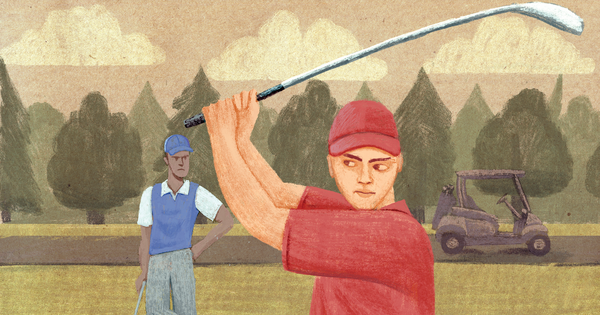
If you wanted to understand how political polarization affects the workplace, you probably wouldn’t start by looking at professional golfers. But it turns out that the sport offers a great opportunity to examine this question because it has an element of chance that isn’t typical of office jobs: On the PGA Tour, players are randomly assigned to tee pairs. If a Democrat and a Republican were to play side by side, Professor Balázs Kovács and former researcher Tim Sels wondered, would the golfers’ performance suffer?
Researchers need to delve deeper into these questions, as politics becomes an increasingly strong force in society, says Kovács. Burning questions permeate many industries, whether it’s the effect of tariffs on a company’s imports or a teacher’s ability to talk about non-binary people. Polarization has become so intense that “there’s no way it’s not going to affect the way people work,” he says.
In their new study, Kovács and Sels, now at the University of California, Berkeley, found that golfers who played with people of the opposite political orientation had on average about 0.2 worse shots. That may not seem like much, but it could mean up to tens of thousands of dollars in lost winnings per tournament.
It seems likely that a similar dynamic could also occur in traditional office workplaces, Kovács believes. After all, these golfers “are really professional,” he says. “They should be able to shut out everything else from the outside world and just do their job. » And they don’t even need to talk to each other.
Hey, I’m AIviews
Ask me about the article and its underlying research. Let’s chat!
Ask for AI-powered insights…
Many studies have been done on how other types of diversity (based on race, nationality, gender, and age) affect job performance. But researchers haven’t looked as closely at political differences. And the few studies carried out so far have produced contradictory results; some suggest that having politically mixed groups promotes team performance, while others indicate that it is detrimental.
Sels got the idea to use golf data to address the issue while he was an international member of the Yale SOM. The fact that the PGA Tour group assignments were random was key; this meant that researchers could more strongly conclude that political differences caused changes in scores. In this case, due to the nature of the game, the team would measure individual rather than collective performance.
To investigate, Sels and Kovács gathered data from near-weekly PGA Tour tournaments from 1997 to 2022. For each tournament, golfers were divided into groups of two or three. They then filtered out non-Americans and attempted to determine the political leanings of American players, based on sources such as social media accounts, donations, magazine interviews and voter registration records. They classified 278 golfers as Republicans and 82 as Democrats.
Next, the team compared the performance of homogeneous groups, in which all players had the same political leanings, to mixed groups containing at least one Democrat and one Republican. They found that golfers in mixed groups took an average of 0.2 strokes longer to complete a round, even after controlling for factors such as age, race and quality of the individual player and the group as a whole.
The researchers also examined whether the results changed depending on how polarized the country was at the time. To measure polarization each month, they used an index that tracked political conflicts based on newspaper articles.
During the least polarized period, the performance gap between mixed groups almost disappeared. But during the most politically tense period, it rose to 0.55 shots.
Kovács and Sels also wondered whether physical proximity made a difference. Players stand close together at the beginning when teeing off, as well as at the end when putting on the green. Between the two, when playing on the fairway, rough and around the green, they are generally further apart from each other.
Performance suffered more during periods of proximity, the researchers found. In politically mixed groups, players’ chances of their tee shot landing on the fairway decreased by half a percentage point, and they took an average of 0.1 more shots onto the green.
Why is this happening when the players aren’t even working together as a team? Kovács speculates that they might feel anxiety during these close moments. Although golfers generally don’t talk much during the match, they spend a lot of time together throughout the tour (staying in the same hotels, sharing meals, etc.) and likely know each other’s political preferences. Even if they don’t debate the merits of the president’s green policies, the mere presence of someone who disagrees with them could distract their attention.
Finally, the team calculated the economic consequences of this loss of concentration. The total prize pool for a tournament is usually around $10-20 million, split between players. A difference of 0.2 strokes translates to a significant sum: on average, a loss of $13,000 to $23,400 per tournament.
The study suggests that political differences do influence people’s ability to perform their jobs, says Kovács. “These things matter even if you don’t speak.” And with increasing polarization, “the situation is getting worse.”
Of course, people have always dealt with colleagues with whom they had little in common. But “if I don’t like someone because they like chocolate ice cream and I like vanilla ice cream,” that’s not the same as if they’re “pro-choice and I’m pro-life,” Kovács says. “It’s harder to reconcile.”
And it’s hard to escape politics in an age of hyperpolarization. Even if managers state that political speech is prohibited in the workplace, this policy itself could have serious consequences. “For many people, it can be problematic if a company doesn’t take a position on certain issues,” he says. “Every decision is political.”
