

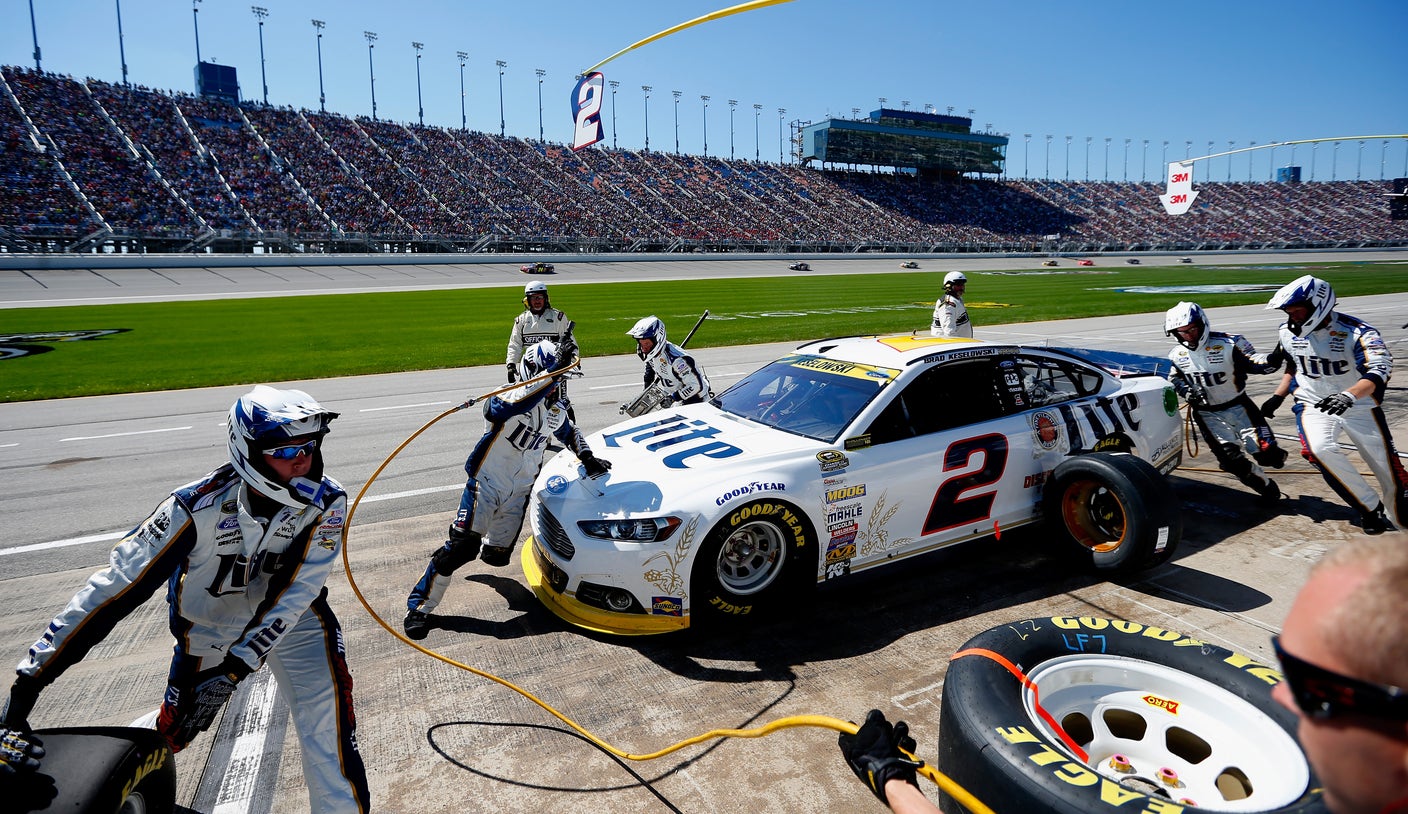

When the Challenger Round of Chase for the Sprint Cup began at Chicagoland Speedway, Brad Keselowski took the victory and sent a message to the field that his team was one of the ones to beat for the title.
After the race, fellow Chase driver Dale Earnhardt Jr., then road manager, took to Twitter and accused Keselowski and Team Penske of cheating with their side skirt flares.
The 2012 Sprint Cup champion responded by saying that those in the glass houses should be careful of stone throwing. A few days later, Mike Hoag resigned over his comments on Twitter, but the flaring continued to grow throughout the Sprint Cup garage.
By the time the Chase traveled to Kansas Speedway to kick off the Contender Round three weeks later, nearly every car in the top 15 finished the day with flared side skirts.
With so many teams using this strategy, it raises many questions about the purpose, the end result and whether NASCAR views this as something that could potentially violate current rules.
While side skirt flares are now getting some media and fan attention, many crew chiefs in the Sprint Cup garage have indicated that it is something that has been happening for some time.
“I’ve been doing this sport for 18 years, and it’s been going that long,” said Hendrick Motorsports’ Alan Gustafson, crew chief for Jeff Gordon. “I think the media is just realizing it. There are some slight aerodynamic advantages there. In old cars we used to remove the front fenders and side skirts. It’s not new, and I think everyone knows how to exploit it. I think people are going further and further, so it’s more visible and people realize it.”
“It’s something we’ve been doing for 10 years,” Richard Childress Racing driver Ryan Newman said of the flared skirts. “It’s just a matter of what guys can do in the pit stop without slowing down the pit stop. Any advantage is an advantage, so you try to add it all up by the end of the day.”
While most people in the garage understood the benefits and details of the side skirt flare, Kevin Harvick crew chief Rodney Childers said it didn’t really become a widespread practice until NASCAR allowed Keselowski and his Paul Wolfe-led team to get away with it early in the race.
“I don’t think anyone in the garage ever thought NASCAR would let everyone do it,” he said. “Once someone did it in Chicago and no one said anything about it, there were 10 people the next week, then it turned into 15 people the next week and 20 the week after that. At this point in the season, if you’ve ever let one person do it, you have to let everyone else do it. You can’t just say ‘Hey, we’re not doing that anymore’ after you’ve let someone win a race with it.”
There’s no doubt that the side skirt flare adds more downforce to the car, but Childers was quick to point out that “it’s not huge, but you’ve got to take whatever you can get.”
Matt Kenseth’s crew chief Jason Ratcliff echoed Childers’ thoughts, saying the flare didn’t provide much downforce, but every little bit helps and if anyone else tries it, you should too.
“It’s right there, it’s something you can do during a pit stop, and as long as NASCAR lets you do it, you have to take advantage of it, right?” he said. “If you see your competitors doing it and getting away with it, you better get in on the ball game.”
While NASCAR arguably places teams in a pretty narrow box when it comes to innovation and rules, the practice of tampering with side skirts is a gray area of the rule book.
Crew chiefs now work closely with their pit crew members to coordinate the appropriate stop time to make adjustments, while completing the stop in less than 12 seconds.
One of the best innovators to ever roam the NASCAR garage, Ray Evernham told FOXSports.com that while there are some benefits to flaring the side skirts, it’s just another case of monkey-see, monkey-do in the garage.
“We used to play with the tape on the grille,” said Evernham, winner of three Sprint Cup championships as Gordon’s crew chief. “You could upset people by changing the tape on your grille or changing something that didn’t matter. We were all like that. If you beat me and your car had a big red X on it, I’d put a big red X on mine. You’ll do whatever it takes.”
Evernham argued that side skirt flaring could easily happen during a pit stop when removing the car’s rear tire, but he said that once someone started doing it, “now everyone has to have it.”
“It’s one of the things that’s still fun in the garage,” he said. “Trying to motivate yourself and play games.”
NASCAR spokeswoman Kristi King told FOXSports.com that side skirt flaring is something the sanctioning body “continuously monitors,” but that anything teams currently do falls within the parameters of the current rule.
Each car must pass several rounds of inspection before and after the race, King pointed out, and so far, nothing the teams have done during the Chase races has pushed the limits laid out in the inspection process.
Although NASCAR has yet to find a real problem with the side skirt flares, King indicated that a lot is happening and unfolding in the middle of a heated Chase battle. As this trend continues to grow, NASCAR may take a closer look at it during the off-season, but King wouldn’t rule out the sanctioning body doing something sooner “if it gets out of hand.”
With so much on the line and such fair competition these days, teams will do whatever they can to find the edge over their competitors. Flaring side skirts appears to be the next evolution of this process, as teams attempt to gain the upper hand in the crucial final weeks of the season with a title on the line.
