

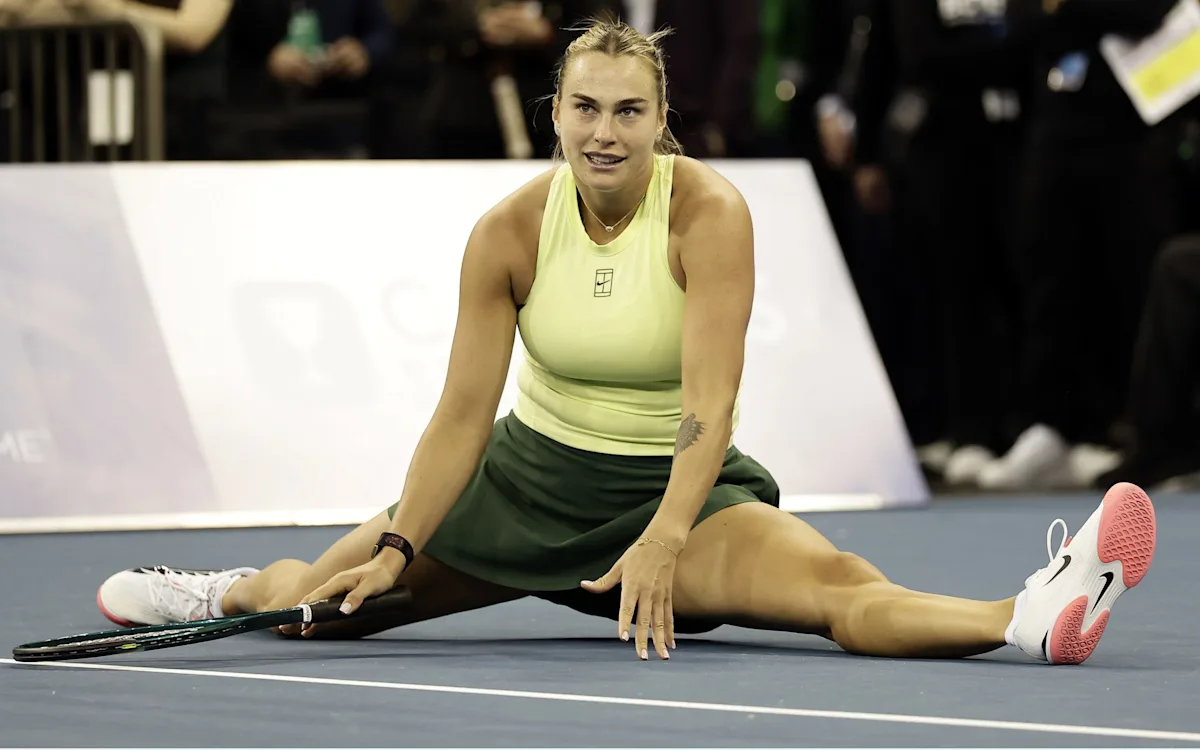
World No. 1 Aryna Sabalenka spoke out against the inclusion of transgender athletes in women’s tennis, stating: “I don’t agree with this kind of thing in sport. »
In theory, the Women’s Tennis Association guidelines allow trans athletes to participate provided they have maintained a testosterone level in the blood less than 2.5 nmol/L in the previous two years.
Advertisement
In practice, no examples of this type of phenomenon have been observed in professional tennis in recent years, although the first transgender player Renee Richards played at a high level on the WTA Tour from 1977 to 1981, before becoming a coach to Wimbledon legend Martina Navratilova.
Navratilova became a fierce adversary of trans inclusion in modern tennis – just like Richards – and in June she told the BBC that “by including male bodies in the women’s tournament, now… a woman is not entering the tournament because a man has taken her place”.
On Tuesday, this point was put to Sabalenka by Piers Morgan during an interview on his Uncensored channel. “That’s a tricky question,” Sabalenka replied. “I have nothing to do against them (the trans community), but I feel like they still have a huge advantage over women and I think it’s not fair for women to go up against basically biological men.”
“It’s not fair,” Sabalenka repeated. “The woman has worked her whole life to reach her limits and then she has to face a man, who is biologically much stronger so for me, I don’t agree with this kind of thing in sport.”

Aryna Sabalenka and Nick Kyrgios appeared together in interviews and also performed in New York – ERIK S LESSER/EPA/Shutterstock
During the same interview – in which she sat alongside Nick Kyrgios to promote their next “Battle of the sexes» in Dubai on December 28 – Sabalenka was asked about recent comments from Marta Kostyukthe Ukrainian world No. 26, who said in October that she was at a disadvantage against players like Sabalenka and this summer’s Wimbledon champion, Iga Swiatek, because they have higher testosterone levels than her.
Advertisement
“All I hear here are just excuses,” Sabalenka responded. “It’s actually quite funny, because she (Kostyuk) is a strong girl, and she probably has more muscles than me and she looks fit and strong, and I think that (a difference in testosterone levels) is not the case in all the matches she has lost against top players.”
Another area of controversy that emerged during the interview concerns the seemingly unequal treatment of top tennis players who have tested positive for banned substances.
There has been unrest behind the scenes of the sport following the manner in which Swiatek and men’s world number 2 Jannik Sinner were both given relatively light and practical sentences over contamination, after each returning a positive test in 2024. Meanwhile, lesser names have often had to serve lengthy provisional suspensions before their cases are heard.
Sabalenka seemed to share the general feeling of skepticism about the whole process, but ultimately settled for a vague statement of unease.
Advertisement
“With Iga, they counted his weeks (of suspension, which lasted up to a month) somehow randomly,” Sabalenka said. “‘Okay, we count them during the China swing, then you can play the (WTA) finals, then we’ll take a few weeks off during the next season.’ I think we should have the same treatment for every player.
Sabalenka and Kyrgios – who is ranked 672nd after several months out due to injury – will play their match in three sets in Dubai. The playing conditions stipulate that each player will have only one serve per point, while the court will be nine percent smaller on Sabalenka’s side. Live coverage should be available on BBC2.
b’

‘
