

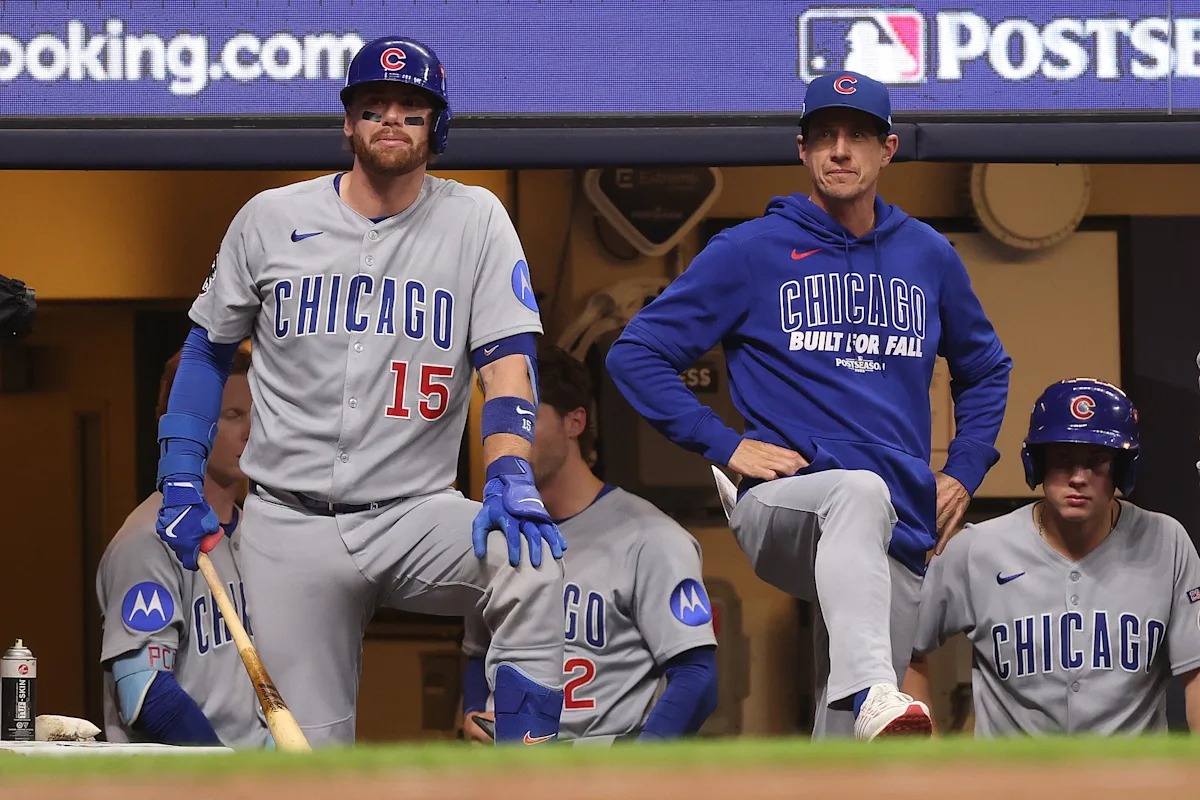
Were the 2025 Cubs a success?
It probably depends on who you ask.
For some franchises, a 92-win campaign, a wild-card series victory and a well-fought five-game loss in the NLDS would be dreamland. During the regular season, Chicago’s offense was a legitimate wagon, the only lineup in baseball with six position players worth at least 4.0 bWAR: Nico Hoerner, Dansby Swanson, Ian Happ, Pete Crow-Armstrong, Michael Busch and Kyle Tucker. Wrigley Field, as usual, was packed for most of the summer as the Cubbies reached October for the first time since 2020 and won their first playoff game since 2018. There was a lot to like.
Advertisement
(Get more Chicago news: Cubs team feed)
Yet at no point in the second half did the Cubs feel like legitimate World Series contenders. The gap between them and the eventual champion Los Angeles Dodgers was gargantuan. Milwaukee comfortably won the division crown. Kyle Tucker, who the Cubs traded for last winter, was injured and disappointing throughout the streak and postseason. Chicago’s pitching was clearly subpar. There was a lot to blame the fans for.
And midseason, that’s still the case, as president of baseball operations Jed Hoyer hasn’t done much this winter to quiet the noise. Because even though the Cubs have signed more free agents so far this winter (6) than any other team, none of those additions are real drivers of change. Five are one-year contracts. Four are relievers. One was to retain Shota Imanaga on a qualifying offer. In short, the Cubs are no better today than they were the day they lost the NLDS.
Here are the three big questions that will define the rest of their offseason.
1. Will they try to replace Kyle Tucker?
That the Cubs seem entirely content to let Tucker go, the best free agent in the market consensusleaving the city remains one of this winter’s most underrated developments. Chicago parted ways with some major pieces to acquire him a year ago, but the team appears to have no interest in retaining his services moving forward. This says a lot about Tucker’s profile And the financial avarice of the Cubs.
Advertisement
With Tucker’s departure a foregone conclusion, the Cubs will have to replace that production one way or another. Because for all the consternation over Tucker’s relatively disappointing walk year, the 28-year-old posted an .841 OPS, hit 22 home runs and won a Silver Slugger. These types of players, as Tucker’s massive contract will soon show, don’t grow on trees.
Right now, Chicago seems content to fill the void internally. Outfielder Owen Caissie, a 23-year-old who struggled during a brief 12-game ristretto, possesses tremendous power and a prospect pedigree. That should earn the rookie a sustained look in right field at some point. The same goes for top prospect Kevin Alcántara. Seiya Suzuki has DH for most of 2025, but could move back to right in order to give positionless rookie Moisés Ballesteros some DH at-bats.
In Moneyball parlance, Hoyer and Co. will look to replace Tucker overall. It’s a reasonable strategy, considering the glut of in-house options and holes on the pitching side.
Advertisement
2. How will they strengthen the rotation?
Chicago’s pitching staff for 2025 was far from a disaster. The quintet of Matthew Boyd, Cade Horton, Shota Imanaga, Jameson Taillon and Colin Rea was capable, sufficient and, as a unit, about league average. Horton, in particular, was a revelation. The rookie dominated the Cubs down the stretch, and his absence due to injury in October played a significant role in Chicago’s exit from the NLDS. As volatile as pitching can be, Horton looks like a true frontline arm.
But behind him lie a myriad of questions. Boyd, a first-time All-Star at age 34, was a wonderful story, but had a 4.63 ERA after the break and didn’t reach five innings in any of his three postseason starts. In fact, not a single Cubs pitcher has gone higher than fifth in the team’s eight postseason games. Taillon was effective in his two starts, but the club clearly did not feel confident in pushing him. Both Rea and Imanaga were used after the first matches.
Advertisement
Imanaga came back to town with the qualifying offer after a convoluted series of contract maneuvers, but barring an unforeseen late-career move, he’s probably a mid-rotation arm moving forward.
You don’t have to be a professional tipster to see that this rotation could use some help. Another frontline arm to pair alongside Horton would do wonders. Fortunately for Chicago, the starting pitcher market has moved slowly. Framber Valdez, Tatsuya Imai, Ranger Suarez and Zac Gallen all remain available. All four would be reasonable upgrades for the Cubs. However, all four will also require a significant financial outlay, the type Chicago has been reluctant to make of late. Speaking of which…
3. Will the Cubs really be that cheap?
If the season started tomorrow, the Cubs would enter 2026 with a payroll of just over $200 million, good for 11th place in the MLB. For such a profitable, historic and popular franchise, that’s an embarrassing and paltry figure. In no world should the Chicago Cubs lag behind the Arizona Diamondbacks in major league spending. Wrigley Field and all the real estate around it is a piggy bank, and yet the Chicago ownership group continues to operate like a poor little market.
Advertisement
The Cubs have only gone over the luxury tax once since destroying the Bryant-Báez-Rizzo core. That was in 2024, when Chicago passed the threshold of less than $3 million. Currently, the Cubs are projected by Spotrac for an expenditure of 43 million dollars for the tax. Presumably, this should give Hoyer and Co. the opportunity to spend big on a free agent or two. However, all reports from Cubs World suggest that such a splash is far from a given.
Given the state of Chicago’s roster, that would be a shame.
